Indonesia to import additional 1.6 mln tonnes of rice

Indonesia’s National Food Agency (Bapanas) announced that the government is preparing to import an additional 1.6 million tonnes of rice to fill the government's rice reserves managed by the national logistic agency (Bulog).

Jakarta (VNA) – Indonesia’s National Food Agency (Bapanas) announced that the government is preparing to import an additional 1.6 million tonnes of rice to fill the government's rice reserves managed by the national logistic agency (Bulog).

​

​

Bapanas Head Arief Prasetyo Adi stated at the Presidential Palace in Jakarta on February 26 that the President asked that there be a minimum of 1.2 million tonnes in stock at Bulog, while actually he wanted it to be 3 million tonnes.

According to Adi, the government already has an import quota of 2 million tonnes of rice for the CBP stock. From the quota, the realisation of imported rice has only reached 500,000 tonnes.

Adi admitted that the current price of rice is still above 16,000 IDR (1.02 USD) per kilogram. This is because the price of harvested dry grain at the farmer level is still in the range of 8,000-8,600 IDR per kilogram in several areas.

​

​

He targets that the rice price will only be corrected when the harvest reaches 3.5 million tonnes. However, it takes up to three weeks for the harvested rice to be distributed to the community.

​

​

The official said that if the harvest is above 3.5 million tonnes, it usually takes two weeks to three weeks to 'convert' it into rice. At harvest, the grain is dried until distribution in approximately three weeks.

​

​

The government also assigned Bulog to sell rice at a maximum retail price to the public through the Food Supply and Price Stabilization programme of 250,000 tonnes.

Moreover, millers in several areas have been urged to conduct massive distribution of rice in five-kilogram packages to all retailers and traditional markets./.


​

VNA

See more

Indonesia designates 31 mln ha of waters as conservation areas

Indonesia designates 31 mln ha of waters as conservation areas

Head of the Convention and Marine Resource Balance working team at the ministry’s Directorate of Ecosystem Conservation Ahmad Sofiullah said this week that it is a strategic effort to ensure the sustainability of Indonesia’s marine ecosystems.

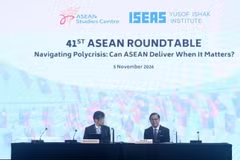
Thai Deputy Prime Minister and Minister of Foreign Affairs Sihasak Phuangketkeow (R) takes part in the Q&A session at the 41st ASEAN Roundtable. (Photo: VNA)

Thailand calls on ASEAN to proactively address polycrisis

Thai Deputy Prime Minister and Minister of Foreign Affairs Sihasak Phuangketkeow noted that no single member state could tackle challenges ranging from major-power competition and economic fragmentation to climate change and energy and food security on its own. Regional cooperation is therefore a strategic imperative, enabling ASEAN not only to overcome crises but also to sustain its development momentum.

Palm oil and palm oil-based products are among Indonesia’s promising export commodities. (Photo: VNA)

Indonesia to launch commodity export monitoring platform next year

DSI will draw on data from customs authorities, trade activities and the financial system, alongside contracts and documents uploaded by exporting companies. The platform will monitor the volume, quality, prices and destination markets of various commodities, as well as transactions between related parties.

Philippines increases rice imports from Cambodia

Philippines increases rice imports from Cambodia

Cambodia has contracted to supply a further 87,344 tonnes to the Philippines between September and December. If all orders are fulfilled, its rice exports to the market could reach around 209,000 tonnes in 2026.

Students get free meals under the national school feeding programme at Hun Sen Svay Cek Primary School (Photo: khmertimeskh)

Cambodia expands school meal programme

Cambodian Prime Minister Hun Manet stressed that his Government would proactively allocate budget and strengthen management capacity, with the aim of expanding the school meal programme to more than 7,000 primary schools nationwide. The move is expected to improve students' nutrition and learning conditions.