Industrial real estate expected to be a highlight this year and in 2021

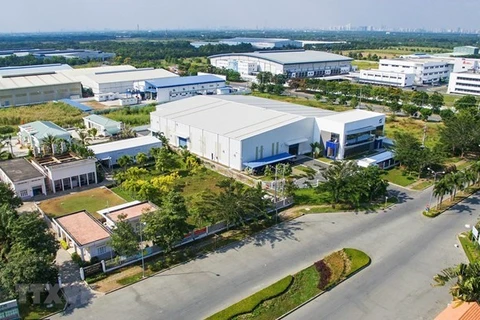
Industrial real estate will be a highlight this year and next, despite the sector as a whole struggling with the impact of COVID-19, according to Nguyen Quoc Anh, Deputy Director General of Batdongsan.com.vn, the leading property website in Vietnam.
Industrial real estate expected to be a highlight this year and in 2021 ảnh 1Batdongsan.com.vn holds the release of a market report for the third quarter on October 6 in Hanoi. (Photo: VNA)

Hanoi (VNA) - Industrial real estate will be a highlight this year and next,despite the sector as a whole struggling with the impact of COVID-19, accordingto Nguyen Quoc Anh, Deputy Director General of Batdongsan.com.vn, the leading propertywebsite in Vietnam.

Industrialproperties around the country have become more attractive to foreign investorsthanks to the new EU-Vietnam Free Trade Agreement (EVFTA), shifts in globalmanufacturing bases, and its effective control of the coronavirus, Anh said atthe release of a market report for the third quarter on October 6 in Hanoi.

Batdongsan.com.vn’sQ3 market report shows that industrial real estate enjoyed impressive growthduring the period, while COVID-19 continued to cast a long shadow over othersub-sectors.

Data fromthe Ministry of Planning and Investment reveals that 336 industrial parks (IPs)were established in the first half of this year, 261 of which have been putinto operation, on an area of 29,100 ha.

Searchesfor IPs were on the rise from June to September, according to the report.Compared to the same period last year, searches for Vietnam-SingaporeIndustrial Park (VSIP) Bac Ninh rose 22 percent, Tan Binh IP 20 percent, HiepPhuoc IP 23 percent, and Tan Tao IP 37 percent.

Prices ofland lots near IPs in Bac Ninh’s Tu Son and Yen Phong districts rose 1 percentquarter-on-quarter, while those in Binh Duong’s Di An and Thuan An districts alsogrew considerably.

The COVID-19 resurgence in late July and early August landed apunch on the chin of the real estate market. This was followed by theseventh month of the lunar calendar, known as the “Ghost Month” and duringwhich people around the country avoid making big decisions like home purchases.

However,a survey conducted by the site indicates that real estate remains the leading investmentchannel. Even when the gold price hit a record high, 57 percent of the site’susers still leaned towards real estate as their choice of investment. And some58 percent of respondents said they would still purchase properties during theGhost Month, Anh said.

Condos remainthe most popular choice, accounting for 29 percent of searches on the site,followed by land lots (23 percent). Some 64 percent of respondents said theywould rather buy a condo than a house down a small laneway.

The site forecastthat real estate prices would pick up by about 1.4 percent in Hanoi and fall bysome 2 percent in HCM City in the final quarter of the year./.
VNA
See more

Electronic components are produced at a factory in Hanoi. (Photo: VNA)

Hanoi's imports surge 41% in first eight months of 2026

Hanoi aims to achieve average annual export growth of at least 12% during 2026-30, with the city seeking to diversify export markets, boost high-tech and value-added products and reduce reliance on traditional markets.

Ben Thanh Market in Ho Chi Minh City attracts a large numbers of domestic and international visitor.( Photo: VNA)

Vietnam targets 50 million international visitors by 2030

The Ministry of Culture, Sports and Tourism has outlined three scenarios for 2027–2030. Under the high-growth scenario, international arrivals would rise 15–18 percent annually to reach 45–50 million, while domestic tourism would reach around 160 million trips. Total tourism revenue is projected at 80–90 billion USD.

Factories and production facilities in the Chu Lai Open Economic Zone, Da Nang city, are equipped with modern production lines. (Photo: VNA)

Ready-built factories gain from new manufacturing FDI wave

Ready-built factories attracted 73% of new manufacturing FDI in northern Vietnam over the past two quarters, as foreign investment continued to surge at the region's industrial hubs during the first eight months of 2026. The trend points to growing demand for premises that can be put into operation quickly.

Vietnamese durian industry pivots from volume to value

Vietnamese durian industry pivots from volume to value

Durian has morphed from a high-value crop into a strategic Vietnamese export. But as output climbs and importing markets tighten rules on quality, food safety and traceability, the industry must pivot from volume growth to sustainable value chains, better quality and diversified markets.

A display area for Mid-Autumn Festival cakes at a supermarket (Photo: VNA)

Mid-Autumn Festival cake market heats up at affordable end

Industry insiders say competition is no longer just about the cake itself. Product quality, packaging, brand reputation, delivery services and personalisation are increasingly shaping consumer choices in a market crowded with both domestic and foreign players.

Minister of Foreign Affairs Le Hoai Trung (Photo published by VNA)

Vietnam, India set 25 billion USD trade goal

Vietnam and India agreed to make better use of complementary strengths, ease market access difficulties and facilitate business activities toward achieving the 25 billion USD bilateral trade target.

Delegates at the meeting between Vietnamese businesses operating in Cambodia and the Council for the Development of Cambodia (CDC) on September 14. (Photo: VNA)

Vietnamese businesses seek to expand investment in Cambodia

Vietnam currently has 223 investment projects in Cambodia with total registered capital of nearly 3.4 billion USD. Vietnamese companies operate in agriculture, particularly large-scale farming, finance and banking, telecommunications, aviation, processing, trade and services.

Children visit President Ho Chi Minh's hometown and learn about his childhood. (Photo: VNA)

Vietnam's tourism sector faces labour shortage

A 2026 survey by Hoteljob.vn found that nearly 90% of tourism businesses planned to recruit. In Ho Chi Minh City alone, 89.7% of businesses were hiring, while 71.8% said recruitment was difficult or very difficult. The biggest shortages were among frontline workers, particularly in housekeeping, engineering, food service, front-office operations, and kitchens.