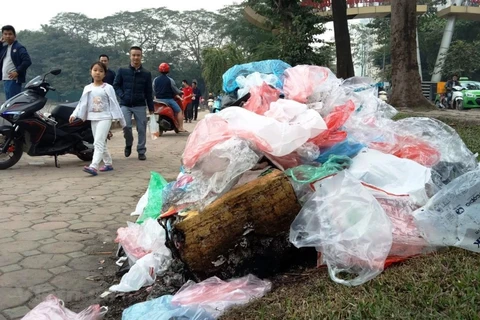
Heaps of stinky used bags outside an informal recycling facility in Thanh Hoa province. (Photo: VNA)
 Waste management in Vietnam involves waste collectors, who normally rummage through household waste to collect tradable items such as plastic bottles and cardboard.
After going from street to street filling their bags, the collectors bring their items to a collection point to do their daily trading. The point then consolidates waste from different sources and trades with recycling facilities, where the waste gets pre-processed and ready for recycling.
In 2022, about 3.27 million tonnes of plastic waste were disposed in landfills. As informal facilities often outbid formal ones for items sold by collection points, the former obtained most of the waste for recycling whereas the latter had to import waste to keep their operation running. Remarkably, the imported waste has topped 3 million tonnes annually.
But the cost advantage does not mean informal facilities provide an inexpensive solution to plastic pollution. In fact, the advantage comes directly from the environmental controls that they dodge by taking shortcuts.
"Formal facilities are no match for informal facilities cost-wise because the latter never spend a penny on green technologies," said Hoang Duong Tung, former Deputy Director of the Vietnam Environment Administration.
Huynh Thi My, Secretary-General of the Vietnam Plastics Association, said the waste management industry has around 4,500 informal facilities but all of them were recycling waste with substandard technologies.
In a World Bank's estimation, the ensuing inefficiency costs Vietnam nearly 3 billion USD per year and causes heavy damage to the environment.
The Ministry of Natural Resources and Environment is drawing up proposals for defining the reasonable and valid rate of recycling cost for a unit volume of waste (Fs), which is expected to lay the ground for recycling cost calculation and foster the formal recycling sector.
The European Chamber of Commerce (EuroCham) in Vietnam has raised concerns about the proposed cost norms, which were believed to fail to take into account the core principles of the circular economy.
The chamber suggested Fs be set at zero for highly-profitable recyclable items such as aluminum-based products and cardboard. It is unreasonable to get producers to cover the recycling costs of those items, given the profits from recycling them come straight to recyclers' pockets.
In contrast, the Fs applicable to unprofitable items such as plastic bags and composite papers should be set to non-zero to support the facilities which are recycling those items. More importantly, the Fs should not surpass the global average norm.
EuroCham also suggested factoring out the administrative costs of 3% from the Fs formula to ensure the rate is in line with Law on Environmental Protection./.
VNA