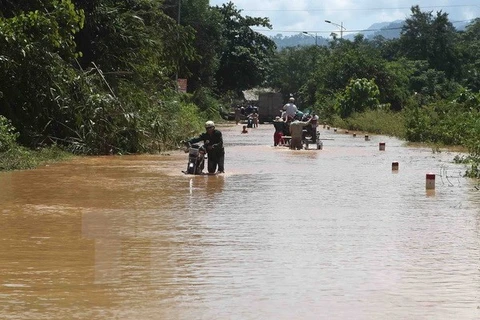
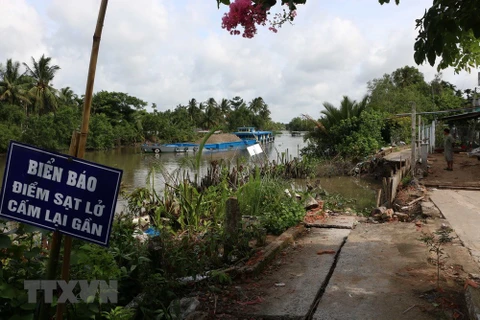
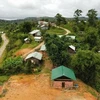
Damage caused by a storm in Lao Cai last October (Photo: VNA)
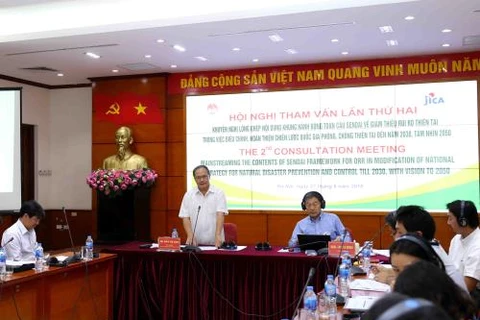
 Hanoi (VNA) –The application of policies and advanced technologies from Japan towards reducing the damage caused by floods and landslides was highlighted at a seminar held in Hanoi on November 9 by the Vietnam Disaster Management Authority (VDMA) in collaboration with the Japanese Ministry of Land, Infrastructure, Transport, and Tourism.
The event is significant for disaster prevention and mitigation in Vietnam.
As a country hard-hit by natural calamities, Japan spent an average of 1.2 percent of its gross domestic product (GDP), equivalent to 60 billion USD during the 2010-2016 period, on the implementation of disaster prevention, response, recovery, and rehabilitation programmes.
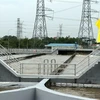
According to Yusuke Sakai, a representative from Japan’s National Institute of Advanced Industrial Science and Technology, the construction of sabo dams – a leading model in channels for debris flow control – is one of the most effective measures to reduce the damage of landslides.
Sabo dams are built at the upstream areas of rivers where they suppress the flow of sediment.
At the event, participants also introduced some state-of-the-art technologies used in natural disaster mitigation in Japan, including a global satellite mapping of precipitation (GSMaP) and a global high-resolution 3D map service (AW3D).
Head of the VDMA Tran Quang Hoai said that Vietnam is among the countries facing the most severe impact of climate change. The country has suffered from 20 out of the 21 forms of natural disasters, only being sparred by a tsunami.
Flash floods and landslides have created critical losses to Vietnam, accounting for 10.1 percent of the total loss in terms of human and assets caused by natural disasters, he added.
Nguyen Trung Kien, from the Department of Science-Technology and International Cooperation under the VDMA, said that previous research on flash floods and landslides have made significant contributions to lessening risks caused by future natural disasters.
However, he stressed that the research should be made more detailed to ensure precise forecasting and suitable responses to natural calamities.
In the time to come, competent authorities should immediately implement the Government’s Decree No.76/NQ-CP dated on June 18, 2018 and the Prime Minister’s Direction No.19/CT-TTG dated July 13, 2018 on the prevention of natural disasters. Furthermore, preventative works should be put in place, including a pilot monitoring system, warning map system, and early flood warning system, among others. –VNA
VNA