Japanese firms’ recruitment demands start recovering from Q2

Recruitment demand of Japanese companies in Vietnam is recovering in the second quarter of 2021, but being good at Japanese is no longer a competitive advantage for candidates applying to the company, according to a report released by Navigos Group, a leading recruitment group in Vietnam, on June 22.
Japanese firms’ recruitment demands start recovering from Q2 ảnh 1Illustrative image (Source: VNA)

Hanoi (VNA) – Recruitment demand of Japanese companies in Vietnam is recovering in the second quarter of 2021, but being good at Japanese is no longer a competitive advantage for candidates applying to the company, according to a report released by Navigos Group, a leading recruitment group in Vietnam, on June 22.

The reported, entitled “One year after impact of the COVID-19: Challenges and opportunities for job seekers at Japanese enterprises in Vietnam”, said COVID-19 has contributed to notable changes in not only production and business, but also recruitment activities at Japanese enterprises in Vietnam. 

According to the Japan Business Association in Ho Chi Minh City and JETRO Office in Ho Chi Minh City, up to 70 percent of the firms have been affected in both their production and business and human-related activities.

One year after the outbreak of the COVID-19, most pf the Japanese businesses have adapted to the situation and showed signs of recovery. Recruitment activities started to flourish in the second quarter of 2021.

Due to the pandemic, many new Japanese companies have temporarily delayed their plans in Vietnam. A hiring freeze still occurred during the first quarter of 2021 at several businesses. Instead, the companies focused on their current staffs.

In the second quarter of 2021, Japanese enterprises have started to recruit manpower for middle management jobs, mainly supervisory positions and deputy heads of departments.

Japanese manufacturers rarely cut down management staff during the time of COVID-19.

Due to the great impact on personnel recruitment activities, staff streamlining was necessary in Japanese enterprises. The work, however, was applied mainly for workers and ordinary employees. It rarely happened to office staffs and managers.

Japanese companies hardly closed their factories and offices. Instead, they chose other measures such as reducing wages or allowing employees to work rotating shifts. The organisational restructuring also helped the enterprises to retain the most suitable and engaged employees.

According to the report, being good at Japanese is no longer a competitive advantage for candidates applying to Japanese companies.

One of the biggest changes in the recruitment policy of Japanese enterprises lies in the foreign language requirement. In addition to being fluent in Japanese, employers sought for candidates who knew another foreign language such as English, Chinese or Korean. This is because Japanese enterprises wanted to expand their export markets or to export goods to enterprises outside Vietnam.

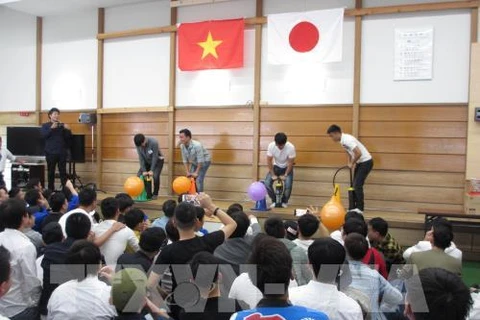
Japanese firms’ recruitment demands start recovering from Q2 ảnh 2Japanese companies are requiring higher foreign language skills from employees (Photo: VietnamPlus)

This high requirement for foreign language skills makes it difficult for international students or trainees returning from Japan. They may have to face stiff competition as businesses are now requiring candidates to know both Japanese and English or Chinese or Korean.

Meanwhile, the report highlighted that Japanese enterprises have not yet attracted young candidates.

Japanese companies often prefer candidates who have worked at Japanese enterprises as they are familiar with the Japanese culture and working environment.

However, those companies have not yet attracted young candidates and fresh graduates. It is mainly because of low salary and unattractive welfare and the strict and regulated working environment.

Candidates with more experience, expertise and better soft skills will have a competitive advantage in the market.

As observed by Navigos Search, there is now a surplus of candidates for Japanese companies. In order for them to be able to transfer to other Japanese enterprises, they will need to meet higher recruitment requirements from employers in terms of foreign languages, experience and expertise.

Soft skills relating to communication, negotiation, self-expression and impressing the employer would give candidates more advantages when applying to Japanese enterprises.

Japanese enterprises are still attractive to Vietnamese candidates, according to the report.

Japanese enterprises are attractive due to their reputation for stable, well-organised and well-planned operation, particularly in the period of considerable changes and the “new normal”.

Professional and well-trained environment is also another attraction for candidates. For those who are familiar with the environment and culture at Japanese enterprises, they often have the desire to stick with the company.

Rare termination of employment is also an advantageous point for Japanese enterprises. The culture of Japanese companies is to ensure stable and long-term work for employees.

In this context, Navigos Search advised enterprises to focus on staff training through courses on soft skills, including communication and presentation ones. In order to attract good and potential candidates, Japanese enterprises can build a new salary and bonus mechanism that is more appealing in the market. Career development orientation and language teaching should be provided since the first working day of their employees, it recommended.

At the same time, it also advised job-seekers to equip themselves with other foreign language skills such as English, Chinese and Korean, along with knowledge and other soft skills such as communication and presentation ones./.

VNA

See more

Delegates observe a minute of silence in tribute to Cuban leader Fidel Castro Ruz (Photo: VNA)

Quang Tri celebrates 100th birthday of Cuban leader Fidel Castro

Addressing the ceremony, Vice Chairman of the provincial People’s Committee Le Duc Tien said Fidel Castro was a figure of exceptional stature whose life and revolutionary career were closely associated with the victory of the Cuban Revolution and the struggle for national independence and sovereignty, as well as the aspirations of peoples around the world for independence, freedom, peace and justice.

General Secretary of the Communist Party of Vietnam Central Committee and President To Lam addresses the 2026 Vietnam–New Zealand higher and vocational education forum in Auckland on August 13, 2026. (Photo: VNA)

Top leader calls for stronger Vietnam–New Zealand ties in higher and vocational education

General Secretary and President To Lam called on the two sides to jointly develop high-quality human resources for the digital, green, circular and knowledge-based economies, prioritising areas of strong demand and high complementarity such as artificial intelligence (AI), data science, digital technology, cybersecurity, biotechnology, smart agriculture, food technology, renewable energy, environmental technology, public governance and emerging occupations of the future.

Machinery has been integrated into cargo handling lines, helping reduce labour requirements and improve import-export efficiency. (Photo: VNA)

Lang Son tackles skilled labour shortage in border-gate logistics

As the province promotes investment in logistics services and infrastructure at border gates, businesses are increasingly shifting from relying on manual labour for loading and transshipment to workers capable of operating modern equipment and handling specialised tasks.

Textbooks are sold at a bookstore operated by the Vietnam Education Publishing House. (Photo: VNA)

Hanoi to provide free textbooks from 2026–2027 school year

The municipal Department of Education and Training will work with the Department of Finance to guide wards, communes and educational institutions in implementing the student support policies adopted by central authorities and the municipal People’s Council.

The defendants at the trial. (Photo: tuoitre.vn)

AIC case in Ca Mau: Nguyen Thi Thanh Nhan sentenced to 10 years in prison

The People's Court of Ca Mau province on August 12 sentenced former Chairwoman and General Director of the Advanced International Joint Stock Company (AIC) Nguyen Thi Thanh Nhan to ten years in prison for "violating bidding regulations, causing serious consequences" in a case involving the inflation of equipment prices for environmental monitoring stations in the former Bac Lieu province (now Ca Mau province).

General Secretary of the Communist Party of Vietnam (CPV) Central Committee and President To Lam speaks with Vietnamese Embassy staff and representatives of the Vietnamese community in New Zealand and South Pacific island countries in Auckland on August 12 evening. (Photo: VNA)

Party General Secretary and President meets Vietnamese community in New Zealand

General Secretary of the Communist Party of Vietnam (CPV) Central Committee and President To Lam described overseas Vietnamese as “ambassadors” who help promote Vietnam's positive image internationally, and urged them to maintain solidarity, preserve national pride and cultural traditions, and make practical contributions to the country's development.

A teacher of the Canada–Vietnam Cultural and Educational Council (CVCEC) uses vivid images to illustrate the Vietnamese language. (Photo: VNA)

Vietnam’s language push abroad gains traction

The 2023–2030 project to honour the Vietnamese language overseas kicked off at a timely moment, meeting the OVs' expectations for wider language spread. More than four years since its 2022 launch, the project has produced concrete results, with a growing number of effective initiatives and novel approaches.

Aerospace engineer Tran Thang (first, left) attends the Congress of the Vietnam Fatherland Front Central Committee in January 2026. (Photo published by VNA)

Resolution 23 creates space for overseas Vietnamese to contribute to national development

After more than 20 years of implementing Resolution 36, the Party and State’s policies have been translated into numerous effective policies and actions, helping strengthen the group’ attachment to their homeland and creating favourable conditions for increasing numbers of them to return to Vietnam to visit relatives, invest, do business, work and engage in exchanges.

Layton Pike, Advisory Board Member of the Australia Vietnam Policy Institute (Photo: VNA)

Vietnam–Australia education cooperation enters new phase

The Vietnam–Australia TechConnect Forum, held on August 10 at the University of Technology Sydney during General Secretary and President To Lam’s state visit to Australia, showcased this opportunity. The event brought together representatives from both countries’ governments, universities, research institutes, and businesses, creating a space to link education with science, technology, and investment.

Tourists visit the Imperial Citadel of Hue. (Photo: VNA)

Australian tourists show growing appetite for Vietnam

Australia has become one of Vietnam’s fastest-growing long-haul tourism markets. Vietnam welcomed 490,880 Australian visitors in 2024, up 26% year on year and around 28% higher than in 2019, before the COVID-19 pandemic. In the first seven months of 2026, the country received 396,648 Australian tourists, a year-on-year increase of 25.8%, placing Australia among Vietnam’s top 10 source markets.

Head of the CPV Central Committee’s Commission for Publicity Trinh Van Quyet (centre) tours ABC facility (Photo: VNA)

Vietnam, Australia cultivate media cooperation in digital age

To match media cooperation with the weight of the Vietnam–Australia Comprehensive Strategic Partnership, he proposed five key collaboration areas, said Head of the Communist Party of Vietnam (CPV) Central Committee’s Commission for Publicity Trinh Van Quyet.

Vietnam takes effective steps to build seamless digital ecosystem for foreigners

Vietnam takes effective steps to build seamless digital ecosystem for foreigners

Despite recognising Vietnam’s progress in digital transformation, many foreigners living in the country believe that digitising individual services is only the first step. What they expect is a seamlessly connected digital ecosystem in which a single electronic identity allows users to access services and conduct transactions conveniently and securely.

Assoc. Prof. Dr. Nguyen Van Tung, a member of the Members' Council of the Vietnam Education Publishing House, speaks at a meeting with the Vietnamese Embassy. (Photo: VNA)

Vietnam-Germany cooperation strengthened in educational publishing

The VEPH is conducting a working and study visit to Germany from August 8-14 to learn from advanced models for the production and distribution of e-books and digital learning materials. The delegation is led by Assoc. Prof. Dr. Nguyen Van Tung, a member of the VEPH Members' Council.