Chief Representative of JICA in Vietnam Shimizu Akira (Photo: VNA)
 Hanoi (VNA) – The Japan International Cooperation Agency (JICA) is proud to be part of Vietnam’s socio-economic development progress, said Chief Representative of JICA in Vietnam Shimizu Akira in an exclusive interview with the Vietnam News Agency (VNA).
The interview focuses on the JICA Chief Representative’s views on Vietnam’s recent economic achievements and Vietnam – Japan cooperative relations via official development assistance (ODA) projects. Following is the extract of the interview.
Reporter: What are your assessments of Vietnam’s achievements in economic development since JICA restarted ODA operations in Vietnam in 1992?
Mr Shimizu Akira: Vietnam’s economic success is an inspiring development story. Let’s look at some figures over the period: GDP has been more than 20 times bigger and GDP per capita has been almost 20 times higher. From an embargoed economy, Vietnam has opened up and now has a trade value at two times of the GDP, and become one of the most open economies in the world. During the process, tens of millions of people have escaped from poverty and thrived for prosperity and better opportunities in lives.
I think the figures speak so much about the energy, dynamics and potentials of your country: the young and skillful labor force, the dynamic enterprises and the more improved business and investment climate that your Government has been trying to provide during the past years. It is very impressive that at present, Vietnam is doing very well for preventing covid-19 outbreak while keeping the economy going. And JICA is very proud to contribute a part in the process.
Reporter: In a recent book, the World Bank has recognised Vietnam as one of the most successful emerging economies, what do you think about this assessment?
Mr Shimizu Akira: I agree with the assessment. As the World Bank assessed, one of the key factors of Vietnam’s economic success was its transition from a centrally planned to a market economy.
Besides this, from my personal viewpoint, I think it owes much to the potential of Vietnamese people, such as hard working and flexible mind. Attitude while respecting history, also look forward to make positive history with the other countries are also one of a key factors.
JICA has been cooperating with Vietnam in a variety of fields aiming at its smooth transition to market economy, and providing technical assistance tailored to the stage of economic development for over decades. For example, JICA supported various institutional reforms in accordance with policy frameworks under policy-based loans of Poverty Reduction Support Credit (PRSC) and following Economic Management and Competitiveness Credit (EMCC), both of which are syndicated loans with the World Bank. We highly evaluate outstanding achievements backed by Vietnam’s continuous efforts under these policy frameworks.
Reporter: You said JICA is proud to contribute in the progress of Vietnam’s development. Could you please tell us more about this? And what are JICA’s evaluations on Vietnamese policies in regard to ODA over the past years?
 Chief Representative of JICA in Vietnam Shimizu Akira (Photo: VNA)
 Mr Shimizu Akira: We have been working closely with the Government in various projects and programs for bringing in higher living standard and more economic opportunities for all Vietnamese people.
The operation of JICA aims at improvement of both hard and soft socio-economic infrastructures. We work with various Vietnamese agencies for capacity development of the officials, efficient and effective state governance, better delivery of public services, improvement of human resources, etc. In addition, we provide financing for various important infrastructure projects in transport, energy, urban development, agriculture, etc. Many Japanese ODA projects have served as catalyst factors for inviting private investment. At present, Vietnam is among top five of the largest recipients of Japanese ODA in the world.
One thing I would like to emphasize here, that JICA cannot successfully implement all the projects and programs without the cooperation and trust of our Vietnamese counterpart agencies. In this regard, I believe that the ODA policies have functioned well in terms of creating an enabling and facilitating environment for ODA attraction and use. However, I think Vietnam can even do better, e.g. further streamline administrative procedures to avoid project delay (which is quite common), and narrow the gap between domestic regulations and good international practices in procurement, contract management, taxation issues and so on. These efforts not only promote better use of ODA but also development of the market economy which private sector will ultimately benefit, which leads to further promotion of Foreign Direct Investment.
Reporter: In general, please kindly highlight JICA's achievements in Vietnam over the past years?
Mr Shimizu Akira: In recent years, Japan’s ODA share over the total ODA to Vietnam exceeds 30 percent and Vietnam has been one of the biggest recipient countries of Japan’s ODA in comparison to the rest of the whole world. In five years between 2014 and 2018, the total amount of loan, technical cooperation and grant aid has accumulated up to 5,324 billion JPY, 40 billion JPY and 73 hundred million JPY, respectively.
The first pillar is Promotion of Economic Growth and Strengthening International Competitiveness, which aims to support to improve the market economy system. JICA’s support to Vietnam under this pillar in recent years continue to focus on financial reform and state-owned enterprises reform, infrastructure development (road, bridges, urban transport) as well as to strengthen industrial competitiveness and human resource development. Some out of the numerous projects effectively being implemented under this Pillar are: the “Ho Chi Minh City Urban Railway Construction Project (Line 1), which will be the first underground metro system currently under construction; the “Lach Huyen Port Infrastructure Construction Project,” which was the first PPP collaboration using Yen Loan opened in 2018; and the “Vietnam-Japan University (VJU)”, which is a joint creation of both countries and opened in 2016 in Hanoi. Recently, we positioned agriculture as the key issue in this pillar as well, as we are all aware that Vietnam is a major agricultural country.
The second pillar, Response to fragility, supports to address emerging issues caused by rapid urbanization, natural disasters and climate change and to develop the systems in the fields of health-care sector and social security etc. JICA has been providing cooperation for adaptation and mitigation measures for climate change in addition to support in policy formulation and enforcement, supporting HCMC and Hanoi with water environment improvement for flood damage prevention; helping Ben Tre province with water management to protect agriculture from salinity intrusion during dry season.
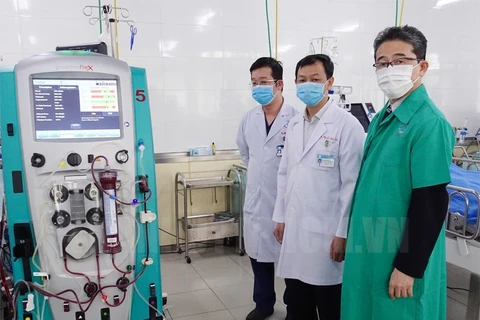
In terms of healthcare and social security, for a long time, we have been closely collaborating with top institutes and hospitals such as National Institute of Hygiene and Epidemiology (NIHE), Bach Mai, Cho Ray and Hue Central hospital, which the result contributed much in controlling COVID-19 pandemic. Moreover, projects such as Vaccine production facilities of POLYVAC or insurance provider payment methods and basic health service have helped Vietnam to address the pending issues in health care and social security.
Under “Good Governance”-the 3rd pillar, JICA continues to provide training to government officials, to support developing training curriculums and texts for legal professionals (judges, prosecutors and lawyers), to promote E-Government and to strengthen the capacity of the Office of the National Assembly of Vietnam. These interventions have helped to strengthen the governance, enhancing capacity of improving and executing the legal system, ensure justice, fairness, neutrality and transparency of the governance.
JICA’s focus in transparency is not only in the governance sector, but also in the economic section. Supporting in legislation and fair practices in competition law, human resource development in the security sector, and strengthening the corporate governance will help to lead the investment from foreign countries.
Reporter: Global economy is currently facing challenges of the COVID-19 pandemic. In that context, Vietnam and Japan are both significantly affected. Please kindly advise if JICA will adopt new forms of cooperation in order to adapt to the current "new normal" state?
Mr Shimizu Akira: As I said above, in the context of COVID-19 spreading, the society has slightly changed all over the world. JICA is going along with the same policy of the government of Vietnam in order to adapt to the current “new normal” state.
Based on 3 pillars’ cooperation, JICA is implementing projects to prevent infectious diseases in health sector and to promote economic growth by explaining the Vietnamese Government to enhance public investment, in order to stimulate the country’s private sector.
We also started reviewing the outcomes of some of the on-going and completed projects, which the influence of COVID-19 was not pre-requisite, so that we can be able to acquire the same results under the COVID-19 situation.
Thank you!
VNA