Khe Van Waterfall: serenity and adventure

With its pristine natural beauty, Binh Lieu mountainous district in the northern province of Qua ng Ninh is known as an attractive destination for adventurous tourists.
Khe Van Waterfall: serenity and adventure ảnh 1Serenity: A terrace field on the way to Khe Van Waterfall (Photo:binhlieu.com)

Hanoi (VNA/VNS) – With its pristine natural beauty, Binh Lieu mountainous district in the northern province of Quang Ninh is known as an attractive destination for adventurous tourists. 

One of its destinations that not many people have discovered is Khe Van Waterfall in Huc Dong Commune. 

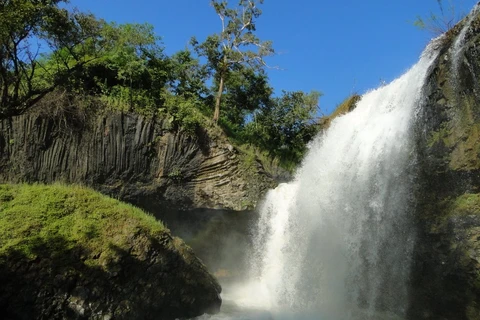
Visitors will be impressed by the imposing three-storey waterfall, especially in the rainy season from May to August when the white water flow forms picturesque scenery. 

Khe Van Waterfall is 12km to the southeast of Binh Lieu Town. 

On the winding road to Huc Dong Commune, which looks like silk ribbons wrapped around the mountains, are beautiful paddy fields of the Tay ethnic people. 

From the parking lot a 3km path through the forest leads to the waterfall. 

The waterfall is 100m high. The water runs from the Khe Van–Thong Chau mountain range 1,000m above sea level, creating three separate water layers. 

Each has unique features. 

The top one is the large stream of water flowing from the cliff down to a large lake. Flowers and grass on the cliff enhance the view. A complex of imposing angled stones scattered under the water creates an amazing natural landscape. 

The second layer of water is divided into two small waterfalls running beside each other. One flows down to streams and a wide lake. The large and flat stones are ideal places to rest and have a sunbath. This lake is a natural swimming pool inviting tourists to immerse themselves in the cool, fresh water. 

Khe Van Waterfall is not only picturesque, it also has a cultural aspect. It’s where San Chi and San Diu ethnic couples go on dates and sing soong co (folk songs of their groups). These ethnic groups believe that the fourth day of the forth lunar month is not a favorable day for any work. If they plant trees, the trees will not blossom or if they build a house, the house will collapse. They set aside all work and go out to have fun at the area’s waterfalls, lakes and streams. 

Despite the site’s beauty and ethnic interest, tourism hasn’t developed there and visitors can only sleep at homestays. 

On the other hand, the site still hold onto its pristineness and attracts backpackers. 

They stay in local residents’ houses, enjoy their singing and local food such as grilled fish (caught in the streams) and boild snails and crabs (caught in the mountains). At night, young backpackers gather around bonfires. After singing and dancing, the host will offer them boiled buffalo horn-shaped cakes. The guests can join the local women in wrapping this cake. It’s not too difficult. The stuffing includes mung bean and sticky rice. People use bamboo leaves to wrap them and then boil the cakes to fete hungry tourists at midnight. 

Located in the eastern part of Quang Ninh Province and bordering China, Binh Lieu District attracts travellers with its wild beauty, serenity and diverse ethnic culture of groups such as Tay, San and Dao. 

Trekkers can choose different routes to discover the mountainous region. Many ride motorbikes and go trekking to enjoy the spectacular view and visit landmarks along the border and the Hoanh Mo Border Gate. Some border markers are placed on the road and easy to find, others are hidden on mountains and fields. 

Authorities of Binh Lieu District are reportedly planning to develop local tourism. All information about Binh Lieu tourism is now available on http://binhlieu.com.-VNA
VNA

See more

Secretary of the Party Central Committee and Deputy Prime Minister Pham Thi Thanh Tra speaks at the conference. (Photo: VNA)

Vietnam moves to make tourism a true new growth driver

Resolution No. 26-NQ/TW, issued on August 22, sets out a new vision, with a focus on fundamentally renewing the mindset, methods and approaches to tourism development and governance, shifting from quantity to quality and increasing the sector’s contribution to the national economy.

Tourists visit Golden Bridge in Da Nang city in the rainy season. (Photo: hanoimoi.vn)

Turning rainy season into tourism opportunity

Seasonality has long been a challenge for Vietnam’s tourism industry. In many localities, tourism peaks in summer but visitor numbers fall during the rainy months. Destinations are now seeking to restructure their tourism ecosystems and develop products that can operate year-round.

A pot of Mi Quang (Quang noodles). (Photo: VNA)

Da Nang promotes distinctive cuisine as key tourism attraction

As travellers increasingly seek authentic local experiences, the central coastal city of Da Nang is stepping up efforts to integrate cuisine into tourism itineraries, linking culinary promotion with destination branding and cultural preservation.

Flower vendors form a distinctive feature of Hanoi’s autumn. (Photo: VNA)

Hanoi builds four-season tourism appeal

Hanoi’s tourism events are increasingly designed to inspire exploration beyond individual festivals. At the Hanoi Tourism Gift Festival, for instance, visitors can make handicrafts with artisans, explore destinations through virtual reality and discover new tours and tourism stimulus programmes.

A view of the Lo Lo Chai community tourism village in Tuyen Quang province (Photo: VNA)

Vietnam taps community tourism potential for sustainable development

The tourism market is shifting from sightseeing towards living and connecting with destinations. Visitors increasingly seek authentic and locally rooted experiences, interaction with local people, culture and nature, as well as small-group and personalised trips with limited environmental impact and clear benefits for communities.

Delegates press the button to launch the “Phong Nha – Hue Ancient Capital: World Heritage Journey” tourist train. (Photo: VNA)

Tourist train linking Phong Nha and Hue heritage sites launched

The 190-km route runs between Hue, Dong Ha, My Trach, Dong Hoi and Tho Loc stations, giving travellers access to destinations including the Complex of Hue Monuments, Quang Tri Ancient Citadel, Vinh Moc Tunnels, Hien Luong–Ben Hai historical site and Phong Nha-Ke Bang National Park.

International tourists visit Hoi An Ancient Town in Da Nang city. (Photo: VNA)

Tourism ready for National Day holiday, eyes year-end acceleration

A range of cultural and artistic activities will be held during the holiday. In Da Nang, the “Hoi An Memories” show will present its “Flag Hat” version from August 26 to September 2. Phu Quoc will host the “The Memory of Flowers” exhibition, while Thanh Hoa will organise the Sam Son Kite Festival 2026 from August 30 to September 1.

Businesses introduce their tourism products at the 20th International Travel Expo Ho Chi Minh City. (Photo: VNA)

Vietnam ready to create new momentum for regional, global MICE tourism

Vietnam has consistently identified tourism as a spearhead economic sector, Deputy PM Pham Thi Thanh Tra stressed, adding that in the new development era, with the need for rapid and sustainable growth and a stronger national position, MICE should be positioned as a strategic tourism product, targeting high-quality visitors while generating additional momentum for trade and investment and enhancing national competitiveness.

Officials at the 7th ACMECS Tourism Ministers’ Meeting in Ho Chi Minh City on August 27 (Photo: VNA)

ACMECS strengthens tourism ties, promotes “Five Countries, One Destination”

The newly adopted joint action plan on ACMECS tourism cooperation for 2026–2028 focuses on five key pillars: improving connectivity and facilitating travel; promoting digital transformation and smart tourism; developing ecotourism, community-based and cultural tourism; enhancing tourism security and safety; and developing human resources.

A stall at the 20th International Travel Expo Ho Chi Minh City (Photo: VNA)

International Travel Expo 2026 opens in Ho Chi Minh City

ITE HCMC 2026 features one of its largest and most diverse tourism networks to date, with tourism promotion agencies and businesses from the Republic of Korea, Japan, Malaysia, Thailand, Laos, Cambodia, Bhutan, Russia’s St. Petersburg and Nicaragua.