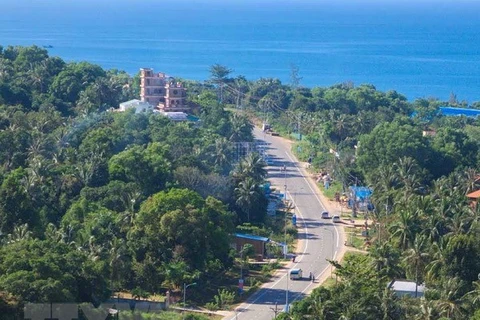
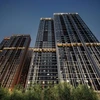
A corner of Phu Quoc island (Photo: VNA)
Kien Giang (VNA) - Boasting 200 km of coastline and 143 islands, the Mekong Delta province of Kien Giang is striving to branch out its maritime sector and become a sea-based economic powerhouse by 2025.
The move aims to contribute to realising the “Strategy for Sustainable Development of Vietnam’s Marine Economy by 2030 with a Vision to 2045”.
According to Standing Deputy Secretary of the provincial Party Committee Mai Van Huynh, the province is prioritising building its maritime sector to boost economic development while protecting the environment and strengthening national defence at sea and on islands.
Major investments have been made in several spearhead industries, such as seafood, tourism-marine services, energy, and maritime industry, among others, helping the province rank second among the 13 Mekong Delta localities in terms of maritime economic development in 2020.
The sea-based economy accounted for 79.75 percent of the local gross regional domestic product (GRDP) during the year, he added.
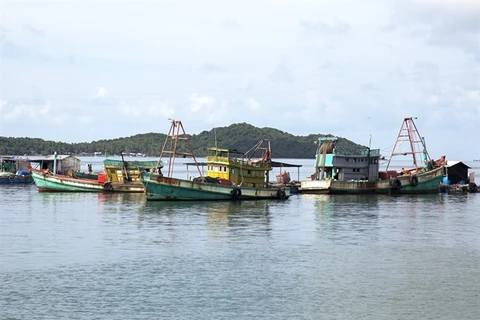
High-capacity fishing vessels have been built to bolster off-shore fishing, contributing to sustainable fisheries and the protection of the nation’s sovereignty over sea and islands.
With vast fishing grounds and a strong fleet, the province’s annual seafood output tops 500,000 tonnes and its aquaculture yield was estimated at more than 264,100 tonnes in 2020.
 A batch of fish is transported to Duong Dong market in Phu Quoc island city. (Photo: VNA)
Kien Giang is working to secure a total seafood catch and aquaculture output of 800,000 tonnes by 2025.
According to the provincial Department of Agriculture and Rural Development, farming areas in Phu Quoc city, Kien Hai island district, the island commune of Tien Hai in Ha Tien city, and Son Hai and Hon Nghe in Kien Luong district will focus on farming groupers, cobias, yellow-fin pompanos, and seabass, as well as blue lobster, mantis shrimp, crab, and oysters for pearl farming.
Meanwhile, coastal areas in Ha Tien city and the districts of Kien Luong, Hon Dat, An Minh, and An Bien will develop zones for farming molluscs such as blood cockles, saltwater mussels, green mussels, and oysters.
Furthermore, due attention will be paid to high-tech aquaculture, the development of quality staples with high economic value, and measures to prevent illegal fishing.
Local maritime tourism has become a locomotive for growth of the tourism sector, with renowned destinations like Phu Quoc Island. A huge amount of capital has been injected into Phu Quoc city for years, most of which comes from strategic investors like Vingroup, Sun Group, BIM Group, and CEO Group.
According to the provincial Department of Tourism, the province welcomed over 5.2 million visitors in 2020, accounting for 55.8 percent of the plan but down 40.7 percent year-on-year. Revenue from tourism services was put at more than 7.8 trillion VND (339.8 million USD), or 39.3 percent of the target, and down 57.7 percent compared to 2019.
Local tourism is seeing a sound recovery thanks to supportive stimulus measures.
The province will sharpen its focus on tourism infrastructure at key attractions, including Phu Quoc Island, which is to become a world-class marine eco-tourism services hub.
Vice Director of the Department of Tourism Bui Quoc Thai said the province encourages all economic sectors to build and diversify local tourism products, as well as join in efforts to form a major tourism centre.
Regarding energy development, the province prioritises investment in wind power, electrification, solar power, and many other sources of renewable energy.
In the meantime, it has plans to build coastal roads and improve logistics services, while working to preserve ocean biodiversity and restore ocean ecosystems, in particular protecting mangrove forest in tandem with the effective and sustainable exploitation of marine resources./.