Korean firms eye investment in renewable energy in Vietnam

Korean investors are keen to invest in renewable energy due to its potential and the incentives that Vietnam has offered to foreign investors, an HSBC official has said.
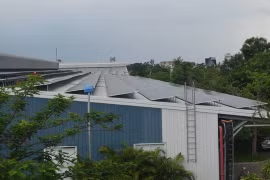
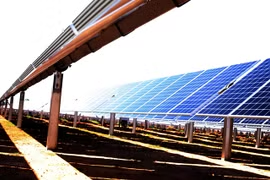
Korean firms eye investment in renewable energy in Vietnam ảnh 1Workers install solar panels in the central province of Quang Ngai (Photo: VNA)

HCM City (VNS/VNA) - Korean investorsare keen to invest in renewable energy due to its potential and theincentives that Vietnam has offered to foreign investors, an HSBC officialhas said.

Speaking recently with Vietnam News, Pham HongHai, CEO of HSBC Vietnam, said that electricity was one of the most importantinvestments of Korean businesses into Vietnam. “Korean firms are nowlooking to invest in the renewable energy sector.” 

The investment trend from the Republic of Korea (RoK) washighlighted at the Vietnam–Korea Electricity and Renewable Energy Forum heldearlier this year.

Vietnam plans to cooperate with the RoK in reducinggreenhouse gas emissions, adaptation to climate change and environmentalprotection. It will also assist Vietnam in personnel training andtechnological transfer in the field, he said. 

As the country is growing, Vietnam needs more power sources.Coal and nuclear power could be short-term solutions, but air quality might beaffected.

If Vietnam pursues sustainable growth, renewable energy isan area that will attract foreign investment.

The Government has issued regulations on tax relief forrenewable projects, as well as a strategic plan for renewable energydevelopment and a national power development plan. 

Power demand is forecast to grow by more than 10 percenteach year from now to the end of 2020 and by 8 percent annually during 2021-2030. 

According to the Vietnam Energy Association, Vietnamaims to increase renewable power to 32 percent of the total energy mix by2030 and to 43 percent by 2050. 

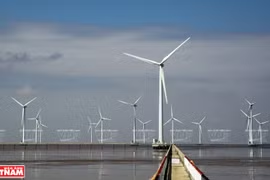
The potential for developing renewable energy is huge,especially for solar power production as the country is located in theequatorial area with a hot climate all year long in the south and centralregions.

Abundant energy sources such as wind, solar power andbiomass remain largely untapped, according to Hai.

To realise the great potential of solar power, theGovernment has developed policies to speed up investment in the sector.

Advantages for foreign investors include the favourablegeographic location of the country and the Government's incentivepolicies. 

The RoK’s investment in ASEAN member countries last yearrose by 16.7 percent over 2017.

Vietnam accounted for 51.5 percent of the RoK’s totalinvestment in ASEAN, followed by Singapore with 25.6 percent.-VNS/VNA
VNA
See more

The sidewalks on Hung Vuong street in Quang Tri province are under renovation. (Photo: VNA)

Quang Tri approves 103 priority projects for investment during 2026–2030

The 103 projects are categorised into seven fields, comprising energy; logistics; tourism, services, and trade; green and high-tech agriculture; industry, industrial zones, and production infrastructure; urban development and commercial housing; and healthcare, wellness, and resort services.

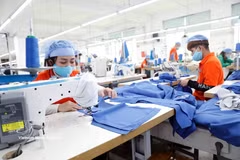
Workers make clothes for export to the Japanese market at Hung Viet Garment Company in Hung Yen province (Photo: VNA)

Vietnam’s textile-garment firms striving to achieve export targets, sustain employment

To achieve the annual target, textile and garment businesses are jointly implementing several core tasks, including diversifying export markets and partners, developing the supporting industries for raw materials and accessories to establish integrated supply chains, investing in technological innovation linked to AI, stepping up high-quality workforce training, promoting green transformation based on circular economy models, and building brands in both domestic and international markets.

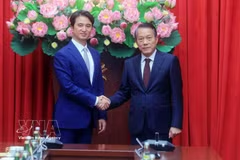
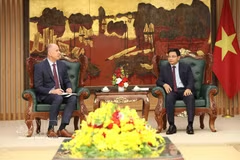
Minister of Public Security General Luong Tam Quang (R) receives Choo Hyeong Wook, President and CEO of the Republic of Korea’s SK Innovation in Hanoi on November 16. (Photo: VNA)

Vietnam promotes international cooperation in energy, high technology

Minister of Public Security General Luong Tam Quang called on the RoK's SK Innovation to share experience and work with Vietnamese partners in developing clean and renewable energy, hydrogen, liquefied natural gas, energy storage technologies and carbon emission reduction solutions.

Delegates pose for a photo at the Chile-Vietnam Business Forum in Hanoi on November 16 (Photo: VNA)

Vietnam, Chile seek to expand trade ties

Chilean President José Antonio Kast pointed to potential for cooperation in agriculture and food, and called for stronger technical cooperation, better market access and closer links in innovation, technology, services and sustainable development.

Production of footwear for export at Lefaso Tra Vinh Industrial Investment and Production Joint Stock Company, Tra Cu commune, Vinh Long province (Illustrative image. Source: VNA)

VEFTA implementation requires exporters to restructure supply chains: Experts

Under VEFTA, tariff reductions to zero will be meaningless for Vietnam’s key export sectors, including textiles and garments, footwear, and agricultural and aquatic products, if goods are found to contain banned chemicals, violate rules of origin or lack transparency regarding their carbon footprints.

Deputy Prime Minister Nguyen Van Thang meets with Martin Sommer, head of the IMF’s Article IV consultation mission team to Vietnam, in Hanoi on November 13, 2026. (Photo: VNA)

IMF sees positive growth prospects for Vietnam, urges cautious monetary policy

Martin Sommer, head of the IMF’s Article IV consultation mission team to Vietnam, noted that inflation risks in Vietnam remain under control, but several factors could add to price pressures. He therefore called for cautious monetary policy management and readiness to respond promptly if inflationary pressures increased.

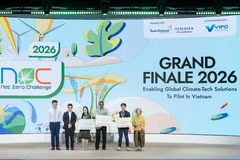
Representatives of the three first-prize-winning startups receive their awards at the event. (Photo: SGGP)

Seven green-tech startups secure 770,000 USD at Net Zero Challenge 2026

In its fourth year, the competition attracted more than 1,100 applications from 80 countries and territories, making it the most competitive edition since its launch in 2023. Nine finalists presented solutions in three categories, namely renewable energy and carbon removal; food systems and sustainable agriculture; and circular economy and waste management.