Labour productivity critical for growth: minister

Improving labour productivity is now critical for Vietnam to boost gross domestic product (GDP) per capita to become an industrialised and upper-middle income nation in the next two decades.
Labour productivity critical for growth: minister ảnh 1Farmers harvesting oranges on a farm in northern Tuyên Quang Province. Việt Nam needs to improve labour productivity to boost economic growth towards sustainablity and efficiency. (Photo: VNA)

Hanoi (VNA) – Improving labour productivity is now critical for Vietnam to boost gross domestic product (GDP) per capita to become an industrialised and upper-middle income nation in the next two decades.

Minister of Planning and Investment Bui Quang Vinh said that with an ambitious goal of achieving a GDP growth rate of 7 percent to 8 percent set in the Socio-economic Development Strategy in the 2011-2020 period, the Southeast Asian country must shift its economic growth model from extensive to intensive, and the core issue in the transition process was improving labour productivity.

According to Nguyen Quoc Viet from the Vietnam National University’s University of Economics and Business, limitations of an extensive economic growth model which are based on the expansion of the quantity of inputs such as capital, labour, and resources, were hindering the implementation of economic stimulus policies.

Viet wrote in a story published on bnews.com that the capital now contributed around 60 percent to GDP growth while total factor productivity (TFP) contributed about 25 percent, compared to the rate of 50 percent in developed economies.

An analysis by the General Statistics Office (GSO) said that labour productivity of Vietnam remained lower than other countries in the region and was uneven between industries. The statistics office said that the gaps between labour productivity based on purchasing power parity in 2005 of Vietnam were widened during 1994 to 2013 period with Asean+4 countries, including Singapore, Malaysia, Thailand and Indonesia by between 50 percent, 43 percent, 17 percent and 7 percent, respectively.

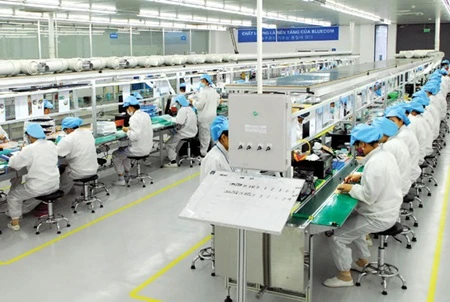
The Statistics office said that this was due to the slow economic growth model transition, with labour in the farming sector accounting for a large percentage with low productivity.

According to Nguyen Thi Huong, Director of GSO’s Agricultural Statistics, many labour-intensive industries such as the farming sector had low added value, resulting in low productivity.

The 12th National Party Congress’s documents also pointed out problems of the Vietnamese economy. There was heavy dependence on investments for growth, low-skilled labour, modest application of science and technology, and slow improvement in productivity.

Improving labour productivity and growth quality were the two most important issues for Vietnam with regard to macroeconomic stability, economic efficiency and sustainable development, experts said.

“Increasing labour productivity is the only way to reach a GDP per capita between 15,000 USD and 18,000 USD by 2035,” Vinh said.

The TFP of Vietnam must be increased to around 35 percent to enable the country to fulfil its goals by 2020.

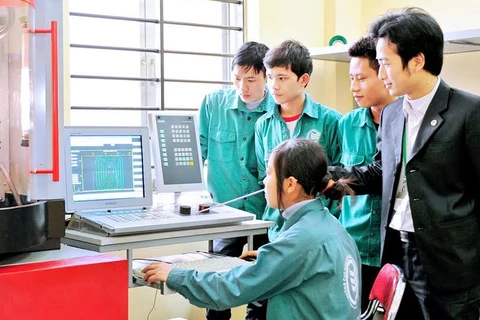
An economic expert said that one solution to enhancing labour productivity was shifting to sectors with high content of science and technology and high added value from sectors such as support, IT and processing.

Developing the private economic sector was also important to drive the development of a skilled labour market and improve management capacity, which would contribute to boosting productivity.

The report "Vietnam 2035: Toward Prosperity, Creativity, Equity and Democracy" last month in co-ordination of the Vietnamese government and the World Bank said that improving productivity was essential for the country to reach upper-middle income status by 2035.

Christine Largarde, Managing Director of the International Monetary Fund, at a meeting with students of the National Economics University last week urged Vietnam to boost labour productivity, adding that local SOEs and private companies currently have very low productivity, which is only about one-fifth of that of foreign-invested firms.-VNA
VNA

See more

Yen Huong Xua company introduces solutions to combat counterfeit and imitation goods (Photo: VNA)

Fight against counterfeit goods fostered amid rising digital-era fraud

Dr. Bui Van Quyen, Director of the Anti-Commercial Fraud and Counterfeiting Institute, warned that counterfeit goods have become a global challenge, exacerbated by the rise of online platforms and digital technologies. While these innovations drive economic growth, they also create fertile ground for fraudulent activities.

The fuel storage tank area of the Nghi Son Refinery and Petrochemical Plant is located in the Nghi Son Economic Zone in Nghi Son ward, Thanh Hoa province. (Photo: VNA)

Nghi Son refinery receives over 950,000 barrels of Congo crude oil

Diversifying crude oil supply sources is considered crucial for Nghi Son Refinery and Petrochemical LLC (NSRP) in ensuring stable feedstock supplies and safeguarding domestic fuel supply, particularly as traditional crude imports from Kuwait have been affected by tensions in the Middle East.

Production of electronic components at Star Engineers Vietnam Co., Ltd. in Binh Xuyen I Industrial Park, Phu Tho province (Photo: VNA)

Vietnam looks to expand fiscal space to support double-digit growth

Experts emphasise that fiscal policy should move beyond a supportive role to actively lead growth. Continued and selectively expanded tax and fee reductions could directly ease cost pressures on businesses, enabling them to sustain operations and expand investment.

Ngo Quang Hung, representative of the Vietnam Trade Office in Malaysia, introduces Vietnamese products at the Melaka International Halal Fair, held from May 16-19, 2026. (Photo: VNA)

Vietnam, Malaysia promote smart business connectivity

Malaysia is paying close attention to Vietnam’s Doi Moi (Renewal) reforms, particularly in land policies, rice production technologies and seafood industry development, as both sides seek to expand practical cooperation.

The exchange of greenhouse gas emission quotas and carbon credits is conducted on the domestic carbon credit exchange through the carbon trading system, which is interconnected with the national registration system. (Photo congly.vn)

Ministry establishes monitoring framework for carbon market

Under a new circular, the exchange of greenhouse gas emission quotas and carbon credits is conducted on the domestic carbon credit exchange through the carbon trading system, which is interconnected with the national registration system.

Le Son Phong, Deputy Director of the Da Nang Department of Science and Technology, speaks at the press conference announcing the Da Nang Venture and Angel Summit 2026. (Photo: VNA)

Da Nang to host international venture capital forum later this month

Le Son Phong, Deputy Director of the Da Nang Department of Science and Technology, said DAVAS 2026 is not merely an investment-matching event for startups, but also demonstrates the city’s commitment to promoting innovation, developing the knowledge-based economy and creating a favourable environment for technology enterprises and startups.

Visitors explore southern Vietnam's products (Photo: vNA)

Vietnam, Cambodia boost supply chain connectivity

Total two-way trade neared 10.1 billion USD in 2024, up 17.5% year-on-year and jumping to more than 11 billion USD in 2025. Vietnam’s key exports to Cambodia include apparel, iron and steel, petroleum, machinery and equipment, chemicals, and processed food. Its main imports are cashew nuts, rubber, farm produce, and industrial raw materials.

Cao Thanh Dinh, founder and CEO of ANPz Co., Ltd (All Nippon Partners) in Japan (Photo: VNA)

Resolution 68 boosts investor confidence in Vietnam’s long-term outlook

Cao Thanh Dinh, Founder and CEO of ANPz Co., Ltd (All Nippon Partners) in Japan, said that after one year of implementation, Resolution No. 68-NQ/TW of the Politburo on private sector development has sent a positive signal to investors by affirming the private sector as a key driver of sustainable and long-term development.

To promote the local lychee brand, expand consumption markets and enhance the fruit's value, Bac Ninh province is organising various trade promotion activities and experiential tourism programmes during the 2026 lychee season. (Photo: VNA)

Bac Ninh promotes lychee tourism with 36 model orchards

According to the Bac Ninh Centre for Culture and Tourism Promotion, the orchards must comply with VietGAP, GlobalGAP or organic production standards while offering suitable conditions for experiential tourism activities. They are also required to connect with nearby tourist attractions, craft villages and historical sites to form integrated tour routes.

Ha Long-Mong Cai Expressway (Illustrative photo: VNA)

Quang Ninh takes lead in public investment disbursement

As of May 13, the northern province had disbursed more than 5.64 trillion VND (213.9 million USD) in public investment capital, fulfilling 24.2% of its annual target and 54% of its disbursement target of 10.56 trillion VND for the year's first half.