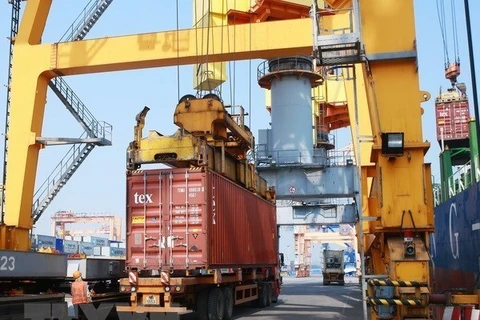
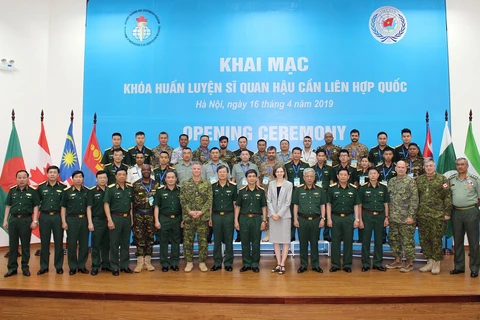
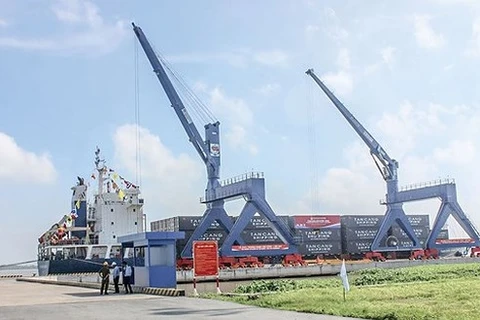
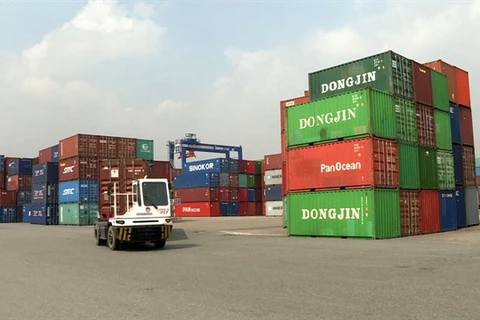
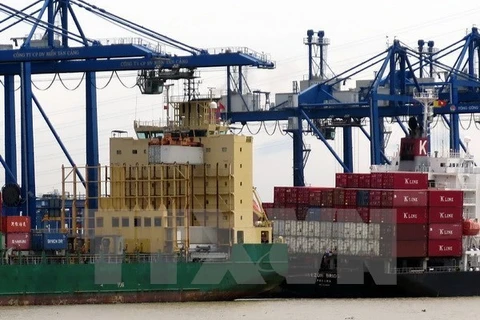
Logistics industry is moving to reskill the existing workforce. (Photo: VNA)
 HCM City (VNS/VNA) - With e-commerce and automation changing the landscape of the logistics sector dramatically, there will be a focus on re-skilling the existing workforce in technology, which will improve the competitiveness of the logistics industry.
The remark was made by Le Duy Hiep, Chairman of the Vietnam Logistics Business Association (VLA) at a recent forum in Ho Chi Minh City.
He said that vocational education and training (VET) colleges often faced challenges aligning graduate’s skills with industry needs, which leads to skills shortages in the job market.
As a result, graduates are placed in low-skilled positions with employers having to invest in re-training.
“Close cooperation between logistics enterprises and vocational schools has had remarkable results in improving the quality of logistics training,” Hiep said.
VLA members would continue to develop linkages between VET providers and logistics enterprises to meet labour demand, he said.
The forum on “Human Resource Development for the Logistics Industry and Future Trends in Vietnam”, held under Aus4Skills - an Australian Government-funded programme by the Vietnam Chamber of Commerce and Industry (VCCI) and VLA, discussed actions to be taken to close the skills gap and shortage of skilled workers in Vietnam.
The Logistics Industry Reference Council (LIRC), an industry-led model established by the Aus4Skills programme, is an example of a successful partnership between the logistics industry and VET providers to develop occupational and skills standards in the logistics sector.
“Australia has made a strong commitment to support improvements to Vietnam’s logistics industry, which in turn we hope will help advance Vietnam’s economic growth,” said Petrina Lawson, deputy consul general of the Australian Consulate General in HCM City.
Members of the LIRC are state administrative agencies, enterprises and business associations, training institutions, and VCCI.
The LIRC helps to ensure that the skills of graduates are relevant and meet employer’s needs, which results in improved productivity and efficiency in the logistics sector.
About 3,000 enterprises, mostly small and medium sized, are involved the logistics industry.
According to recent statistics of the Vietnamese Logistics Association (VLA), the logistics sector lacks about 180,000 skilled labourers.
Logistics enterprises should consider adding women and vulnerable people to their workforce to limit the labour shortage in the logistics industry, said Phan Thi Le Thu, Deputy Rector of Vien Dong College in district 12.
“Women and vulnerable people can perform well in many of these positions in logistics services,” she said.
Stanley Lim, Chairman of FIATA Congress Committee, said the rapid growth of e-commerce would create demand for additional jobs.
“Preparing graduates as newcomers to the industry is necessary, with a focus on learning practical skills and new technologies, and building a talent pool,” he said.
Nguyen Hong Hai, Chairman of LITA Co., Ltd in Phu Nhuan district, said most enterprises were often afraid that their trained employees would find better-paying jobs after they gained experience.
“Administration agencies should issue regulations on cooperation between enterprises and vocational school to clarify the responsibilities of relevant sides,” he said
During the forum, many representatives from businesses, VET colleges, the Vietnamese government and Australian experts discussed the importance of logistics enterprises’ role in setting skills standards and building skills for the sector’s future workforce.
Many experts agreed that training programmes at vocational schools should be updated regularly and be more diverse, focusing on on-the-job training.
Enterprises should also consider “putting employees first and customers second”, providing autonomy, power and encouragement to employees, instead of only offering high salaries and well-being programmes to retain employees.
English, soft skills and IT skills are among the requirements that workers need to learn.-VNS/VNA
VNA