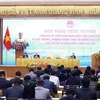
At the Vietnam Energy Forum (Photo: Vietnamplus)
Hanoi (VNA) - Vietnam is forecast to have to import about 56 million tonnes of coal by 2025 and 87 million tonnes by 2030. Other energy sources such as LPG (liquefied petroleum gas) will also be bought from other countries from 2023.
The maintenance of low energy price policy in the past time is the reason why investors use low technology and do not save energy, resulting in a high level of environmental pollution, while energy producers face many difficulties. Therefore, it is necessary to change the way of looking at the energy price issue.
The remarks were made by Dr. Tran Dinh Thien, former Director of the Vietnam Economic Institute at the Vietnam Energy Forum, themed "Energy saving for the Vietnamese industrial sector's sustainable development," organised by the Ministry of Industry and Trade on August 21 in Hanoi.
Many businesses do not save energy
A report by the Ministry of Industry and Trade (MoIT) shows that Vietnam is still one of the countries with high energy consumption in the region and in the world. In particular, the amount of energy used in industry accounts for 47.3 percent of the total consumed across the country.
At present, the primary energy sources are gradually exhausted and do not meet the energy needs of the economy. It is forecast that Vietnam will have to import about 56 million tonnes of coal by 2025 and 87 million tonnes by 2030. Other energy sources such as LPG will also be bought from foreign countries from 2023.
Meanwhile, many businesses using the state budget have not really paid attention to economical and efficient use of energy.
From this fact, Trinh Quoc Vu, Deputy Director of the MoIT’s Department of Energy Saving and Sustainable Development, said that the energy challenge is huge and energy saving is a very important solution to contribute to the sustainable development of the economy.
“According to the World Bank, the social cost to save an energy unit is equal to only one third to one fourth of the cost to produce one unit of energy for consumption,” Vu cited.
Hoang Quoc Vuong, Deputy Minister of Industry and Trade, said that Vietnam will need to have the combined capacity of power generation sources at about 60,000 MW to meet its electricity demand in 2020 and 130,000MW in 2030.
This is a huge challenge for the energy industry of Vietnam in ensuring the arrangement and mobilisation of huge investment capital to expand and upgrade the power transmission grid and distribution system, develop new electricity sources as well as supply enough primary energy sources for power plants, he said.
“As the National Assembly has approved the policy of suspending nuclear power projects, large- and medium-scale hydropower resources have almost been fully exploited, oil and gas reserves will soon decline, and renewable energy cannot immediately meet demand on a large scale due to high prices, promoting activities and measures for economical and efficient use of energy is a highly economical solution that needs to be prioritised in the immediate future,”said Vuong.
Structure of power supply 2018
 Source: VietnamPlus
Economical and effective use must be the top priority
Chairman of the Vietnam Automation Association Nguyen Quan, who is also former Minister of Science and Technology, said about 30 percent of the electricity output is currently used for lighting. If half of the amount of electricity consumed in this field at present is saved by using LED lights, it is equivalent to the energy generated by a 4,000MW nuclear power plant. New technologies will also help save about 10 percent of the electricity used by the 10 million air conditioners nationwide.
He noted that despite the Law on Energy Efficiency, the awareness of electricity saving remains low while there are few scientific research programmes on energy efficiency.
Therefore, in order to promote the economical and efficient use of energy in all social activities, it is necessary to raise the awareness of businesses and people as well as the interest and participation of scientists in the field, he stated./.