Majority of banks apply ESG practices in operations

Some 80-90% of banks have partially or fully applied ESG (Environment - Social - Governance) practices in their operations, the State Bank of Vietnam (SBV)’s official said.

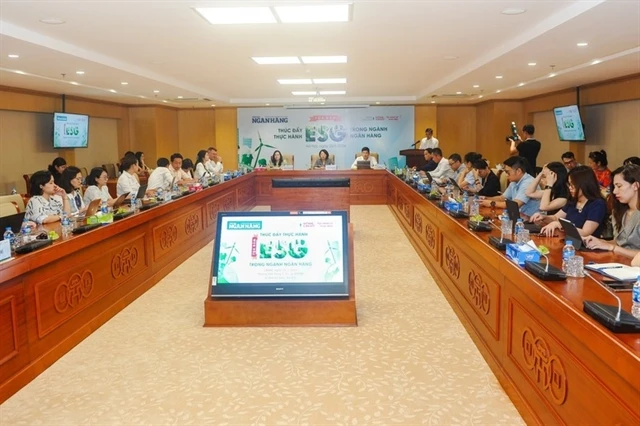
A view of the event. As of March 31 this year, 47 banks reported green outstanding loans of nearly 640 trillion VND, accounting for about 4.6% of the total outstanding loans. (Photo dangcongsan.vn)

Hanoi (VNS/VNA) - Some 80-90% of banks have partially or fully applied ESG (Environment - Social - Governance) practices in their operations, the State Bank of Vietnam (SBV)’s official said.

At a forum on promoting ESG practices in the Vietnamese banking industry, Pham Thi Thanh Tung, Deputy Director of the SBV’s Department of Credit for Economic Sectors, said nearly 50% of banks have established a risk management division for environment protection lending.

Some banks have also issued the Green Credit Framework and the Sustainable Loan Framework to provide procedures for using and managing loan capital for projects in green and emission-reducing sectors. Many banks have so far also published separate reports on sustainable development.

As of March 31 this year, 47 banks had green outstanding loans of nearly 640 trillion VND, accounting for about 4.6% of the total outstanding loans. 34 banks reported that they conducted environmental and social risk assessments with outstanding loans of about 2.9 quadrillion VND, accounting for nearly 21% of the total outstanding loans.

According to Tung, the results of the environmental risk assessment, according to the SBV’s Circular 17/2022/TT-NHNN, show that most credit institutions have integrated environmental risk management into the credit granting and risk management process, with 35 credit institutions having issued separate environmental risk management regulations.

Banks granted credit for 110,371 projects, which implemented environmental risk management, worth nearly 991.38 trillion VND.

Despite the achievements, Dr Pham Minh Tu, Deputy Director of the Banking Strategy Institute, said banks in Vietnam are still in the early stages of implementing ESG practices, so there are still many challenges for them to catch up.

There are currently no general national regulations on criteria and lists of green projects for sectors according to the economic sector classification system, which can be used as a basis for credit institutions to fully identify and count green credit resources. There is also a lack of specific regulations and instructions from specialised management agencies on ESG.

The capital demand for implementing the National Green Growth Strategy is very large, while capital sources to support businesses and investors from the financial market and the carbon credit market are not yet developed or implemented, causing long-term capital pressure on the banking system.

In addition, the management capacity and strategic vision on ESG of enterprises, especially SMEs, are major barriers, causing the process of transforming sustainable business models and practising ESG in Vietnam to be difficult and affecting the efficiency of credit granting and risk management activities of credit institutions.

Sharing their experiences of ESG, Jakub Kudrna, Chief Strategy Officer and Head of ESG Steering Group of finance company Home Credit Vietnam, said the important thing is that we cannot separately build the ESG implementation plan with the business strategy of the enterprise. Practising ESG must be an important part of the development strategy of the enterprise.

No individual or enterprise can implement sustainable development, but all industries and enterprises need to work together to create a more cohesive and sustainable environment, said Kudrna./.


VNA

See more

Vietnamese Ambassador to Brazil Bui Van Nghi speaks at the seminar. (Photo: VNA)

Vietnam, Brazil seek ways to promote trade, investment cooperation

Vietnamese Ambassador to Brazil Bui Van Nghi informed that two-way trade reached 4.22 billion USD in the first six months of 2026, up 16.8% year-on-year. Brazil's exports to Vietnam exceeded 2 billion USD, rising 16.6%, while its imports from Vietnam totalled about 2.11 billion USD, an increase of 17%.

Wave Alpha, Honda Vietnam’s best-selling manual motorcycle model each month. (Photo: Bnews/VNA)

Honda Vietnam posts strong car sales growth, leads motorcycle market

The company sold 172,299 motorcycles in June, up 4.7% from the same month last year, highlighting steady consumer demand even as the market gradually shifts towards greener transport options. For the first six months of 2026, motorcycle sales reached 515,743 units, up 0.6% year-on-year.

Rice harvest in Xuan Giang commune, Ninh Binh province. (Photo: VNA)

Plan issued to develop agricultural logistics system

A key target is that by 2030, all concentrated agricultural, forestry and fisheries production areas will have access to essential services, including product traceability, quarantine, testing, quality certification, processing and market development. The move reflects growing international demand for stricter food safety, quality and traceability standards, which have become increasingly important for agricultural exports.

Delegates at the signing ceremony (Photo: VNA)

Vietnam, RoK boost micro-business cooperation

Vietnam's young population, dynamic market, and big growth potential are a perfect fit for the strengths that Korean micro-businesses bring in K-brands, technology, and service expertise, said KFME President Song Chi Young.

Cars at a public parking lot in Hai Phong city. (Photo: VNA)

Vietnam's auto sales rise 15%, hybrid, imported vehicles continue to outperform

With auto loan interest rates remaining competitive, stable vehicle supply, and an increasingly diverse product range, Vietnam's automotive market is expected to maintain its growth momentum through the remainder of 2026. SUVs, MPVs, and hybrid vehicles are likely to remain the main drivers of overall market sales.

The MoU signing ceremony between Becamex VSIP Binh Dinh and PV Gas CNG in Gia Lai province on June 26, 2026 (Photo: nhandan.vn)

Gia Lai positions itself as magnet for sustainable investment

Vice Chairman of the provincial People's Committee Nguyen Huu Que said ESG is no longer a communications message or a cost burden, but an essential requirement for accessing global capital. Gia Lai has chosen ESG as a pillar for building new competitive advantages and achieving sustainable development.

Chairman of the Tay Ninh provincial People's Committee Le Van Han delivers remarks at the inauguration ceremony. (Photo: VNA)

Suntory PepsiCo inaugurates 300-million-USD plant in southern Tay Ninh province

Built on nearly 20 hectares at Huu Thanh Industrial Park, the facility is the company's largest and most advanced plant in Vietnam and the biggest production site in Suntory PepsiCo's Asian manufacturing network. The factory has a designed annual production capacity of over 1.24 billion litres and is equipped with highly automated production, filling and warehousing systems.