Malaysia shortens interval time for booster jab injection

The Health Ministry of Malaysia has shortened the interval period after the second dose for people receiving booster shots of the Pfizer and Astra Zeneca COVID-19 vaccines to three months from the previous duration of six months.
Malaysia shortens interval time for booster jab injection ảnh 1COVID-19 vaccination in in Kuala Lumpur, Malaysia (Source: Xinhua/VNA)
Kuala Lumpur (VNA) - The Health Ministry ofMalaysia has shortened the interval period after the second dose for people receivingbooster shots of the Pfizer and Astra Zeneca COVID-19 vaccines to three months fromthe previous duration of six months.

Health Minister Khairy Jamaluddin said at a press conferenceon December 28 that the recommendation applies to individuals aged18 years old and above.

According to the official, the latest data showed thatOmicron variant is highly transmissible with higher viral binding affinity andhigher antibody escape from the vaccine or from natural antibody.

The booster may increase the protection against Omicron; andinitial research that involving 21 million doses of boosters that were given inthe UK proved that it is safe, he added.

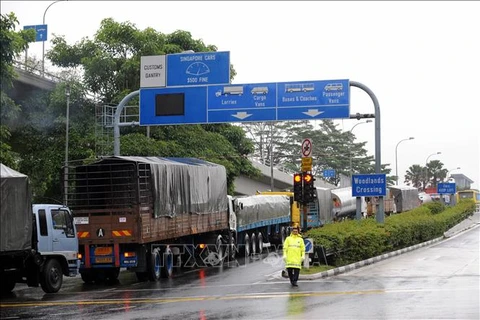
In the context of increasing number of infections of thevariant in Malaysia, local medical experts have called on the government tore-impose centralised isolation regulations on entries after reports showedthat many people did not adhere to home isolation.   

Statistics show that the nation has so far detected 62 casesof Omicron variant, mostly related to people returning home after travelingabroad./.

VNA

See more

Indonesian-branded cosmetic and personal care products are available at supermarkets and shopping malls (Photo: VNA)

Indonesia aims to master cosmetics industry value chain

Key drivers include its large population, expanding middle class, and rapidly rising demand for beauty products, especially among young consumers. The market has reached billions of US dollars and is projected to maintain strong growth in the medium term.

The Anthropic logo is seen in this illustration taken on Mar 1, 2026. (File photo: Reuters)

Singapore warns of cyber risks from Frontier AI models

According to CSA, advanced AI models – among the most cutting-edge systems today – can significantly shorten the time needed to identify system vulnerabilities and develop exploitation tools, reducing the process from months to just hours.

Helicopter carrying eight reported missing in Indonesia

Helicopter carrying eight reported missing in Indonesia

Indonesian authorities are urgently conducting a search and rescue operation after receiving reports that a helicopter carrying eight people suddenly lost contact on the morning of April 16 in West Kalimantan on the island of Borneo.

Malaysia’s job losses surge 47% in the first quarter of 2026 (Photo: AFP)

Malaysia's layoffs rise 47% in first quarter

The report, based on figures from Malaysia’s Social Security Organisation, showed layoffs peaked in January with around 10,700 cases before easing to 7,500 in February and 5,900 in March. Despite the slowdown toward the end of the quarter, the total remained significantly higher than the roughly 16,500 layoffs recorded in the same period of 2025.

People take part in the Songkran Festival in Bangkok, Thailand, on April 13, 2026. (Photo: Xinhua/VNA)

Thailand's tourism sector enjoys windfall during Songkran Festival 2026

TAT estimated that around 500,000 foreign tourists visited Thailand during the April 11–15 period, generating about 8.1 billion THB, a 2% year-on-year increase. Domestic travel is projected at 5.96 million trips, up 7%, contributing about 22.25 billion THB, an annual rise of 8%.

The sixth ASEAN Digital Ministers’ Meeting (ADGMIN) approves the Hanoi Declaration on digital cooperation, reaffirming the bloc’s goals and principles as outlined in the 1967 Bangkok Declaration and the ASEAN Charter. (Photo: ASEAN/Facebook)

ASEAN, Japan envision joint AI development

Amid intensifying US–China rivalry and deepening technological fragmentation, ASEAN and Japan have strong potential to collaborate in developing more inclusive and comprehensive artificial intelligence (AI) models, according to an article published on fulcrum.sg on April 14.