Maritime cargo shipping sees positive growth in first half of 2018

Cargo shipping has seen positive growth in the first six months of the year, with 254.8 million tonnes handled via the country’s seaports, up 17 percent on last year.
Maritime cargo shipping sees positive growth in first half of 2018 ảnh 1

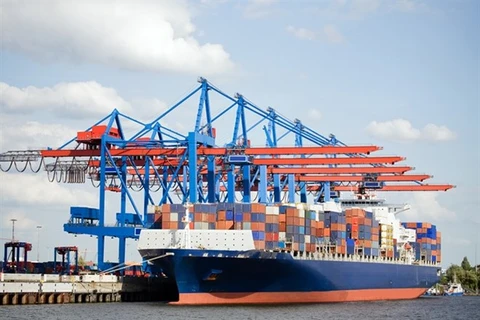
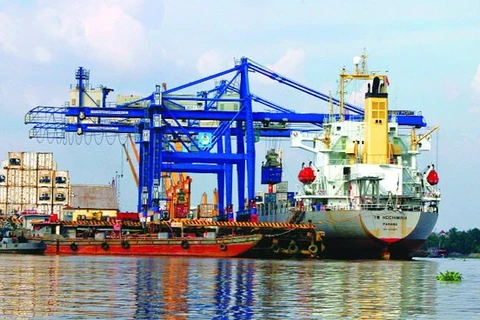
Cargo handled at the Hai Phong Port, one of the three biggest port complexes in Vietnam. (Photo: VNA)


Hanoi (VNA) - Cargo shipping has seenpositive growth in the first six months of the year, with 254.8 million tonneshandled via the country’s seaports, up 17 percent on last year.

The Vietnam Maritime Administration (under theMinistry of Transport) reported that 8.7 million TEUs (20-foot equivalentunits) of freight containers were processed, up 28 percent against the sameperiod last year, and fulfilling 57 percent of the target set for 2018.

During the period, Vietnamese container shipscarried about 69.9 million tonnes of cargo, representing a year-on-year rise of9 percent, according to the administration.

According to Nguyen Dinh Viet, deputy directorof the Vietnam Maritime Administration, despite the positive growth in thefirst half of the year, there remains inherent weaknesses that need to beaddressed.

“The Vietnamese sea fleet still doesn’t have anycontainer ships capable of long-distance journeys, such as to the UnitedStates, Europe and Africa. These journeys are usually undertaken by foreignfleets,” Viet told the Thoi bao Kinh te Vietnam (Vietnam EconomicTimes).

The Vietnamese fleet currently commands about 10percent of the market share and mostly handles short-distance transport such asChina, Japan, the Republic of Korea, or within the Southeast Asian region.

To push the development of maritime transport in asustainable direction, there needs to be a strong logistics system.

Currently, there are nearly 297,000 firms in thecountry registered to operate in the logistics sectors, with 0.43 percent ofthem, or around 1,300, are providers of maritime logistics services.

“There are a decent number of domestic logisticsfirms in Vietnam but their market share is fairly small, with most of them onlyproviding a certain service-related part in the logistics chain, or acting asagents for foreign maritime shipping companies,” Viet said.

Most ports are small-scale, operatinginefficiently, and lacking modern loading and unloading infrastructure.

Deputy Minister of Transport Nguyen Van Cong saidthat many import-export firms are still not fully aware of the importance oflogistics. They usually only understand logistics as purely transport, withoutknowing that it contains many different activities.

“In the last five or six years, the transportministry has implemented its logistics development project, aimed at promotingmultimodal transport, in which sea routes and inland waterways will be fullyutilised,” Cong said.

However, connectivity between modes of transporthas not seen considerable improvement. In rail freight transport, even with thekey route of the North-South railway, there is a lack of appropriate warehousesor equipment to provide services such as storage, loading and unloading,delivery, or short-distance transportation – especially tailored for cargocontainers.

“This shortage must be corrected before we couldhope for future logistics development,” the deputy minister stressed.

In the last half of the year, the transportministry has asked the customs department to facilitate legal documentrevisions, especially in terms of pricing schemes to prevent arbitrary pricehikes by foreign companies.

In the future, efforts and resources would also bespent on dredging operations to ensure uninterrupted traffic in seaports.

Vietnam has a total of 42 public navigation linesstretching 935.9km and 10 specialised navigation lines, with major maritimeshipping routes including Hon Gai – Cai Lan, Hai Phong in the north and Da Nangor Vung Tau – Thi Vai in the south.-VNA 
VNA
See more

Representatives of relevant parties witness the arrival of the shipment. (Photo: VNA)

First Czech pork shipment officially enters Vietnamese market

A Czech diplomat described the arrival of the first container as the successful outcome of a long and complex market-opening process involving years of negotiations, regulatory approvals and close cooperation between Czech and Vietnamese authorities.

A view of financial buildings in downtown Ho Chi Minh City along the Saigon River. (Photo: VNA)

HSBC: Vietnam’s growth, macroeconomic stability to face tougher test in H2

In a recently released report, Vu Binh Minh, CFA, Associate Director, FX Trading, Markets and Securities Services at HSBC Vietnam, said Vietnam’s economy has built a relatively favourable position in the first six months of the year with GDP expanding 8.18% – the highest first-half growth rate in recent years – as key growth drivers have operated in tandem.

Ha Tay Shoes has secured numerous export orders from the US and European markets. (Photo: VNA)

CPTPP strengthens free trade, expands global economic connectivity

Since taking effect, the CPTPP has significantly expanded Vietnam's access to major markets across North America, the EU, and the Asia-Pacific, contributing to strong export growth in key sectors such as textiles and garments, footwear, and agricultural, forestry and fishery products. The agreement has also encouraged greater investment into Vietnam by promoting regional production networks and clearer rules of origin.

Tan Mingming, Deputy Director of the Foreign Affairs Office of the Dezhou Municipal People’s Government. (Photo: VNA)

Chinese firms put Vietnam on expansion radar

Tan Mingming, Deputy Director of the Foreign Affairs Office of the Dezhou Municipal People’s Government, told Vietnam News Agency reporters that the city has spent years deliberately tightening its links with the Association of Southeast Asian Nations (ASEAN), with Vietnam seen as a key partner.

A perspective of the Viettel Military Industry and Telecoms Group's high-tech semiconductor chip manufacturing plant at Hoa Lac Hi-Tech Park. (Photo: Viettel)

Hanoi builds momentum as Vietnam's semiconductor hub

As Hanoi continues to strengthen its semiconductor ecosystem, the city is creating a new growth driver for both the capital and the country, enhancing Vietnam's technological capabilities and paving the way for deeper integration into the global semiconductor value chain.

Clams are processed for export at the factory of Thanh Hoa Seafood Import-Export JSC in Thanh Hoa province. (Photo: VNA)

Vietnam steps up export to achieve 550-billion-USD target

Against a backdrop of persistent uncertainty in global commerce, the Government is implementing a broad range of measures to strengthen export growth during the remainder of the year. These include expanding overseas markets through economic diplomacy, maximising the benefits of free trade agreements (FTAs), streamlining administrative procedures, reducing logistics costs, improving access to credit and helping businesses overcome trade barriers. Authorities are also encouraging deeper processing, official cross-border exports and greater market diversification to improve the competitiveness of Vietnamese products.

A hydroponic vegetable garden in Nguyet Hoa ward operated by Green Farm Co., Ltd. (Photo: VNA)

Incentive policies for high-tech agricultural zones

Under Decree No. 263/2026/ND-CP, qualified projects are given priority to participate in State support programmes as well as funds and policies on research and development, technological innovation, technology transfer, human resource training, investment promotion and trade promotion.

Wind turbines stand fully installed at a wind power project in Gia Lai province. (Photo: VNA)

Gia Lai approves 56-million-USD wind power project

The 42MW wind farm is expected to generate about 123,780.8 MWh of electricity each year. Power generated will be transmitted to the national grid via the 220kV Pleiku 2–Krong Buk transmission line.

Garments for export to the Japanese market are produced at Hung Viet Garment Company in Hung Yen province. (Photo: VNA)

Vietnam’s garment sector pivots towards value-added growth

Future growth can no longer rely on expanding production capacity alone. Meeting this year's 48 billion USD export target will require greater productivity, higher value addition, stronger domestic sourcing, broader market diversification, and faster digital and green transformation.

Trucks carrying goods wait for customs clearance at the Thanh Thuy International Border Gate in Tuyen Quang province. (Photo: VNA)

Border economy strengthens Tuyen Quang’s growth momentum

While the stronger performance provides momentum for the province's 2026 growth target of 10.17%, officials say the focus must now shift from increasing cargo volumes to expanding services, reducing costs and retaining more value locally.

Construction of several key components of Long Thanh International Airport is entering its final stages. (Photo: VNA)

Major works at Long Thanh International Airport gather pace towards completion

The ACV said on July 20 that contractors are deploying additional workers and equipment to speed up construction under Component Project 3, which covers the airport's essential aviation infrastructure. Major facilities, including the first and second runways, taxiways, aircraft aprons, the passenger terminal apron and the aircraft fuel supply system, are approaching completion.