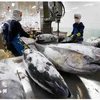
Rice for exports (Photo: VNA)
With an area of more than 36 million square meters and a combined population of nearly 1.5 billion, the Middle East-African region has become a promising market for Vietnamese businesses.
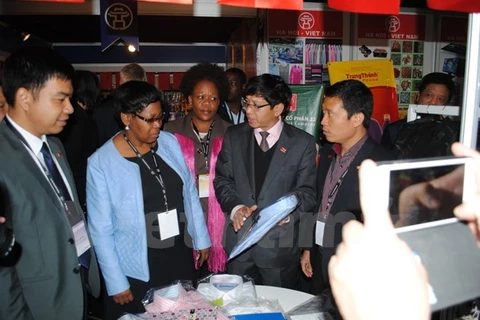
At a recent workshop on the prospects of economic co-operation between Vietnam and countries in the Middle East and Africa, Deputy Prime Minister Vu Van Ninh said Vietnam has founded sound traditional friendships and co-operative ties with countries across the region, laying a firm foundation to expand partnership in trade, economics and investment.
Secretary General of the UN Conference on Trade and Investment (UNCTAD) Mukhisa Kituyi affirmed that Vietnam was one of the few countries in the world to have long-standing friendly collaboration with the Middle East and Africa.
Many Vietnamese businesses, particularly the military-run telecom Viettel and the Vietnam Oil and Gas Group (PetroVietnam or PVN), have co-operated across the region.
In a new meeting with Deputy Prime Minister and Foreign Minister Pham Binh Minh, Mukhisa Kituyi said the UNCTAD was willing to support Vietnamese firms to enhance connectivity and investment with partners in the region, particularly in agriculture and food security.
Within the framework of the South-South Co-operation (SSC) in natural resources, techniques and knowledge between developing countries and the Triangular Co-operation (TC) between two developing nations and one partner, the UN Food and Agricultural Organisation (FAO) has worked to connect and expand co-operation among Vietnamese and Middle East-African enterprises.
Nguyen Song Ha, an assistant FAO representative, said Vietnam was one of the key suppliers of technical assistance for the SSC, adding that African countries highly valued skilled technicians from Vietnam.
Agricultural, seafood, and agro-aquatic processing businesses in particular are finding great opportunities to exchange their know-how with experts and investors in the Middle East and Africa, he noted.
Deputy Minister of Foreign Affairs Vu Hong Nam said the ministry is working with relevant ministries and sectors to speed up the signing of a legal framework agreement with Middle Eastern and African countries to facilitate the expansion of Vietnamese businesses there.
Additionally, the Foreign Ministry will host a number of workshops and forums for entrepreneurs to study law and business environment in the respective societies.
Nam said Vietnam is integrating extensively and inclusively into the global community with the signing of many new-generation free trade agreements (FTAs) with the EU, the Eurasia Economic Union (EAEU), and the Republic of Korea.
The co-operation prospects for Vietnamese and Middle East-African business players would be expanded further, he said, adding that Vietnam needs a big consumption market like the Middle East and Africa.
On the other hand, the Middle East and Africa need Vietnam to embrace links with other markets, specifically ASEAN, he said.
The diplomat suggested that local firms diversify their products and take advantage of business opportunities.
Mukhisa Kituyi said Vietnamese firms, especially small-and medium-sized enterprises (SMEs), should sharpen their competitive edge to secure a firm foothold and expand operations in the market.
Two-way trade between Vietnam and the Middle East-Africa has increased from 2 billion USD in 2005 to 15.7 billion USD in 2014. This, however, remains modest compared to both sides’ strengths and potential.
Vietnam has established diplomatic ties with all countries in the Middle East and 52 out of the 55 nations in Africa.-VNA