Minister urges fisheries development to base on three pillars

It is necessary to develop the fisheries sector based on three pillars of chain exploitation, processing aligned with the market and using science and technology to develop aquaculture, said Minister of Agriculture and Rural Development Nguyen Xuan Cuong.
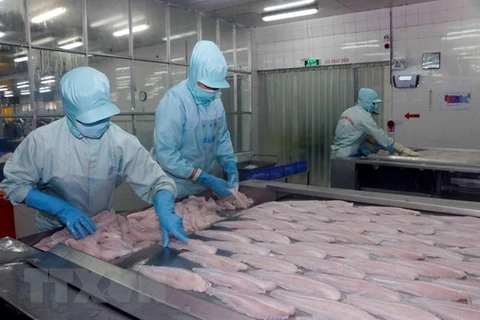
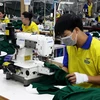
Minister urges fisheries development to base on three pillars ảnh 1Processing shrimp for export at the Minh Phu Seafood Corp (Photo: VNA)

Hanoi (VNA) – It is necessary to develop thefisheries sector based on three pillars of chain exploitation, processingaligned with the market and using science and technology to developaquaculture, said Minister of Agriculture and Rural Development Nguyen XuanCuong.

He said seafood exploitation, preservation,processing and consumption should be based on demand of domestic and foreignmarkets, adding that fishing activities need to be re-organised.

Businesses should enhance processing to add valueto their products. Meanwhile, the latest scientific and technological advancesneed to be utilised to develop aquaculture.

Pointing out problems in the fisheries sector,the minister said fishing activities have only developed in quantity instead ofquality. While fishing vehicles and equipment are limited, seafoodclassification and preservation haven’t been done well.

The fisheries sector faces an array ofchallenges posed by climate change, international integration and the sector’srestructuring, Cuong added.

Data of the ministry’s Directorate of Fisheriesshow that aquatic exports reached 1.7 billion USD from January to March, up11.5 percent from the same period of 2017.

[Measures sought for fisheries sector’s sustainable development]

The US, Japan, China and the Republic of Koreawere the top importers of Vietnamese aquatic products in the first two monthsof 2018, accounting for 50.5 percent of Vietnam’s total aquatic exports.Notably, strong growth was recorded in shipments to the Netherlands (49.7 percent),Thailand (35.5 percent) and China (34.9 percent).

However, the fisheries sector encountered amajor challenge in March when the US decided to levy high anti-dumping dutieson shrimp and tra fish, two key export items of Vietnam. The directorate saidthis is a groundless decision and will cause difficulties for businesses sincethe US is a leading tra fish importer of Vietnam. Agencies are working to solvethis problem.

Regarding the European Commission (EC)’s “yellowcard” warning issued last September for Vietnam’s failure to progress infighting IUU fishing, Minister Cuong said the country has been taking actionsas suggested in the nine recommendations of the EC. It is striving to build afisheries sector of sustainable development that is responsible and adheres tointernational regulations.

Deputy Minister of Agriculture and RuralDevelopment Ha Cong Tuan said the EC agreed to send a delegation to assess thesituation in Vietnam in late April or early May so as to consider whether ornot the yellow card should be withdrawn.

Vietnam is satisfied with the strides it hasmade during the implementation of the EC’s recommendations recently. These arenot temporary solutions, and the country will keep working to develop a sustainablefisheries sector, he added.-VNA
VNA
See more

Pham Van Cong, Chairman of the Vietnam Cashew Association, speaks in a conference reviewing the industry’s 2025 performance and deploying procurement plans for 2026 in HCM City on March 13. (Photo: VNA)

Cashew sector braces for challenges in 2026 amid global uncertainties

Vietnam’s cashew industry recorded export turnover of about 5.5 billion USD in 2025, the highest level ever. He noted that the result reflects the industry’s remarkable development, dynamism and timely adaptation to complex and unpredictable challenges both domestically and globally.

An Phát Complex Industrial Park in Hai Phong City is one of the eco-friendly industrial parks. (Photo: VNA)

Green industrial parks become new magnet for FDI

Statistics show that about 80% of FDI enterprises prioritise investing in industrial parks with green energy infrastructure, reflecting a growing shift in investment preferences amid tightening global environmental standards.

Wood panel production at the Thuan An Wood JSC in Ho Chi Minh City (Photo: VNA)

Vietnamese businesses ride wave of investment in green manufacturing

Recent developments in private investment show that as confidence in the private sector has grown and is a key driver of economic development, investors are strengthening support for enterprises not only through capital but also management expertise and market connectivity.

Officers and soldiers of Son Tra Border Guard Station, Da Nang City Border Guard Command tell local fishermen about IUU fishing. (Photo: VNA)

Fishing solidarity groups help Vietnam with IUU “yellow card” warning removal

Over the years, coastal authorities in Da Nang have intensified efforts to educate fishermen about regulations, particularly the need to avoid illegal fishing in foreign waters. Local administrations and competent forces have also strengthened vessel registration and inspection procedures, installed vessel monitoring systems and ensured transparent declarations of catches at ports.

Representatives of Central Retail Vietnam and Lotte Plaza Market sign a distribution cooperation agreement at the networking event in Ho Chi Minh City on March 13. (Photo: VNA)

Vietnamese firms step up cooperation with international distribution chains

Connecting Vietnamese businesses with international distribution networks has been a key component of government-led trade promotion programmes for many years, which are designed to help domestic companies place goods directly into global retail systems rather than exporting solely through intermediaries.

Direct Hanoi–Amsterdam flights by Vietnam Airlines to begin on June 16. (Photo: Vietnam Airlines)

Vietnam Airlines to launch direct Hanoi–Amsterdam service on June 16

Under the plan, the Hanoi–Amsterdam route will commence operations on June 16, 2026, with an expected frequency of three return flights per week using modern wide-body Airbus A350 aircraft. This will be the first direct air link between Vietnam and the Netherlands, helping to shorten travel time and enhance connectivity between Vietnam and one of Europe’s key economic, logistics and aviation transit hubs.

Farmers harvest the 2025 Winter–Spring rice crop in An Giang province. (Photo: VNA)

An Giang accelerates export shift to meet green consumption trends

To enhance competitiveness, authorities are assisting businesses in obtaining globally recognised certifications such as GlobalG.A.P., Organic and HACCP, enabling key exports including rice, seafood and clean agricultural products to strengthen their position in global markets, according to Quang Xuan Lua, Director of the An Giang Centre for Trade and Investment Promotion.

Motorcycle riders refill their vehicles at a petrol station in Hanoi (Photo: VNA)

E5 RON92 biofuel price falls in latest adjustment

Since the beginning of this year, domestic fuel prices have undergone 14 adjustments, including five decreases and nine increases for RON95 and six declines and eight hikes for E5 RON92. Meanwhile, diesel price has fallen three times and risen 11 times.

A French customer is tasting Vietnamese lychee. (Photo: VNA)

Vietnamese agricultural products boost global brand recognition

Vietnam aims to achieve about 74 billion USD in agro-forestry-fishery export turnover this year. Expanding value-added products, improving quality standards and strengthening brand building, especially through international supermarket systems, will be key to enhancing the competitiveness and global recognition of Vietnamese agricultural products.

An apartment building developed by BCONS in Binh Duong (Photo: VNA)

Resolution 68 boosts businesses entering market

By the end of 2025, Vietnam had more than one million active enterprises. In the first two months of 2026, about 64,500 enterprises entered or re-entered the market, up 29.4% year-on-year, averaging 32,200 newly established or returning businesses per month.