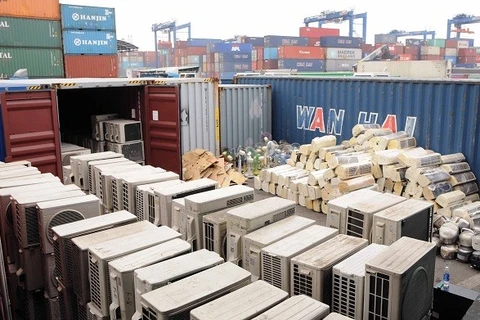
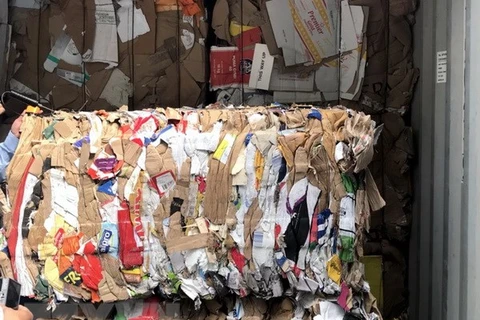
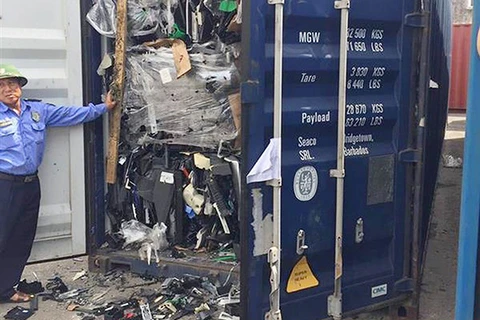
A container of scrap at Hai Phong Port (Photo: baogiaothong.vn)
 Hanoi (VNS/VNA) - As many as 158 individuals and organisations have been found illegally importing scrap into Vietnam as they are not certified to carry out such activities.
According to the Vietnam Environment Administration under the Ministry of Natural Resources and Environment (MoNRE), the individuals and organisations imported 4,514 containers of scrap, of which, 2,209 containers have been at Vietnam’s sea ports for less than 90 days and the other 2,305 containers have been at ports for over 90 days.
From September 6 to September 12, the Vietnam Environment Administration sent seven groups of inspectors to seven ports – Ba Ria-Vung Tau, Binh Duong, Binh Dinh, Can Tho, Da Nang, Hai Phong and Ho Chi Minh City to examine scrap import activities.
The inspectors found 15,442 containers of scrap stored at the seven ports.
Of 274 organisations and individuals who claimed to be scrap importers, only 116 have certificates that prove they are qualified to import scrap while the other 158 individuals and organisations were unable to provide such certificates.
The Vietnam Environment Administration asked the General Department of Vietnam Customs and customs offices to identify violating importers.
Moreover, the illegally-imported scrap would be re-exported. If the scrap is not re-exported, it would be handled or destroyed in accordance with regulations on waste treatment.
Recently, Prime Minister Nguyen Xuan Phuc signed a directive calling for urgent measures to improve the management of imports of waste as production material.
The PM directed the Ministry of Natural Resources and Environment to not issue new scrap import certifications or to extend the validation of existing certificates.
The ministry only considers granting the permit, which certifies firms’ fulfillment of environment protection conditions for the imports, when the direct importer can prove a demand for and ability to use the scrap in goods production.
The Ministry of Finance was tasked with directing customs agencies to hasten clearance for scrap containers of firms or individuals with valid certifications in terms of date and import quota.
The Ministry of Industry and Trade is in charge of strengthening the inspection and monitoring of the scrap imports, trade and usage.
After China banned the import of 24 types of scrap, the amount imported to Vietnam in 2017 and the first five months of 2018 has increased. Local firms have imported scrap from many different countries for production, with some forging import permits.-VNS/VNA
According to the Vietnam Environment Administration under the Ministry of Natural Resources and Environment (MoNRE), the individuals and organisations imported 4,514 containers of scrap, of which, 2,209 containers have been at Vietnam’s sea ports for less than 90 days and the other 2,305 containers have been at ports for over 90 days.
From September 6 to September 12, the Vietnam Environment Administration sent seven groups of inspectors to seven ports – Ba Ria-Vung Tau, Binh Duong, Binh Dinh, Can Tho, Da Nang, Hai Phong and Ho Chi Minh City to examine scrap import activities.
The inspectors found 15,442 containers of scrap stored at the seven ports.
Of 274 organisations and individuals who claimed to be scrap importers, only 116 have certificates that prove they are qualified to import scrap while the other 158 individuals and organisations were unable to provide such certificates.
The Vietnam Environment Administration asked the General Department of Vietnam Customs and customs offices to identify violating importers.
Moreover, the illegally-imported scrap would be re-exported. If the scrap is not re-exported, it would be handled or destroyed in accordance with regulations on waste treatment.
Recently, Prime Minister Nguyen Xuan Phuc signed a directive calling for urgent measures to improve the management of imports of waste as production material.
The PM directed the Ministry of Natural Resources and Environment to not issue new scrap import certifications or to extend the validation of existing certificates.
The ministry only considers granting the permit, which certifies firms’ fulfillment of environment protection conditions for the imports, when the direct importer can prove a demand for and ability to use the scrap in goods production.
The Ministry of Finance was tasked with directing customs agencies to hasten clearance for scrap containers of firms or individuals with valid certifications in terms of date and import quota.
The Ministry of Industry and Trade is in charge of strengthening the inspection and monitoring of the scrap imports, trade and usage.
After China banned the import of 24 types of scrap, the amount imported to Vietnam in 2017 and the first five months of 2018 has increased. Local firms have imported scrap from many different countries for production, with some forging import permits.-VNS/VNA
VNA