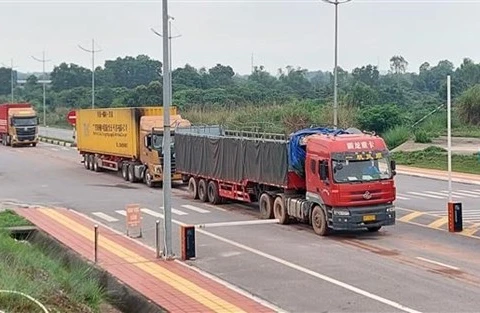
A vehicle loaded with Vietnamese goods goes through Ma Thu Lang Border Gate to enter China.(Photo: VNA)
 Hanoi (VNS/VNA) - The Ministry of Industry and Trade (MoIT) is seeking public comments on a legal draft amending Decree No. 14 on cross-border commercial activities.
The draft aims to plug some loopholes that have been exploited by traders to disguise their commercial activities as cross-border individual transactions (CITs).
It is also part of the government's efforts to promote the movement of goods via official channels, putting an end to trade bottlenecks at border gates.
The draft stipulates that traders who engage in commercial activities at auxiliary border gates or border crossing points must do so at the gates or points approved by provincial authorities.
The traders and their companies are also required to carry a valid passport or equivalent papers while doing the trade. Vehicle drivers, in addition to the papers, are required to have a valid driving licence as well.
Article 24 puts the Ministry of Finance (MoF), with the assistance of provincial authorities, in charge of issuing guidelines on the collection of taxes applied to imports and exports. MoF and the Ministry of National Defence assume the role of inspecting vehicles involved in cross-border commercial transportation.
MoF is also tasked with establishing a database of traders and sending the data to MoIT every 10 months. Provincial authorities, meanwhile, are required to provide data for MoIT on request.
Under the draft, the number of times and the amount of tax exemption applied to CITs would be cut down on January 1, 2025. Goods in CITs are required to strictly comply with the quality standards and origin-tracking rules imposed by the importing countries as of the date.
The draft also establishes new norms for CITs, under which border residents are required to show up at border gates for exit procedures if they engage in CITs.
From January 1, 2026, traders who export goods via official channels must report their exit of the country at either border gates or border crossing points approved by bilateral trade agreements.
"Trade at not-yet-approved border gates or border crossing points will be suspended from January 1, 2027," said the draft.
The draft also stipulates that from January 1, 2028, only the types of goods that have cleared through customs at approved border gates are eligible for customs clearance at other border gates and border crossing points.
MoIT said cross-border trade had been flourishing in recent years on the grounds of Decree No.14, significantly improving the livelihood of border residents, especially those from ethnic minorities.
However, the decree has begun to show some loopholes after five years of being in place, exposing the need for a revision to fix the cracks, and here comes the draft, which is expected to end commercial congestion at border gates and encourage a shift from unofficial to official channels./.
The draft aims to plug some loopholes that have been exploited by traders to disguise their commercial activities as cross-border individual transactions (CITs).
It is also part of the government's efforts to promote the movement of goods via official channels, putting an end to trade bottlenecks at border gates.
The draft stipulates that traders who engage in commercial activities at auxiliary border gates or border crossing points must do so at the gates or points approved by provincial authorities.
The traders and their companies are also required to carry a valid passport or equivalent papers while doing the trade. Vehicle drivers, in addition to the papers, are required to have a valid driving licence as well.
Article 24 puts the Ministry of Finance (MoF), with the assistance of provincial authorities, in charge of issuing guidelines on the collection of taxes applied to imports and exports. MoF and the Ministry of National Defence assume the role of inspecting vehicles involved in cross-border commercial transportation.
MoF is also tasked with establishing a database of traders and sending the data to MoIT every 10 months. Provincial authorities, meanwhile, are required to provide data for MoIT on request.
Under the draft, the number of times and the amount of tax exemption applied to CITs would be cut down on January 1, 2025. Goods in CITs are required to strictly comply with the quality standards and origin-tracking rules imposed by the importing countries as of the date.
The draft also establishes new norms for CITs, under which border residents are required to show up at border gates for exit procedures if they engage in CITs.
From January 1, 2026, traders who export goods via official channels must report their exit of the country at either border gates or border crossing points approved by bilateral trade agreements.
"Trade at not-yet-approved border gates or border crossing points will be suspended from January 1, 2027," said the draft.
The draft also stipulates that from January 1, 2028, only the types of goods that have cleared through customs at approved border gates are eligible for customs clearance at other border gates and border crossing points.
MoIT said cross-border trade had been flourishing in recent years on the grounds of Decree No.14, significantly improving the livelihood of border residents, especially those from ethnic minorities.
However, the decree has begun to show some loopholes after five years of being in place, exposing the need for a revision to fix the cracks, and here comes the draft, which is expected to end commercial congestion at border gates and encourage a shift from unofficial to official channels./.
VNA