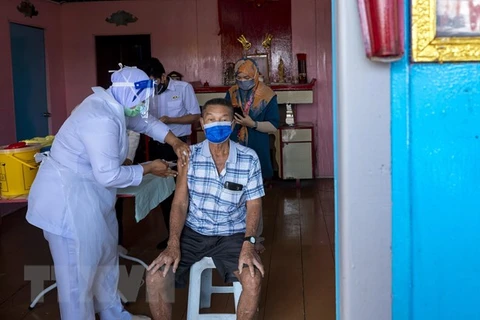
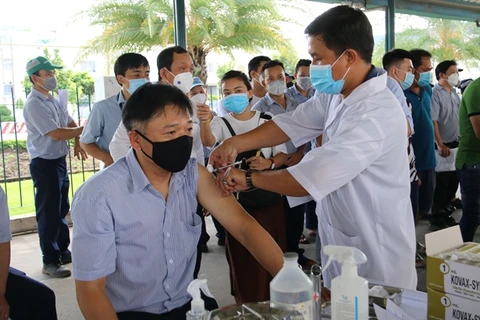
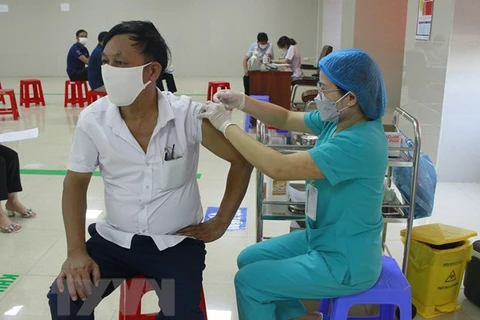
COVID-19 vaccination (Photo: VNA)
 Hanoi (VNA) – The Ministry of Health has proposed considering COVID-19 a Group A infectious disease, not an endemic disease in its latest draft on COVID-19 prevention and control measures in the new situation.
As per the draft, Vietnam is still in the transition period between pandemic prevention and sustainable management.
Regarding the reason why COVID-19 is not yet considered an endemic disease, the Ministry of Health said that most countries in the world have unstable case numbers and deaths. Case numbers are volatile as new variants of the SARS-CoV-2 appear. At the same time, acquired immunity (due to vaccines and infection) is unstable and decreases over time.
As a result, the application of epidemic prevention and control measures should be flexible and gradually move towards the "new normal".
There are two scenarios for COVID-19 in the future that the ministry is preparing for, both with a focus on vaccination as a key way to keep the infectious disease under control.
In the first scenario, the coronavirus continues to mutate but thanks to herd immunity, severe cases and deaths trend down and outbreaks are not serious. Or, the dominant strain of the virus does not cause serious illnesses.
In this scenario, the health ministry will focus on reviewing the need for a fourth dose of COVID-19 vaccine in the adult population and a third dose in children aged 5-18 years, as well as quickly rolling out vaccination among children 3-5 years old within 2022.
Health authorities will also step up the surveillance and genetic sequencing of COVID-19 cases to discover the emergence of variants of concern (VOC). This aims to assess their ability to cause severe disease and transmissibility, and the effectiveness of intervention measures. SARS-CoV-2 testing on animals – including domestic pets and wild animals – will also need to be expanded, the health ministry noted.
The outbreak level assessment will also need to be adjusted depending on the situation to facilitate socio-economic development efforts.
The second scenario is that a new strain/variant of the coronavirus emerges, capable of evading vaccines’ protectiveness or humans’ immunity, leading to an increase in severe cases and deaths, especially among clinically vulnerable populations.
The health ministry will closely coordinate with the World Health Organisation (WHO) and vaccine manufacturers around the world to get updates on new vaccines that can deal with variants of SARS-CoV-2 and report to the Government on the procurement plans.
Administration of COVID-19 vaccines will continue to ensure the fastest progress possible. This is the case with booster doses for high-risk groups (people over 65 years old, people with chronic diseases), and those who have received the last dose three months or more ago.
At the same time, authorities will closely monitor the pandemic situation around the world and in the country. They will also strengthen surveillance of the ‘arrival’ of new variants of the coronavirus via border gates and border areas. Authorities will continue monitoring for early detection of cases in the community, focusing attention on supervising hospitalised COVID-19 cases, cases requiring intensive care, and deaths.
There is also a need to improve the capacity of the health system, especially preventive medicine and grassroots health care, and put in place appropriate remuneration policies for health care workers – especially at local levels.
More medical examination and treatment activities will be available virtually according to regulations to increase the rate of access to medical services among people with COVID-19 and those who cannot access medical examination and treatment facilities due to COVID-19.
In this scenario, the principles of ‘prevention – detection – quarantine/isolation – zoning – outbreak elimination’ will be carried out at the smallest scale possible depending on the outbreak situation. The COVID-19 formula “5K + vaccines, medications + treatment + technology + public awareness + other measures” will be flexibly applied. The 5K stands for the five public health measures used to combat COVID-19 in Viet Nam for the last two years: Khau trang (face mask) – Khu khuan (disinfection) – Khoang cach (distance) – Khong tụ tap (no gathering) – Khai bao y te (health declaration).
The health ministry said that after two years, many variants of coronavirus had appeared, but currently, the new infections, hospitalisations, and deaths are dropping consistently, while vaccination coverage goes up./.