NA looks at policies for ethnics, power plants’ environmental impacts

The National Assembly heard explanations presented by two ministers on policies for ethnic minorities and mountainous regions, and the environmental impacts of power plants, among other issues.
NA looks at policies for ethnics, power plants’ environmental impacts ảnh 1NMinister of Industry and Trade Tran Tuan Anh is among ministers giving explanations on November 3 (Photo: VNA)

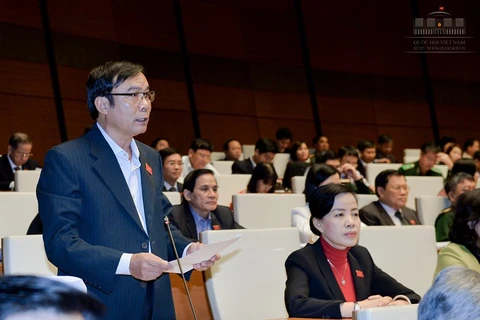
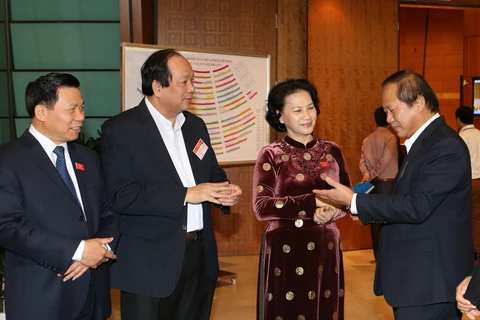
Hanoi (VNA) - The National Assembly heard explanations presented by two ministers on policies for ethnic minorities and mountainous regions, and the environmental impacts of power plants, among other issues, at the November 3 morning session.

Minister-Chairman of the Committee for Ethnic Affairs Do Van Chien reported that among important policies for ethnic minorities and mountainous regions during 2016-2020, the Prime Minister has instructed raising capital allocation for extremely disadvantaged areas by two to four times compared to other areas. Under the national target programme on sustainable poverty reduction, ethnic minority-inhabited areas benefit from two projects – the 18-trillion VND investment programme on socio-economic developments in poor districts (Programme 30a) and the 16-trillion VND Programme 135 for rural areas, with three components for ethnic areas as against two components for other rural areas.

In addition to overall policies, the Prime Minister issued other policies designed specifically for ethnic and mountainous areas, including the specific scheme on supporting socio-economic development in ethnic minority and mountainous areas for 2017-2020; a project on supporting socio-economic development of ethnic groups with very small populations for 2016-2025; and a plan of forest development in combination with sustainable poverty reduction in the target areas.

Moreover, there is also Decree 52 on human resource development for ethic minority groups, and a freshly-approved plan on measures to reduce child marriage and marriage amongst blood relatives.

Minister Do Van Chien added that the Committee for Ethnic Affairs has submitted three more plans to the Government for approval.

According to the Minister, the Government has adjusted its forms of support for ethnic and mountainous areas, changing its focus from families to communities and paying more attention to creating livelihoods, with a view to reduce reliance on aid. The provision of grants is replaced by provison of loans at preferential interest rates.

He also noted the need to give provincial and district authorities more management power and promote the community’s participation and monitoring role in development projects.

There are 5,359 communes in 457 districts of 52 centrally-run cities and provinces classified as ethnic minority and mountainous areas, with a population of 13.4 million, of which more than 8 million people are of ethnic minority groups.

The issue of environmental impacts from hydro and thermal electric power plants, Minister of Industry and Trade Tran Tuan Anh said this is a priority of the industrial sector, as those two sources of power will continue to play a key role in power supply until 2025.

He stressed that the ministry and related agencies have paid attention to this issue, requiring power projects to use advanced technology. However, the problem is the main contractor and sub-contractors failed to obey, or were incapable of obeying relevant rules on environmental protection. The minister admitted that this is a lesson for state management agencies and investors.

Regarding the impacts of hydro power projects on local communities, Minister Tran Tuan Anh affirmed that the ministry attaches great importance to the interest of relocated communities and social development in affected areas, adding that the ministry has submitted a detailed report on this issue.

The National Assembly continued to discuss issues related to the implementation of the socio-economic development plan for 2016 and the plan for 2017 in the afternoon of November 3.-VNA
VNA

See more

General Secretary of the Communist Party of Vietnam Central Committee and State President To Lam speaks at the working session in Hanoi on May 13, 2026. (Photo: VNA)

Party, State leader calls for consolidation of central steering committees on legal, judicial reform

Consolidating the central steering committees for institutional and legal reform and for judicial reform is necessary in order to streamline organisational structures without reducing responsibilities, while ensuring clear accountability, measurable outputs and concrete results. Following the restructuring, the body will be renamed the central steering committee for institutional improvement and law enforcement, with the Party General Secretary and State President serving as its head.

Civil servants provides administrative services for citizens in Son Hai commune of Bac Ninh province. (Photo: VNA)

Reform drive expected to remove barriers, unlock growth momentum

Prime Minister Le Minh Hung recently ordered ministries and agencies to immediately cut at least 30% of administrative procedures, 50% of processing time, 50% of compliance costs and 30% of business conditions, while eliminating all unnecessary procedures.

Ambassador Do Hung Viet, Permanent Representative of Vietnam to the United Nations (UN), meets with Annalena Baerbock, President of the 80th session of the UN General Assembly (UNGA). (Photo: VNA)

Vietnam strives for substantive outcome at NPT review conference

At the meeting this week, Ambassador Viet briefed the UNGA President on developments during the first two weeks of the conference. He stressed that the current international geopolitical landscape poses numerous complex challenges, while reaffirming Vietnam’s determination, together with other member states, to promote substantive and balanced outcomes at the conference.

General Secretary of the Communist Party of Vietnam Central Committee and President of Vietnam To Lam (R) receives Athsaphangthong Siphandone, member of the Lao People’s Revolutionary Party Central Committee, Secretary of the Vientiane Party Committee and Chairman of the municipal People’s Council, in Hanoi on May 12, 2026. (Photo: VNA)

Top leader of Vietnam receives Vientiane official in Hanoi

The host leader stressed that cooperation between localities, particularly between the capitals of Hanoi and Vientiane, plays an especially important role as a pioneering force in effectively implementing the foreign polices of the two Parties and States, while also serving as a bridge between politics and development, as well as between strategy and concrete action.

Prime Minister Le Minh Hung receives Chinese Ambassador to Vietnam He Wei in Hanoi on May 12. Photo: VNA

Prime Minister receives Chinese Ambassador

The Party and State of Vietnam always value the assistance China has provided to Vietnam during its past struggle for national independence as well as in national development today. Vietnam consistently regards the development of relations with China as a steadfast policy, an objective requirement, a strategic choice, and a top priority in its foreign policy of independence, self-reliance, multilateralisation and diversification.

Secretary of the Hanoi Party Committee Tran Duc Thang and Secretary of the Vientiane Party Committee Atsaphangthong Siphandone witness the signing of a memorandum of understanding on cooperation between the Women’s Unions of Hanoi and Vientiane for 2026–2030, as well as a memorandum on enhanced cooperation between the Ho Chi Minh Communist Youth Union of Hanoi and the Lao People’s Revolutionary Youth Union of Vientiane for the same period. (Photo: VNA)

Hanoi, Vientiane promote comprehensive cooperation in new phase

The capitals of Vietnam and Laos signed memoranda of understanding on joint work in the fields of public communication and mass mobilisation, women and youth affairs, foreign relations, industry and trade, education and health care. These are expected to provide an important basis for implementing their cooperation priorities for 2026–2030.

An overview of the seminar held in Hanoi on May 12 (Photo: VNA)

Two-tier local administration improves public service delivery: Seminar

The two-tier local government model has operated relatively stable despite heavy workloads and high reform demands. Many localities have quickly adapted, while people have shown support for streamlined administration and expectations for a more modern, efficient and accountable public sector.