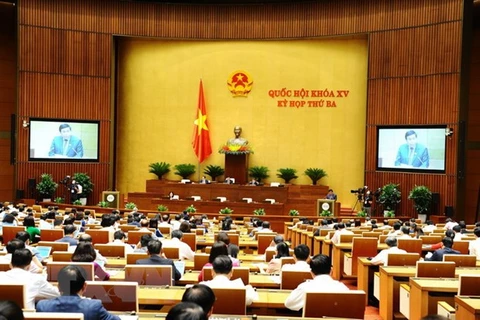
An overview of the NA session (Photo: VNA)
 Hanoi, (VNA) – Chairman of the NA Economic Committee Vu Hong Thanh on May 30 delivered a report to the NA's third session, detailing NA supervision over the implementation of policies and laws related to planning activities since the Planning Law took effect.
 Chairman of the NA Economic Committee Vu Hong Thanh (Photo: VNA) Thanh said that since the NA supervision group was form on July 27, 2021, it has worked with 11 ministries and 14 provinces and centrally-run cities in both in-person and online forms.
Since the Planning Law was adopted in 2007, the NA has approved seven related laws and the NA Standing Committee has issued one ordinance. Meanwhile, the Government has issued 43 decrees, while ministries and branches released 96 guiding circulars.
In addition, in order to ensure the smooth implementation of the Planning Law, the NA, NA Standing Committee, the Government and the Prime Minister have issued many documents related to planning work. The Prime Minister also held three national online conferences on planning, he noted.
Thanh underlined that the planning progress for the 2021-2030 period is lagging far behind from the NA’s request and reality. Among 111 planning schemes to be made in line with the law, 104 have yet to be completed and approved, affecting the implementation of the socio-economic plans for the 2021-2025 and 2021-2040 period. Due to the slow progress, the validity of existing planning schemes for the 2011-2020 period has been extended, leading to the parallel existence of two types of planning and causing difficulties during the implementation.
The Chairman of the NA Economic Committee held that there are many subjective and objective reasons behind the situation, including the slow, incomprehensive and incomplete issuance of documents guiding the implementation of the law.
On the foundation of the supervision results, the supervision team gave a number of proposals to deal with current difficulties in the work, improve the quality and speed up the progress of planning work.
It recommends that the NA allows the Government and relevant agencies to make decision on issues that have yet to be included or made coherent in the Planning Law and relevant laws in order to speed up the design and approval of planning in the 2021-2030 period until the Planning Law is revised.
The Government should work to improve the national planning database and quicken the updating and sharing of information, while ensuring no more administrative procedures are made to cause difficulties for businesses, it said.
Regarding solutions in the medium and long terms, the Government should comprehensively review the implementation of the Planning Law and other related laws and legal documents, thus proposing amendments and supplements to them in order to meet the requirements of State management over planning work, ensuring the uniformity and consistency of the legal system./.
 Chairman of the NA Economic Committee Vu Hong Thanh (Photo: VNA)
 Since the Planning Law was adopted in 2007, the NA has approved seven related laws and the NA Standing Committee has issued one ordinance. Meanwhile, the Government has issued 43 decrees, while ministries and branches released 96 guiding circulars.
In addition, in order to ensure the smooth implementation of the Planning Law, the NA, NA Standing Committee, the Government and the Prime Minister have issued many documents related to planning work. The Prime Minister also held three national online conferences on planning, he noted.
Thanh underlined that the planning progress for the 2021-2030 period is lagging far behind from the NA’s request and reality. Among 111 planning schemes to be made in line with the law, 104 have yet to be completed and approved, affecting the implementation of the socio-economic plans for the 2021-2025 and 2021-2040 period. Due to the slow progress, the validity of existing planning schemes for the 2011-2020 period has been extended, leading to the parallel existence of two types of planning and causing difficulties during the implementation.
The Chairman of the NA Economic Committee held that there are many subjective and objective reasons behind the situation, including the slow, incomprehensive and incomplete issuance of documents guiding the implementation of the law.
On the foundation of the supervision results, the supervision team gave a number of proposals to deal with current difficulties in the work, improve the quality and speed up the progress of planning work.
It recommends that the NA allows the Government and relevant agencies to make decision on issues that have yet to be included or made coherent in the Planning Law and relevant laws in order to speed up the design and approval of planning in the 2021-2030 period until the Planning Law is revised.
The Government should work to improve the national planning database and quicken the updating and sharing of information, while ensuring no more administrative procedures are made to cause difficulties for businesses, it said.
Regarding solutions in the medium and long terms, the Government should comprehensively review the implementation of the Planning Law and other related laws and legal documents, thus proposing amendments and supplements to them in order to meet the requirements of State management over planning work, ensuring the uniformity and consistency of the legal system./.
VNA