Nam Dinh works to ensure VMS connections in 100% of local fishing boats

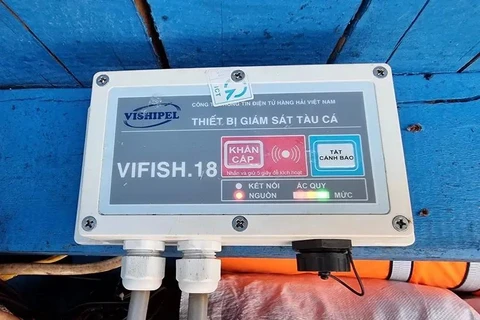
The People’s Committee of the northern province of Nam Dinh has asked provincial departments, sectors, and coastal localities to make sure that 100% of the fishing boats install the vessel monitoring systems (VMSs) and stay continuously connected.

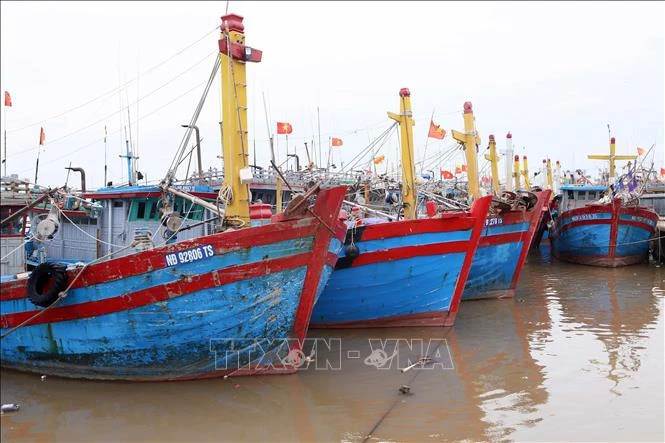
Fishing boats docking at a port in Nam Dinh (Photo: VNA)

Nam Dinh (VNA) – The People’s Committee of the northern province of Nam Dinh has asked provincial departments, sectors, and coastal localities to make sure that 100% of the fishing boats install the vessel monitoring systems (VMSs) and stay continuously connected.

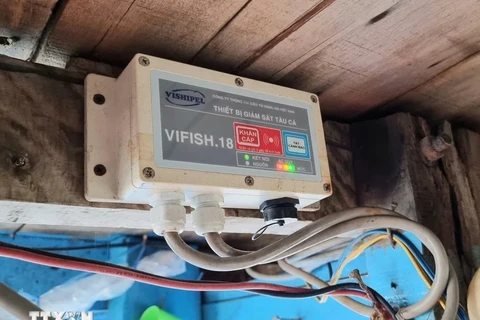
The move aims to put an end to the situation of VMS disconnection among local fishing vessels. According to the committee, 99% of the local fishing vessels have installed the VMSs. However, there are still cases of fishing boats losing VMS connection while operating at sea.

The committee asked coastal localities to maintain 24/24 supervision over local fishing vessels via the VMSs, detecting and preventing illegal operations on foreign waters, contributing to combating illegal, unreported and unregulated (IUU) fishing

In the first seven months of 2024, the provincial Department of Agriculture and Rural Department detected 179 fishing boats losing connections for over six hours and 80 others having no signals for more than 10 days in operations.

Vice Director of the department Tran Duc Viet said that the province found three vessels committing violations in VMS installation and connection.

Meanwhile, local authorities have imposed administrative punishments on 97 IUU fishing violation cases with a total fine of 1.14 billion VND (45,770 USD)./.
VNA

See more

Assoc. Prof. Dr. Nguyen Duc Son presents the decision establishing the Vietnamese Language Proficiency Test Council in Japan to a representative of the Vietnam Studies Centre in Japan. (Photo: VNA)

Japan hosts first standardised Vietnamese language proficiency test

As bilateral ties between Vietnam and Japan continue to expand, demand for Vietnamese language learning in Japan has also grown rapidly among OVs, educational institutions, businesses and Japanese people interested in Vietnam. Against this backdrop, the introduction of a standardised proficiency test is expected to provide an official and widely recognised benchmark for Vietnamese language skills.

The “I Love My Fatherland" Journey 2026 kicks off in Nghe An province on May 16. (Photo: VNA)

"I Love My Fatherland” journey features diverse activities

The “I Love My Fatherland” journey will span seven stages across historical and cultural sites and “red addresses” nationwide. There will be a combination of education on traditions, field-based programmes, and digital communications.

At the handover of 33 Chinese nationals who had violated Vietnamese law to Chinese authorities in Quang Ninh on May 15, 2026. (Photo: VNA)

Vietnam hands over 33 law violators to China

Investigations found that the individuals had violated Vietnamese laws relating to illegal entry and unlawful residence in Vietnam. The handover was conducted safely and in compliance with Vietnamese law and international practice.

At the talks between authorities of the northern province of Lang Son and Pingxiang city in the Guangxi Zhuang Autonomous Region of China (Photo: VNA)

Vietnam, China seek to build modern, smart border gates

Authorities of the northern province of Lang Son and Pingxiang city in the Guangxi Zhuang Autonomous Region of China held talks on May 15 at Tan Thanh (Vietnam) – Po Chai (China) clearance point near markers 1090–1091 in Hoang Van Thu commune of Lang Son to promote trade, develop smart border gates and expand cross-border tourism cooperation.

The Vietnam Association for Victims of Agent Orange (VAVA) has carried out various activities to support Agent Orange/dioxin victims. (Photo: VNA)

Over 9.3 billion VND raised for AO/dioxin victims in 2025

VAVA President Lieutenant General Nguyen Huu Chinh said that although the war ended more than 50 years ago, the consequences of toxic chemicals remain severe and long-lasting, with millions of people affected during the war and hundreds of thousands continuing to suffer serious physical impacts in peacetime.