Nearly 900 million USD in FDI registered in Bac Giang

Nearly 900 million USD in foreign direct investment (FDI) has been registered in the northern province of Bac Giang since the beginning of 2023.
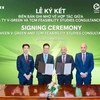
Nearly 900 million USD in FDI registered in Bac Giang ảnh 1Leaders of Bac Giang province grant MoU on investment to representatives of Yadea Group and Tan Hung industrial park (Photo: VNA)

BacGiang (VNA) – Nearly 900 million USD in foreign direct investment (FDI) has been registeredin the northern province of Bac Giang since the beginning of 2023.

Most recently, China’s Yadea Group will invest 100 million USD in afactory to manufacture and assemble electric motorcycles withan expected capacity of about 2 million vehicles per year in Tan Hung IndustrialPark, Lang Giang district.

Covering an area of 23.2 ha, theproject will be implemented in the second quarter of 2023.

At a ceremony on January 7 to hand over an MoU on investment to Yadea and Lideco 1, the investor of Tan Hung IP, Chairman of Bac Giang’s People’s Committee Le AnhDuong said theprovince will create the most favourable conditions for foreign investors, whohave made great contributions to the socio-economic development of Bac Giangprovince.

Earlier on January 2, Bac Giang province granted an investment certificate to Singapore’s Ingrasys Pte. Ltd, the investor of the Fulian precision technology factory project and signed an MoU with Chinese investor Hainan Longi Green Energy Technology Co Ltd on a project to produce solar panels.

Both projects will be conducted from the first quarter of 2023, with combined registered capital of about 761 million USD.

Bac Giang currently is home to more than 480 FDI projects, with totalinvestment capital of over 8.2 billion USD. The province posted an all-timehigh economic growth rate of 19.3% in 2022./.
VNA

See more

Chili peppers are on the list of essential goods in Indonesia (Photo: VNA)

Indonesia reduces imports of strategic food commodities

In 2026, Indonesia is expected to have approximately 12 million tonnes of rice carried over from the previous year, supported by annual production of around 34.7 million tonnes. With projected consumption of 31.1 million tonnes, national rice reserves could reach approximately 16 million tonnes by the end of the year.

Hanoi’s roadmap to implement low-emission zones from July is providing a strong boost to the electric two-wheeler market (Photo: VNA)

Low-emission zone roadmap drives electric two-wheeler boom in Hanoi

From July 1, Hanoi will introduce time-based or area-based restrictions on petrol-powered motorcycles within Ring Road 1, with plans to expand coverage across the entire zone by 2028 and extend to areas within Ring Road 3 by 2030. The policy is expected to reshape travel habits for millions of urban residents.

Delegates at the opening ceremony of the Made in Da Nang Expo 2026 (Photo: VNA)

Nearly 300 firms join Made in Da Nang Expo 2026

Speaking at the opening ceremony, Vice Chairman of the Da Nang People’s Committee Tran Chi Cuong said the exhibition is a large-scale trade promotion event aimed at showcasing products, connecting markets, and helping businesses enhance competitiveness while expanding domestic and export markets.

 Green production, standardised value chains key to fruit, vegetable sector growth

Green production, standardised value chains key to fruit, vegetable sector growth

Facing mounting pressure from increasingly stringent domestic and international standards, Vietnam’s fruit and vegetable sector is accelerating its shift toward green, safe, and sustainable production models. Beyond changing farming practices, localities and businesses are stepping up efforts to standardise value chains and build brands to achieve growth targets for 2026.

Hiep Phuoc Industrial Park in Ho Chi Minh City. (Photo: VNA)

Southern industrial real estate enters strategic growth phase

Key industrial hubs in the south, including Ho Chi Minh City, Dong Nai and Tay Ninh, are transitioning from a period driven largely by supply expansion and rising land prices to a more refined growth model. This new phase is shaped by infrastructure upgrades, supply chain restructuring, product improvement and greater emphasis on operational performance.