Nestle vows to promote Vietnamese coffee in international markets

The Nestle Group is carrying several major projects with the aim of popularising Vietnamese coffee among coffee consumers all over the world and making Vietnam an international reference for robusta coffee, said a Nestle executive.

The Nestle Group is carrying several major projects with the aim ofpopularising Vietnamese coffee among coffee consumers all over the worldand making Vietnam an international reference for robusta coffee, said aNestle executive.

Executive Vice President forNestle Nandu Nandkishore, responsible for Asia, Oceania and Africa, toldthe Hanoi Moi (New Hanoi) newspaper that the recent inauguration ofNestle’s 80-million USD factory in southern Dong Nai province not onlymarks a new step forward in the group’s presence in Vietnam but alsodemonstrates that Nestle is continuing to carry out its commitment tothe community, coffee farmers and consumers in the country.

The Dong Nai factory, Nestle’s second facility to producede-caffeinated coffee beans in the world, will use only Vietnameserobusta coffee beans, and its product will be supplied to Nestleprocessing facilities around the world, according to the executive.

It is expected to raise the production value for Vietnamese coffeefarmers as well as the Vietnamese coffee reputation in internationalmarkets, he said.

Since 2011, the company has alsoassisted coffee farmers in the Central Highlands in replacing old treesin a bid to improve productivity and production value, with a total of11 million coffee seedlings to be supplied at half the price by the endof 2015.

The project also opened technical trainingcourses to more than 20,000 local farmers to spread the application ofgood farming practice.

At the same time, Nestlejoined the public-private partnership project in coffee production, aninitiative put forward at the World Economic Forum 2010. With thecollaboration of other partners such as 4C and Rainforest Alliances, theproject has been building model coffee farms and training farmers insustainable farming techniques, contributing to reducing productioncosts, environmental impact and raising productivity and income forfarmers.

According to the executive, Nestle’sinvestment in Vietnam now totals 450 million USD, but the investmentcarries a greater significance than merely an expansion of business.

The inauguration of the Dong Nai factory and farmingprojects that Nestle is carrying out in Vietnam demonstrate the group’sconfidence in the country, where it has been operating successfully formore than 20 years, he said.

Vietnamese coffee isavailable in more than 80 countries and territories across the world,making the country the second largest coffee exporter in the world, onlyafter Brazil.

The country is currently theworld's leading exporter of robusta coffee. Last year, it earned 3.62billion USD from shipping 1.73 million tonnes of coffee abroad, up 33.4percent in volume and 32.2 percent in value.

Germany and the US remained the two largest importers of Vietnamesecoffee in 2014, accounting for 14.13 percent and 10.17 percent,respectively, of the country's total coffee export turnover.-VNA


See more

The daily reference exchange rate is set at 25,652 VND/USD on November 17. (Photo: VNA)

Reference exchange rate edges higher

With the current trading band of +/- 5%, the ceiling rate applicable for commercial banks during the day is 26,935 VND/USD, and the floor rate 24,369 VND/USD.

Manufacturing materials for solar cell production at JA Solar Vietnam Co., Ltd., a Hong Kong (China)-invested enterprise in the Quang Chau Industrial Park, Bac Ninh city (Photo: VNA)

Vietnam, China widen economic, trade cooperation space

General Secretary of the Communist Party of Vietnam Central Committee and President To Lam’s trip to China for the 33rd APEC Economic Leaders’ Week and bilateral engagements is expected to add new momentum, including deeper economic connectivity, broader trade, investment and supply chain links, and a more balanced, substantive economic relationship that matches both sides’ potential.

The sidewalks on Hung Vuong street in Quang Tri province are under renovation. (Photo: VNA)

Quang Tri approves 103 priority projects for investment during 2026–2030

The 103 projects are categorised into seven fields, comprising energy; logistics; tourism, services, and trade; green and high-tech agriculture; industry, industrial zones, and production infrastructure; urban development and commercial housing; and healthcare, wellness, and resort services.

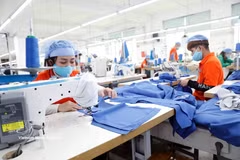
Workers make clothes for export to the Japanese market at Hung Viet Garment Company in Hung Yen province (Photo: VNA)

Vietnam’s textile-garment firms striving to achieve export targets, sustain employment

To achieve the annual target, textile and garment businesses are jointly implementing several core tasks, including diversifying export markets and partners, developing the supporting industries for raw materials and accessories to establish integrated supply chains, investing in technological innovation linked to AI, stepping up high-quality workforce training, promoting green transformation based on circular economy models, and building brands in both domestic and international markets.

Minister of Public Security General Luong Tam Quang (R) receives Choo Hyeong Wook, President and CEO of the Republic of Korea’s SK Innovation in Hanoi on November 16. (Photo: VNA)

Vietnam promotes international cooperation in energy, high technology

Minister of Public Security General Luong Tam Quang called on the RoK's SK Innovation to share experience and work with Vietnamese partners in developing clean and renewable energy, hydrogen, liquefied natural gas, energy storage technologies and carbon emission reduction solutions.

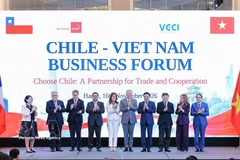
Delegates pose for a photo at the Chile-Vietnam Business Forum in Hanoi on November 16 (Photo: VNA)

Vietnam, Chile seek to expand trade ties

Chilean President José Antonio Kast pointed to potential for cooperation in agriculture and food, and called for stronger technical cooperation, better market access and closer links in innovation, technology, services and sustainable development.

Production of footwear for export at Lefaso Tra Vinh Industrial Investment and Production Joint Stock Company, Tra Cu commune, Vinh Long province (Illustrative image. Source: VNA)

VEFTA implementation requires exporters to restructure supply chains: Experts

Under VEFTA, tariff reductions to zero will be meaningless for Vietnam’s key export sectors, including textiles and garments, footwear, and agricultural and aquatic products, if goods are found to contain banned chemicals, violate rules of origin or lack transparency regarding their carbon footprints.