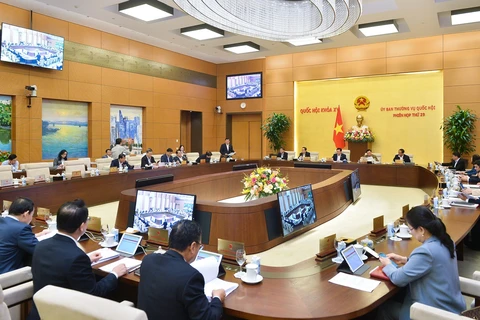
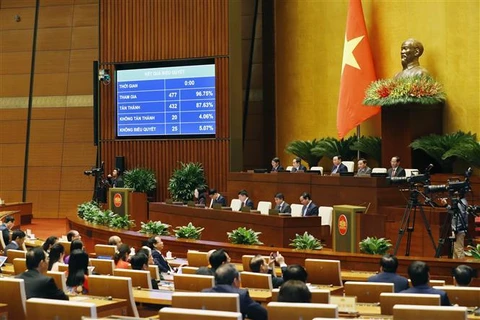
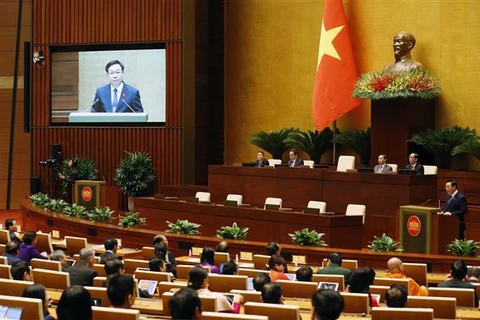
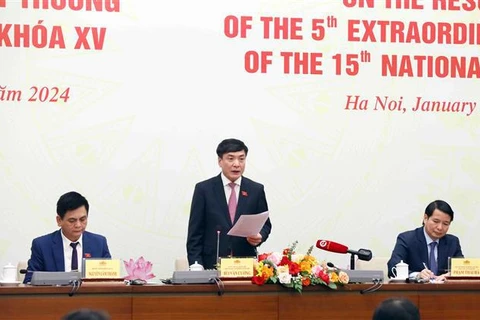
The amended Land Law is expected to promote transparent and sustainable development of the real estate market. (Photo: VNA)
 Comprising 16 chapters and 260 articles, the law would solve existing problems in land management and contribute to promoting growth with innovations and breakthroughs in thinking, Deputy Prime Minister Tran Hong Ha said, emphasising that improving the legal framework for land has been a focus of the Party and the Government.
As land and land management are a huge and complicated issue with an important role in the country’s socio-economic development and impacting all walks of life and the business community, the new law has drawn significant attention.
Efficient and sustainable use of land resources would help accelerate the country’s industrialisation and modernisation process, ensure social stability and national security, and protect the environment, creating motivation for Vietnam to become a developed economy, Tran Minh Son from the Ministry of Justice said.
"The new land law is able to answer three major questions, which are what purpose the land is for, who the land is allocated to, and at what prices," said Le Xuan Nghia, member of the National Financial and Monetary Policy Advisory Council.
Answering these questions would help bring land back to its true value as a rare and precious resource for socio-economic development, he said.
Residents, enterprises and State management agencies expected that the law would help solve existing bottlenecks in land procedures.
“During recent years, hundreds of projects have been stuck while new projects cannot be approved,” Nghia said, adding that the new land law would provide a solution.
There are hundreds of new points in this 16-chapter law, one of the notable points is that the law creates opportunities for users of land without records on use rights to be granted a red book.
This regulation would have huge impact, bringing peace of mind, making land more valuable and encouraging its more efficient use, Nghia said.
The new law also abolishes the land price frame. Instead, land price table will be updated annually and the first land price table will be applied on January 1, 2026.
Nghia said that the land prices would be more market based, contributing to improving fairness and social stability while encouraging the efficient use of land.
The new land law allows expanding the limit of individuals who can receive transfer of agricultural land use rights under regulations on “concentration of agricultural land” and “accumulation of agricultural land”.
Tran Minh Son from the Ministry of Justice said that this would create conditions for large-scale farming and promote agriculture to develop rapidly and sustainably to ensure national food security. There would also be impacts on the real estate market and the entire economy.
There are also specific regulations on land revocation and compensation to ensure transparency.
The new law allows the lump sum payment of land rent or annual instalments, which is flexible to create favourable conditions for production and business.
Possible impacts but not too soon
“The 2024 Land Law will have positive impacts,” Nghia said.
Together with the Law on Housing 2023 and the Law on Real Estate Business 2023, the new land law would remove legal bottlenecks for real estate projects, which are a major problem to the property market in recent years, including credit policies, interest rates and bond issuance.
Nghia said that the law would provide a chance to shorten the recovery time of the real estate market. However, the market would not be able to “wake up” right away because legal problems were still lingering as the law would take effect from January 2025.
“It will take time and effort to improve the legal framework for land for the law to work. I hope that the real estate market will see clear signs of recovery in 2025.”
According to Tran Van Binh, Vice President of the Vietnam Association of Realtors, the new law will untie legal constraints and create momentum for the real estate market to develop more safely and transparently.
With rapid urbanisation, the housing demand is increasing rapidly, accounting for 80% while the demand for long-term investment accounts for 15% and speculation 5%. "With the new law, a new phase of development for the real estate market is opening. The 2024 Land Law will bring the real estate market to a new normal,” Binh said.
In 2024, the real estate market is expected to continue encountering difficulties and challenges, but there are opportunities, according to Binh.
The announcement of planning and the implementation of public-invested projects will have huge impacts on the real estate market in 2024.
However, not until 2025 can the real estate market see clear signs of recovery, when the new law comes into force and helps tackle existing legal bottlenecks.
According to Dinh Minh Tuan, Director of PropertyGuru Vietnam, Southern region, on the impact of the new law, land prices will increase sustainably. The efficiency of land use will also be improved.
In addition, the real estate supply would increase, he said, pointing out that one reason for the prolonged delays of a number of projects is difficulty in land clearance as compensation is not reasonable.
Market-based land prices would help the land bank to expand more rapidly. The regulations on access to land resources are also more detailed, opening opportunities for enterprises and residents to access land resources more easily, he said.
“We should not expect the real estate market to recover rapidly. It will take time,” Tuan said.
Drastic actions
The next focus would be on how to bring the law into life, how to make land a truly important resource and how to promote land commercialisation to accelerate the country’s socio-economic development and national security and defence, Deputy Prime Minister Tran Hong Ha said.
The Ministry of Natural Resources and Environment has drafted a plan to implement the amended Land Law, including specific responsibilities of ministries and agencies in developing by-law documents, communication and training, as well as supervision.
Emphasising that developing by-law documents is the top priority, Ha asked the Ministry of Natural Resources and Environment to coordinate with relevant ministries to complete the plan for developing by-law documents, including decrees on general issues and specialised issues such as rice growing land management, land use fee, land valuation, land revocation and compensation for relocation, land for traffic infrastructure, urban development, energy and industry.
“Reviews must be carried out carefully to prevent legal gaps in land policies,” Ha stressed, adding that the general spirit is that the number of decrees must be kept to a minimum and the law implemented in a scientific way./.
VNA