Newly-registered labourers in May down 24.5 percent

A total of 80,500 workers were registered at newly-established businesses in May, down 24.5 percent year-on-year, according to the General Statistics Office (GSO).
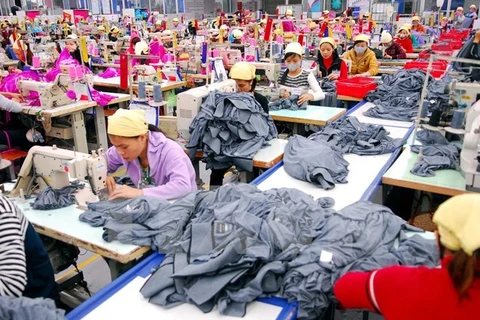
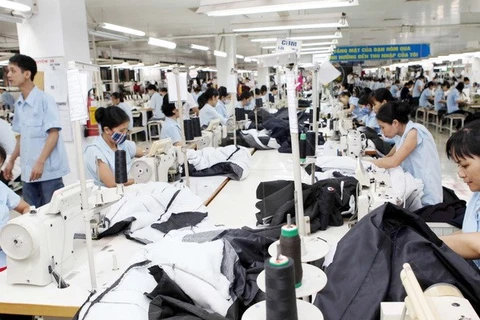
Newly-registered labourers in May down 24.5 percent ảnh 1Workers at a company specialising in production of electronic products and spare parts in Hai Phong city (Photo: VNA)

Hanoi (VNA)
- A total of 80,500 workers were registered atnewly-established businesses in May, down 24.5 percent year-on-year, accordingto the General Statistics Office (GSO).

The GSO reported that the number of workers at State-ownedenterprises fell by 0.4 percent in the first four months of 2018.

The figures for non-State enterprises and foreign directinvestment (FDI) firms respectively rose by 4.3 percent and 4.2 percent in theperiod.

Meanwhile, the number of labourers in industrial firms increased 3.8 percent comparedto the same period last year.

According to the Business RegistrationManagement Department under the Ministry of Industry and Trade, a total of11,027 businesses with combined registered capital of 104.8 trillion VND (4.61billion USD) were established in May.

The figures represent decreases of 24 percent innumber and 21.5 percent in capital compared with April.

In the month, 2,306 businesses resumed operations, down 29.7 percent and 6,855enterprises temporarily stopped operations, up 11.7 percent. Meanwhile, 834others completed dissolution procedures, down 39.5 percentmonth-on-month. 

The number of newly-established enterprises inthe first five months rose by 3.5 percent year-on-year to 52,322, withtotal registered capital of 516.9 trillion VND (22.77 billion USD).

Large numbers of new enterprises were seen in sectorssuch as wholesale and retail, repair of cars and motorcycles, processing andmanufacturing and construction.

Twelve sectors saw an increase in newlyestablished enterprises in the first five months. The real estate tradingsector had the highest growth in the number of new enterprises at 41.1 percent.

The sector also saw the highest development in registered capital of new firms,accounting for some 29 percent of the total registered capital.

Sectors such as electricity production anddistribution, real estate trading, finance-banking and mining led in terms ofaverage capital per enterprise.-VNA
         
VNA
See more

Saigon Marina IFC, an emerging landmark, reflects Ho Chi Minh City’s pioneering spirit.

Saigon Marina IFC – The light of Ho Chi Minh City’s new icon

Saigon Marina IFC, an emerging landmark, reflects Ho Chi Minh City’s pioneering spirit. Designed to become an International Financial Centre, this new architectural icon along the Saigon River is envisioned not only as a premium commercial complex, but as a central platform supporting financial institutions, international investors and cross-border capital flows in the years ahead.

Shoppers at a supermarket in Hung Yen (Photo: VNA)

Retailers see tax compliance, AI as key to survival in 2026 survey

The annual survey, conducted at the end of 2025 among retail and food and beverage (F&B) sellers nationwide, found that businesses are shifting their focus from rapid growth to operational efficiency, cost control and legal compliance amid increasingly stringent regulatory standards.

Visitors shop at Glorious Spring Fair 2026 (Photo: VNA)

Spring Fair 2026 opens broader prospects for Vietnam–UAE trade cooperation

For Vietnam, the UAE serves not only as a consumer market but also as a gateway to the Middle East and North Africa. Vietnamese agricultural products such as cashew nuts, pepper, cinnamon and rice have steadily gained market share, while aquatic products, including tra fish and tuna, are increasingly present in the UAE’s hospitality sector.

Bao Viet Bank's employee counts Vietnamese banknotes at a transaction counter in Hanoi. (Photo: VNA)

Credit quota reform, tighter capital rules may widen gap among banks

Yuanta Vietnam Securities estimates that to achieve GDP growth above 10%, credit growth would need to exceed 16%. This suggests bank credit is no longer expected to be the main growth driver, with greater reliance on fiscal policy, public investment and capital markets.

Commercial Counsellor Do Viet Phuong, Head of the Vietnam Trade Office in Cambodia. (Photo: VNA)

Spring Fair 2026 offers ample room to deepen Vietnam–Cambodia trade ties

Cambodia holds substantial potential for cooperation in agro-processing and exports, especially in key products such as rice, cashew nuts and rubber. In recent years, the country’s cultivation area and agricultural output have grown steadily, providing a stable raw material base for processing industries.

Vietnam is projected to have approximately 2.4 million SMEs, accounting for over 98% of the country’s total enterprises. (Photo: cafef.vn)

Banks offer diverse solutions to support SMEs

With an increasingly significant role in the economy, the small and medium-sized enterprise (SME) sector is becoming a key segment in the credit growth strategies of many banks and the banks have been taking diverse solutions to support the enterprises.

Workers process coconuts for export at Vina T&T Group. (Photo: nhandan.vn)

Agricultural exports reliant on securing raw material supply

According to Secretary General of the Vietnam Pepper and Spice Association Le Viet Anh, pepper remained Vietnam’s leading spice export in 2025, with shipments exceeding 247,000 tonnes, accounting for 59.3% of total spice export volume. Export revenue reached 1.66 billion USD, out of total spice exports of 2.1 billion USD.