Nguom Ngao Cave - nature's masterpiece in Cao Bang province

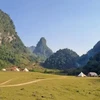
Nguom Ngao Cave is located in a mountain in Gun village of Dam Thuy commune, Trung Khanh district, is a priceless asset that the nature has gifted to the northern mountainous province of Cao Bang.
Nguom Ngao Cave - nature's masterpiece in Cao Bang province ảnh 1Exploring Nguom Ngao Cave (Photo: VNA)

Hanoi (VNA) – Nguom Ngao Cave is located in a mountain in Gun village of Dam Thuy commune, Trung Khanh district, is a priceless asset that the nature has gifted to the northern mountainous province of Cao Bang.

Nearly 5 kilometres away from the renowned Ban Gioc Waterfall, Nguom Ngao Cave was discovered in 1921, opened to tourists in 1996, and recognised as a national-level scenic landscape in 1998.

Nguom Ngao means “Tiger Cave” in the Tay ethnic language. It is said that that this site used to be a den of many tigers which were then killed by local residents to guarantee a safe life. Given this, local Tay people named this place “Nguom Ngao”.

However, another story said there was an underground stream with piles of pebbles flowing into the Quay Son River and releasing murmur which echoes in the cave and sounds like a tiger’s roar, thus earning this cave the name “Nguom Ngao”.

The cave section surveyed by the British Caving Association in 1995 is 2,144 metres long and has three entrances, namely Nguom Ngao, Nguom Lom, and Ban Thuon.

Researchers said this cave is a limestone one containing many coral and crinoid fossils. It used to be part of an ancient sea that existed about 400 million years ago.

According to a 2016 survey by the Vietnam Institute of Geosciences and Mineral Resources, Nguom Ngao is 2,769.6 metres long and features five openings located at altitudes of between 420 and 507 metres.

The cave management board has just opened 945.8 metres and two entrances of Nguom Ngao to visitors.

Once entering the cave, visitors will be amazed at strangely shaped stalactites. Nguom Ngao is home to multiple limestone chambers, floors, stairs, and corridors in various sizes, along with stalactites and stalagmites in diverse shapes such as a coral reef, a ship, a waterfall, an overturned lotus flower, and a terraced field. All give this cave magnificent and fantastic beauty.

Notably, colours of stalactites here are different from those in caves in other localities thanks to the mixture of calcium with many other substances.

The deeper tourists go into Nguom Ngao, the more charming it becomes. Sometimes, they can also see small streams snaking through this cave.

With pristine and breathtaking beauty, Nguom Ngao Cave is truly a masterpiece of nature.

Although Cao Bang authorities have opened just nearly 1 kilometre of the cave to tourists, Nguom Ngao is still a not-to-be-missed destination once coming to the province. From this place, travellers can also visit the nearby overwhelming Ban Gioc Waterfall, another scenic landscape.

Nguom Ngao Cave is part of Non Nuoc Cao Bang, which was recognised as a member of the UNESCO Global Geoparks Network in 2018.

Non Nuoc Cao Bang is about 300 kilometres from Hanoi. Covering over 3,000 sq.km, the geopark is home to fossils, ocean sediment, volcanic rocks, minerals and karst landscapes, which can give researchers insight into the 500 million years of the earth’s history.

The park is well known for its rich biodiversity and many indigenous species of fauna and flora. Apart from Nguom Ngao Cave, it is also home to other famous destinations such as Ban Gioc Waterfall, Thang Hen Lake, and Phia Oac ecological site.

"Non Nuoc Cao Bang UNESCO Global Geopark offers numerous outstanding historical and archaeological sites and a rich cultural heritage of national and international significance, lending the area prominence in Vietnam and providing a strong basis for the tourism industry as it attracts large numbers of domestic and international visitors,” read the UNESCO statement. “In addition, numerous international and national geosites such as fossil sites, geological boundaries, mineral deposits and intrusive, volcanic and sedimentary rocks are well preserved."

This is the second UNESCO-recognised global geopark in Vietnam after Dong Van Karst Plateau in the northernmost province of Ha Giang, which received the honour in 2010./.
VNA

See more

Thailand has become the sixth international destination of Vietnam's newest carrier, Sun PhuQuoc Airways. (Photo: The courtesy of Sun PhuQuoc Airways)

Thailand is sixth international destination of Vietnam's newest airline

Speaking at the recent launch event for the Bangkok route, La Vinh Nam, the airline's Deputy Commercial Director, said the full-service carrier, owned by Vietnam's Sun Group, views Thailand as an important partner in promoting two-way tourism and attracting international transit passengers, rather than as a competitor.

Vietnam Railways has introduced a range of tourism, heritage and dedicated train services, attracting growing numbers of passengers. (Photo: VNA)

Railways reinvent themselves with tourism, heritage trains

One of the most notable successes is the premium Hoa Phuong Do (Flamboyant Flower) train operating between Hanoi and Hai Phong city. Since entering service in May 2025, the train has completed nearly 3,000 trips and carried around 1.33 million passengers.

A rammed-earth house of the Mong ethnic community in the mountainous province of Tuyen Quang. (Photo: VNA)

Heritage fuels distinctive destination brands across Vietnam

As localities move beyond resource-based tourism towards value-driven cultural development, they are creating distinctive destination brands while reinforcing Vietnam's position as a culturally rich and compelling destination on the global tourism map.

Foreign tourists explore Hoi An ancient town in Da Nang city. (Photo: VNA)

Tourism sector pivots to quality-led growth in second half of 2026

According to the Vietnam National Authority of Tourism (VNAT), Vietnam welcomed 12.3 million international visitors in the first six months of 2026, up 15% year-on-year. The figure is the highest first-half number in recent years and puts the country close to halfway towards its target of 25 million foreign arrivals this year.

Travel guide Lonely Planet describes Da Nang as an outdoor lover’s paradise. (Photo: VNA)

Da Nang proves Lonely Planet right as Asia’s must visit summer destination

According to Lonely Planet, Da Nang stands out for its harmonious blend of beautiful beaches, an energetic yet relaxed lifestyle, a rich culinary scene and a diverse range of experiences spanning nature, culture, leisure and entertainment. The city is also praised as an ideal gateway to central Vietnam, offering convenient access to Hoi An, Hue and My Son Sanctuary.

Sun PhuQuoc Airways' new aircraft livery (Photo: Sun Group)

Vietnam's newest airline races from Phu Quoc onto the global stage

Sun PhuQuoc Airways, the airline of Sun Group, officially launched in October 2025 and began commercial flights the following month, entering a Vietnamese aviation market riding a wave of post-pandemic recovery, but also grappling with rising costs, fleet constraints, talent shortages, infrastructure pressure, and intensifying service competition. Less than a year in, this newcomer has already made its presence felt.

A Korean tourist family poses for a photo in the coastal city of Da Nang. (Photo: VNA)

Vietnam remains second most popular destination for Korean tourists

Japan remained the top destination, attracting about 951,000 Korean visitors, accounting for 40.6% of total outbound tourists. Vietnam ranked second with approximately 278,000 visitors, followed by the US with 100,000, Taiwan (China) with 79,000, Thailand with 64,000, the Philippines with 61,000 and Hong Kong (China) with 59,000.

Tourists explore a tourist attraction in Hue city. (Photo: VNA)

Wellness tourism helps Hue shape identity as Asia’s emerging "healing city"

The development of wellness tourism is also aligned with the Politburo's Resolution No. 57-NQ/TW on breakthroughs in science and technology development, innovation and national digital transformation. For Hue, the strategy provides an opportunity to combine modern medicine with traditional healthcare, biotechnology, indigenous medicinal herbs and tourism to create high-value services.

Keo Hanh Thien Pagoda is recognised as a special national relic in 2016. (Photo: VNA)

Digitalising rural heritage to boost tourism

Authorities in Xuan Hong commune of the northern province of Ninh Binh are leveraging digital technology to preserve cultural heritage and promote rural tourism, with the centuries-old Keo Hanh Thien Pagoda serving as the centrepiece of the initiative.

Discover Moscow offers a comprehensive hub of practical travel information, seasonal itinerary ideas and useful tips for visitors planning a trip to the Russian capital. (Screenshot)

Discover Moscow debuts Vietnamese-language tourism platform

Accessible at https://discover.moscow/vi, the platform provides a one-stop source of travel information, featuring practical guidance, seasonal itineraries and planning tips for visitors. It showcases the city's key attractions, cultural routes, parks, events, restaurants, shopping destinations and family-friendly activities, enabling travellers to organise their trips before arriving in Moscow.

Boat tours in Cam Thanh village, Da Nang city, generate significant income for local residents. (Photo: VNA)

Rural tourism draws strength from indigenous culture

Vietnam currently has more than 600 agricultural and rural tourism models, generating over 25 trillion VND (956 million USD) in annual revenue. The sector has become an important source of income for many rural communities seeking to diversify their livelihoods.

Located about 200 km from Hanoi, Ta Xua in Son La province is widely regarded as one of the most spectacular cloud-hunting destinations in northern Vietnam. (Photo: VNA)

Ta Xua sets sights on sustainable tourism

Ta Xua is rolling out a campaign titled “Bringing Ta Xua to the world” and aims to establish the image of “Ta Xua - a sea of clouds, majestic nature and Mong cultural identity” during the 2028-2030 period.