Dan Carden, Member of Parliament of the UK, President of the Board of the IPU Forum of Young Parliamentarians, and Vietnamse NA delegate Ha Anh Phuong present the Conference Statement on the role of youth in promoting the implementation of the sustainable development goals through digital transformation and innovation. (Photo: VNA
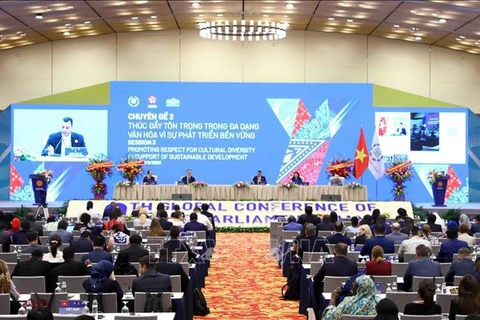
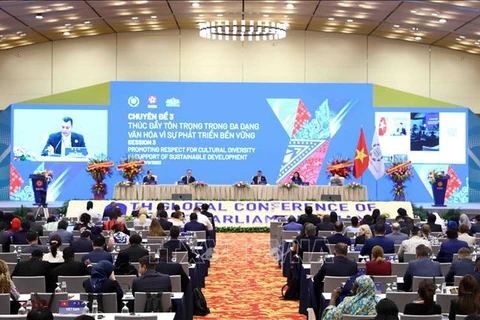
 Hanoi (VNA) – The 9th Global Conference of Young Parliamentarians in Hanoi adopted a statement highlighting the role of young people in accelerating the realisation of sustainable development goals through digital transformation and innovation, and promoted respect for cultural diversity in support of sustainable development at closing session of the event on September 16.
The following is the full statement
CONFERENCE STATEMENT
On “The role of youth in accelerating the achievement of the SDGs through digital transformation and innovation” at the Ninth IPU Global Conference of Young Parliamentarians
in 14 – 17 September 2023 in Ha Noi, Viet Nam
We, over 200 young parliamentarians, came together at the Ninth Global Conference of Young Parliamentarians in 14 – 17 September 2023 in Ha Noi, Viet Nam to affirm our commitment to accelerating the achievement of the SDGs, especially through digital transformation and innovation. Our average age was 37.8 years and approximately 37 % of us were women MPs. Representatives from global and regional organizations, youth groups, start-ups, academia, and influential leaders of IPU and Viet Nam. We are delighted that the Conference coincided with the United Nations' International Day for Democracyon 15 September.
Our meeting in Viet Nam marked the 8th anniversary of the Hanoi Declaration on the SDG, adopted by the Inter-Parliamentary Union in 2015, and setting out the commitment of parliamentarians to address global development priorities. As we pass the mid-way point of 2030 Agenda for Sustainable Development (2030 Agenda), we are at a momentous and critical juncture.
We emphasise and share great concern regarding the fact that, with less than 7 years remaining to achieve the SDG, only 12% of SDG targets are being well implemented, while we are still behind 50% of the targets with levels ranging from moderately to severely off track. These results warrant not only our reflection, but resolute action, especially drawing attention to gaps in achieving goals of education, gender equality, decent work and economic growth, climate action, peace, justice and strong institutions, which are of vital concern to youth. 258 million young people are still out of school, when we need universal education that leaves no one behind. The number of young people not in employment, education, or training (NEET) is increasing considerably, rising to 23.3 per cent. Young women remain worse off than young men, being roughly two-thirds as likely to be employed. We are also nowhere near equity when it comes to representation of women and young people in politics. Less than 27% of world MPs are women, and only 2.8% of MPs are 30 years of age or under. We need to work faster, more creatively, and with a far greater sense of urgency, to achieve the agenda we all agreed upon.
Our world is characterised by the rapid growth in technology, digital transformation, and innovation. We need to harness their potential to accelerate progress towards the SDG, especially for issues important to youth. For example, in education, digital tools can open up educational and training opportunities to more young people through online means. By unleashing innovation, we can help scale up start-ups led by young people that in turn can employ more young men and women. When these are enterprises that help adapt to or mitigate climate change, investing in youth for the clean jobs of tomorrow can have multiplier positive effects.
The opportunities are clear, and they must be available to everyone, yet important gender gaps persist. The fact that women are 26% less likely to own a mobile phone than men is unreasonable. Digital transformation and innovation must be opportunities that bolster gender equality by facilitating new avenues for empowerment.
As key inventors, users and promoters of technological evolution, young people are uniquely positioned to lead in the positioning of digital transformation and innovation at the centre of action to accelerate progress in making development sustainable for the planet and accessible for the people, leaving no one behind. Young people are already leaders in the private sector, as CEOs of tech companies and innovative startups, or, as investors in digital transformation. This should also be mirrored with young people leading in our political institutions.
We young MPs, know how to navigate the complexities of the digital landscape, and we know best the pulse of our country’s youth and future generations. It is our role to give voice to their aspirations. Young people are natives of the latest technologies and are well positioned to drive new solutions for the good of all. This includes through start-ups, developing new technologies and harnessing the rise of Artificial Intelligence (AI). We reiterate our call for MPs and political leaders to take transformative action for more youth in politics by joining the IPU Campaign “I Say yes to youth in Parliament!”.
The Covid-19 pandemic has demonstrated the strategic importance of digital tools in our parliaments. These can contribute to more inclusive legislative processes, monitoring, and decision-making processes on important issues more comprehensively, with greater transparency, and increased public participation. Real-time engagement channels can enable immediate interaction between constituents and representatives. By facilitating participation, digital transformation can empower citizens, particularly the youth, to actively engage in political process and contribute to shaping policy decisions. For parliamentarians, these digital tools offer greater opportunities for combining their work and private life, especially for those with caring responsibilities. We welcome the IPU self-assessment toolkit on the SDGs as an innovative approach to helping parliaments integrate the SDGs in parliamentary work according to their specificities and contributing to their effective implementation in a more coherent and sustainable manner.
Science - technology is a cornerstone for advancing peace and sustainable development and provides solutions to today's complex challenges. It enables evidence-based and informed policymaking, whether it be on environmental protection, development, or conflict resolution. Science and the common search for knowledge and solutions can unite in collective cause, providing a neutral platform for cooperation and an incentive for peaceful coexistence. We, young MPs, can play an important role in helping foster the next generation of tech-savvy and problem-solving youth to help realize sustainable development and peace.
When harnessing the power of technology and innovation in a transforming world, we must work to maximize the positive outcomes that these bring, while mitigating unwanted risks. This includes taking up an ethical and prudent approach to science and technology that ensures that they are used for the betterment of humanity and the environment, as well as privacy, security and well-being. At the same time, our pursuit of digital transformation and innovation should not push us towards global homogeneity. It should amplify the rich tapestry of cultures, experiences and perspectives. Cultural diversity is a strength for sustainable development which should not only be protected but embraced, as it is an indispensable ingredient that can nurture even more creativity and innovation.
To help accelerate the achievement of the SDGs through digital transformation and innovation, we, young MPs discussed the following proposed actions:
Regarding Digital transformation, we are calling for and suggesting that member parliaments :
Update parliamentary rules and working methods to allow for greater virtual participation of MPs, utilize interactive platforms that facilitate inclusive direct communication between constituents and representatives, foster meaningful engagement of specific demographic groups, particularly among the youth in the work of parliamentary committees; Consider developing or strengthening forward-looking parliamentary bodies, such as Committees of the future and other suitable mechanisms with respect to each country's specific conditions, to help parliaments anticipate and respond to long-term trends or potential shocks, and ensuring that the youth are involved in such bodies;
Ensure all parliamentarians are equipped with necessary knowledge and technical support to fully participate in online proceedings; enhance the use of virtual assistance to support parliamentarians; use AI tools to enhance the quality of legislative work; and develop a digital library of legal documents;
Adopt laws and policies that help close the digital gap and ensure accessibility to all, including through low-cost access, building of digital infrastructure and skills-building;
Develop suitable legal frameworks and strengthen international cooperation to protect their respective digital sovereignty to bring about a safe, healthy network environment and sustainable development;
Adopt adequate policies and procedures to prevent and respond to any form of technology-facilitated harassment and violence against members of parliament, including violence against women parliamentarians;
Advocate for the development of effective mechanisms and methods for collecting information and data to monitor the implementation of the SDGs;
Support the role of the United Nations in developing standards and legal frameworks on cyberspace, digital transformation and AI on the basis of consensus.
Regarding Innovation and start-ups, we are calling for and suggesting member parliaments to:
Strengthen the innovation and start-up eco-system, including by developing legal frameworks for innovation and start-ups, scaling up our budgets to support to youth-led and youth-inclusive enterprises, start-ups and innovation initiatives of the youth, including through funding, grants and technical assistance, and making sure they are aligned with the SDGs, especially on empowering young women;
Promote education curricula that provide necessary skills to prepare the next generation of innovators and entrepreneurs, with an emphasis on digital skillsets. Special focus should also be given to young women, including by incentivizing more to study in the science, technology, engineering and mathematics (STEM) fields;
Urge the IPU to consider possible avenues within existing structures for engaging on innovation and digital transformation issues;
Promote global networking of young parliamentarians in digital transformation and innovation, within the framework of the Forum of Young Parliamentarians, in close cooperation with the IPU Centre for Innovation in Parliament;
Strengthen the nexus between the scientific and parliamentary communities to create more space for science to contribute to peace and sustainable development, with priority being the involvement of youth;
Encourage start-ups and innovation initiatives among the youth and students, women, and strengthen gender mainstreaming, relating them with SDG, develop a separate program for digital innovation and start-ups;
Promote innovation and sustainable entrepreneurship in all fields, with a focus on FoodTech, as a way to actively contribute to the process of implementing SDGs, solving food security issues and end famine.
Regarding promoting respect for cultural diversity for sustainable development, we call for and suggest that member parliaments :
Help develop a common parliamentary approach to establishing a framework of principles, values in the decision making, researching, and development around science and technology, such as the IPU International Charter on the Ethics of Science and Technology, which aims at ensuring that the development and application of science and technology are carried out in a responsible, ethical, and sustainable manner;
Contribute robustly to efforts intended to stem online violence against women and girls, including by promoting gender equality, curbing hate speech and regulating and managing AI in a way women and girls are protected and new technologies do not perpetuate gender biases;
Strengthen data protection framework laws and other statutory instruments, especially concerning personal data, cyberthreats, and promote transparent and open-source algorithms;
Promote inclusivity, intercultural dialogue, and respect for cultural diversity and local knowledge as drivers of sustainable development, prosperity and peaceful coexistence;
Promote culture as a driving force of sustainable development, commit to protecting and promoting cultural diversity, affirm the role of the creative economy and cultural industries and the role of culture and cultural diversity in the process of solving difficulties and challenges facing humanity today, especially climate change, preventing illegal trafficking and transfer of cultural heritage property;
Promote respect for cultural diversity in the context of the 4th industrial revolution; strengthen cooperation for economic innovation, increased efficiency, and drivers for economic growth. At the same time, help state agencies operate more transparently and more effectively on the roadmap for digitalization to narrow the development gap, ensure personal privacy in cyberspace, while keeping in mind national sovereignty.
We express our gratitude to the National Assembly of Viet Nam for having considerately, successfully, and professionally hosted this Global Conference of Young Parliamentarians, championing youth participation, promoting the achievement of the SDGs, including through the IPU and international and regional inter-parliamentary mechanisms. We stand ready to do our part in the mission to harness the power of technology and innovation for the SDG, in a responsible way that leaves no one behind, especially not future generations, while respecting the United Nations Charter and international law. We stand together to keep the promises of the 2015 Hanoi Declaration, and to answer the urgent call of the 2030 Agenda./.