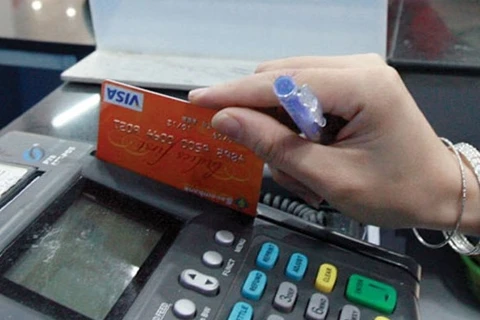
Credit card holders will not be allowed to withdraw cash at card readers of domestic points of sale (POS) from March this year, says the State Bank of Vietnam (SBV) (Photo: tuoitre.vn)
 Hanoi (VNA) - Credit card holders will not be allowed to withdraw cash at card readers of domestic points of sale (POS) from March this year, said the State Bank of Vietnam (SBV).
According to new Circular No 26/2017/TT-NHNN to amend and supplement Circular No 19/2016/TT-NHNN on bank card operation, a cardholder can still withdraw a maximum amount of cash in foreign currency equivalent to 30 million VND (around 1,300 USD) a day in POS units in a foreign country.
The new circular is different from the SBV’s draft circular which was released last November. Under the draft, credit card holders were allowed to withdraw cash at domestic card accepting units, but with a limit of less than 5 million VND a day. The regulation for cash withdrawal in a foreign country has remained unchanged compared with the draft.
According to the draft circular, SBV tended to accept cash withdrawal at card accepting units with the aim of meeting cash payment request in some urgent cases and expanding POS services as well. The plan set a target of gradually increasing the number and value of card payment transactions using card readers.
Experts have so far agreed with the central bank’s decision to prohibit cash withdrawal at domestic card accepting units.
According to banking expert Nguyen Tri Hieu, cash withdrawal at card readers of POS goes against the system and leads to frauds when customers withdraw cash exceeding their credit limit.
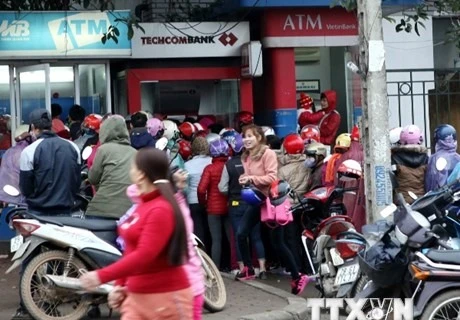
Vietnam saw a decline in cash withdrawals for the third consecutive year in 2017, with the rate reducing from 15 percent in 2016 to 10 percent in 2017, according to reports of the SBV.
Industry insiders predict that non-cash payment will see significant changes next time. They cite the example of payment methods using QR codes. Though launched for a short time, this payment method surged sharply by 120 percent in the first nine months of last year, with 5,000 POS accepting the QR code. The POS number is estimated to increase 10 times by the end of this year to 50,000 points.
The SBV has so far implemented a plan to develop card payment using card readers at POS and mobile points of sale (mPOS) from 2017 to 2020, which is aimed at boosting the non-cash payment method in Vietnam, as approved in Decision 2545/QD-TTg by the Prime Minister.
Accordingly, the ratio of cash to total payment instruments will be below 10 percent by the end of 2020. By 2020, the whole market will have more than 300,000 card readers installed at POS to process some 200 million transactions every year.-VNA
According to new Circular No 26/2017/TT-NHNN to amend and supplement Circular No 19/2016/TT-NHNN on bank card operation, a cardholder can still withdraw a maximum amount of cash in foreign currency equivalent to 30 million VND (around 1,300 USD) a day in POS units in a foreign country.
The new circular is different from the SBV’s draft circular which was released last November. Under the draft, credit card holders were allowed to withdraw cash at domestic card accepting units, but with a limit of less than 5 million VND a day. The regulation for cash withdrawal in a foreign country has remained unchanged compared with the draft.
According to the draft circular, SBV tended to accept cash withdrawal at card accepting units with the aim of meeting cash payment request in some urgent cases and expanding POS services as well. The plan set a target of gradually increasing the number and value of card payment transactions using card readers.
Experts have so far agreed with the central bank’s decision to prohibit cash withdrawal at domestic card accepting units.
According to banking expert Nguyen Tri Hieu, cash withdrawal at card readers of POS goes against the system and leads to frauds when customers withdraw cash exceeding their credit limit.
Vietnam saw a decline in cash withdrawals for the third consecutive year in 2017, with the rate reducing from 15 percent in 2016 to 10 percent in 2017, according to reports of the SBV.
Industry insiders predict that non-cash payment will see significant changes next time. They cite the example of payment methods using QR codes. Though launched for a short time, this payment method surged sharply by 120 percent in the first nine months of last year, with 5,000 POS accepting the QR code. The POS number is estimated to increase 10 times by the end of this year to 50,000 points.
The SBV has so far implemented a plan to develop card payment using card readers at POS and mobile points of sale (mPOS) from 2017 to 2020, which is aimed at boosting the non-cash payment method in Vietnam, as approved in Decision 2545/QD-TTg by the Prime Minister.
Accordingly, the ratio of cash to total payment instruments will be below 10 percent by the end of 2020. By 2020, the whole market will have more than 300,000 card readers installed at POS to process some 200 million transactions every year.-VNA
VNA