Noi Bai airport planned to welcome 63 million passengers per year

The Civil Aviation Authority of Vietnam (CAAV) has submitted to the Ministry of Transport a report on the adjustment of the planning scheme for the already overloaded Noi Bai International Airport which aims to double its capacity to welcome 63 million passengers a year by 2030.
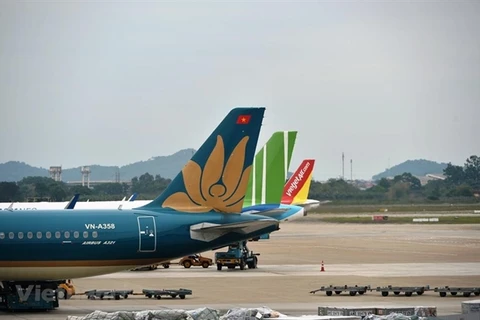
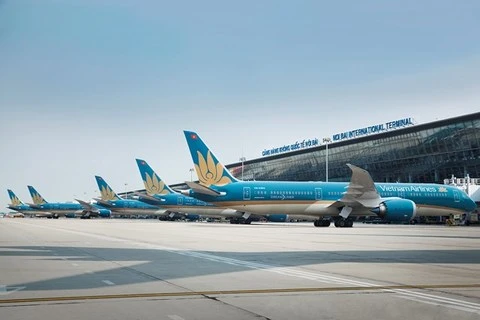
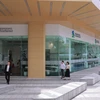
Noi Bai airport planned to welcome 63 million passengers per year ảnh 1A corner of the Noi Bai International Airport (Source: VNA)

Hanoi (VNA) – The Civil Aviation Authority of Vietnam (CAAV) hassubmitted to the Ministry of Transport a report on the adjustment of the planning scheme for the already overloaded Noi BaiInternational Airport which aims to double its capacity to welcome 63 millionpassengers a year by 2030.

According to the plan, the airport is projected to serve both civil and militarypurposes and capable of handling large long-haul aircraft such as B777-X, B747-8, B777-300ER and A380.

By 2030, the airport will have an estimated capacity of 63million passengers and two million tonnes of cargo per year. To this end,the CAAV has proposed building a third runway in the south of the airport. Theairport's existing terminal T2 will be expanded so that the combined capacityof terminals T1 and T2 will reach 30-40 million passengers per year, and a newterminal T3 with a capacity of 30 million passengers per year will be built tothe south.

By 2050, the CAAV estimates the airport to serve 100 millionpassengers and handle 5 million tonnes of cargo each year.

The airport's planning scheme will therefore be adjusted with theaddition of a fourth runway to the south as well as terminal T4 with anannual capacity of 25 million passengers at the site of the current terminal T1and a new terminal T5 with a capacity of 25 million passengers when the demand rises.

The airport's land use planning meanwhile will follow theapproved master plan for Hanoi, which allocates about 2,230 hectares to theairport to ensure enough land for national defence purposes.

The number of passengers and cargo passing through the NoiBai Airport has been increasing by an average of 10 percent per year, with theairport receiving nearly 26 million passengers in 2018 and about 29 millionpassengers in 2019.

However, the airport is only designed to handle 25 millionpassengers per year, with the domestic terminal T1 having a capacity of 15million and the international terminal T2 is servicing the remaining 10 millionpassengers per year./.


VNA

See more

Workers process clams for export at the factory of Thanh Hoa Fishery Import-Export JSC in Thanh Hoa province. (Illustrative photo: VNA)

Vietnam notifies WTO committee of goods origin management reforms

The information presented by Vietnam attracted attention from others WTO members amid global efforts to accelerate the digital transformation of import – export procedures and improve the implementation of rules of origin to enhance supply chain adaptability.

A Petrolimex worker refuels a motorbike. (Photo: VNA)

Energy imports surge in first quarter of 2026

Data from Vietnam Customs shows that the country spent approximately 2.93 billion USD importing nearly 3.37 million tonnes of petroleum products in the first quarter of 2026, an increase of 77.8% in value and over 44% in volume compared to the same period last year.

A perspective of the Quang Ninh 1 Wind Power Plant project (Photo: Quang Ninh provincial Department of Construction)

Quang Ninh gives nod to first offshore wind power plant

The project is expected to have a designed capacity of 50 MW and will be implemented in nearshore waters of the Co To special zone. It will be the first offshore wind power project in the province, playing a pioneering role in tapping Quang Ninh’s abundant renewable energy potential.

Viettel launches the Unitel Logistics brand in Laos. (Photo: VNA)

Vietnamese firms expand global footprint

The Government recently approved the “Go Global” programme for 2026-2030, which identifies the private sector as a key driving force in Vietnam’s international expansion process. It aims to help Vietnamese private enterprises strengthen their overseas presence in a comprehensive, effective and sustainable manner through international investment, business activities and deeper integration into regional and global supply and value chains.

Vietnam and Cambodia are seeking to strengthen supply chain connectivity and promote sustainable border trade at a trade promotion conference in Vietnam's Mekong Delta province of Dong Thap on May 15. (Photo: https://thoibaonganhang.vn/)

Vietnam, Cambodia eye stronger border trade, supply chain connectivity

Vietnam–Cambodia trade ties have grown rapidly in recent years, becoming one of the major pillars of economic cooperation in the Mekong sub-region. The two countries share a 1,137-km border and an increasingly developed network of international and secondary border gates, facilitating cross-border trade, logistics and investment.

Illustrative image. (Photo: VNA)

Three proposals to connect overseas Vietnamese resources with private economy at home

There are currently many Vietnamese IT specialists working in technology corporations, banks, start-ups and innovation ecosystems across Canada. With appropriate mechanisms in place, this workforce could become a technology bridge, helping Vietnamese enterprises access management expertise, technical solutions, international standards and partnership networks in North America.

The Nguyen Van Linh–Nguyen Huu Tho intersection fully opens both underpasses to traffic, helping ease congestion in the area. (Photo: VNA)

Ho Chi Minh City pushes for full public investment disbursement

Ho Chi Minh City was allocated a record 147.599 trillion VND (5.6 billion USD) in public investment capital for 2026, up 22.6% from last year and accounting for nearly 14.6% of the nation’s total public investment budget. However, disbursement by the end of April remained below the national average.

Visitors explore Quang Tri province’s OCOP products (Photo: VNA)

Quang Tri links OCOP products with tourism to expand farm produce markets

The central province currently has 160 OCOP products developed by cooperatives, cooperative groups and businesses, including two five-star and 31 four-star products. These locally distinctive products are gradually becoming "ambassadors" showcasing Quang Tri’s culture and identity to domestic and international visitors.