Origin fraud may erode Vietnamese rice’s prestige: insiders

High prices of rice sold in the domestic market and for export in the recent past have fueled risks of origin fraud, influencing the prestige of Vietnamese rice in the global market, insiders have warned.
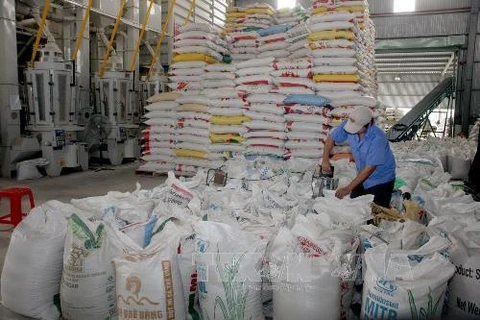
Origin fraud may erode Vietnamese rice’s prestige: insiders ảnh 1Workers package rice for export at a food processing factory in Long An province (Photo: VNA)
HCM City (VNA) – Highprices of rice sold in the domestic market and for export in the recent pasthave fueled risks of origin fraud, influencing the prestige of Vietnamese ricein the global market, insiders have warned.

Export prices of Vietnameserice have stayed high so far this year, helping the five-month export turnoverfall down by only five percent despite an 11.3-percent drop in volume.

By mid-June, businesses imported304,000 tonnes of rice from India via ports in Ho Chi Minh City. The volumeincluded over 112,000 tonnes of 100-percent broken rice, 54,000 tonnes ofunhusked rice and 12,000 tonnes of husked rice for animal feed production, and126,000 tonnes of five-percent broken rice, according to the municipalDepartment of Customs.

The large import of the five-percentand completely broken rice from India is attributed to the fact that theirprices only stand at some 400 USD and 280 USD per tonne, about 100 USD pertonne lower than prices of the Vietnamese counterparts.

Besides, under the ASEAN -India Trade in Goods Agreement, five-percent and 100 percent broken rice fromIndia is entitled to an import tariff of zero percent. Given this, Indian riceimported into Vietnam boasts much more competitive prices than Vietnamese rice.

Notably, the surge in riceimport from India has been accompanied by an increase in origin fraud.

The HCM City Department ofCustoms said it has detected several signs of fraud and violation by riceexporters and importers.

Phan Van Co, MarketingDirector of the VRICE Co. Ltd, noted many enterprises have imported white ricefrom India to polish, mix it with the white rice of Vietnam, and then exportthe grain to foreign markets under the name of Vietnamese rice, which hasseriously affected the prestige and brand of rice from the country.

As a consequence, somepartners have suspended buying rice from Vietnam, he noted.

Some companies have alsoimported the grain from India and sold it as Vietnamese rice at higher pricesin the domestic market, Co went on.

Pham Thai Binh, GeneralDirector of the Trung An Hi-Tech Farming JSC, attributed the high prices of andcustomers’ preference for Vietnamese rice in foreign markets to efforts by thewhole system, from farmers to processing and exporting companies, and economicdiplomacy by the Government, ministries, and sectors.

Therefore, only one batch ofgoods with origin fraud can have severe impact on the prestige and brand of itsentire export sector, he noted, pointing out that due to importers’ suspicionover the origin of Vietnamese rice, export prices have declined fast recently,from 520 - 530 USD per tonne in the last winter - spring crop to 470 - 480 USDat present, while the number of export orders has also been decreasing.

If this problem lingers,domestic rice prices will continue the downward trend, causing losses tofarmers, honest exporters, and the entire rice industry of Vietnam, Binh added.

Co recommended authoritiesadopt mechanisms for monitoring imported rice, strictly dealing with violators,and publicising the names of businesses committing fraud.

The HCM City Department ofCustoms said the customs force has stepped up collecting and analysinginformation about rice importers and exporters so as to detect fraud in atimely manner. It has also proposed the General Department of Vietnam Customsto ask the Ministry of Industry and Trade for more details about export rice ofVietnam and fraud warnings, and for additional regulations on rice export./.
VNA
See more

Head of the Vietnam Trade Office in Australia Tran Thi Thanh My (Photo: VNA)

Vietnam, Australia eye 20 bln USD trade target

The head of the Vietnam Trade Office in Australia hoped that the visit by Party General Secretary and State President To Lam will mark a new milestone, opening the door for firms on both sides to forge stronger links and launch concrete cooperation agendas, helping hit that 20 billion USD trade goal sooner rather than later.

Phu Quoc pepper products, granted three stars under the OCOP programme in An Giang province, are displayed at an exhibition of outstanding OCOP products from the Mekong Delta. (Photo: VNA)

Phu Quoc leverages OCOP programme to take local specialities global

Better known as one of Vietnam’s premier island destinations, Phu Quoc is leveraging its “One Commune, One Product” (OCOP) programme to transform traditional specialities into internationally recognised products, integrating local agriculture, food processing and tourism to promote sustainable economic growth.

Production at an FDI enterprise in Tay Ninh province. (Photo: VNA)

FTA Index 2025 to be unveiled later this month

The index is designed to provide valuable information not only for State management agencies but also as an important reference for businesses, foreign investors, and industry associations in planning investment and business activities in Vietnam.

Air Premia, a carrier of the Republic of Korea, will resume flights between Incheon and Ho Chi Minh City from November 5. (Photo: The Courtesy of Air Premia)

Air Premia to resume Incheon–Ho Chi Minh City route from November

Flights will depart Incheon International Airport at 6:40 pm (RoK time) and arrive at Tan Son Nhat International Airport in Ho Chi Minh City at 11 pm (Vietnam time). Return flights will leave Ho Chi Minh City at 12:30 am on Mondays, Tuesdays, Thursdays, Fridays and Sundays, landing in Incheon at 7:40 am.

Production at Viet Hai High-Tech Structure Production Company Limited in Vung Ang Economic Zone. Ha Tinh province aims to develop Vung Ang Economic Zone into a regional centre for industry, energy, seaports and logistics (Photo: VNA)

Revised master plan of Vung Ang EZ approved

The adjustment aims to create a more rational development framework to maximise the zone’s potential and advantages while providing a legal foundation for construction management and ensuring sustainable development.

Illustrative image (Photo: VNA)

Vietnam looks to domestic market to sustain wood industry growth

Vietnam’s wood sector has long been a top foreign-currency earner. Exports of wood and wooden products neared 17.3 billion USD in 2025, reaching more than 160 countries and territories and clearing the high bars set by the US, the European Union and Japan.

Delegates at the event (Photo: VNA)

Vietnam remains key market for Polish food producers

The campaign promotes selected European Union agricultural and food products, including fresh, chilled and frozen beef and pork, fresh apples, apple juice and dried apples, targeting consumers, importers, distributors, retailers and the hospitality sector.

Wei Xiaoli, a representative of Shandong Jindafeng Machinery Co., Ltd., in an interview granted to the Vietnam News Agency. (Photo: VNA)

Chinese firms see strong potential for agricultural mechanisation cooperation with Vietnam

Business representatives said mechanisation not only helps reduce reliance on manual labour but also improves production efficiency, shortens planting and harvesting times, reduces post-harvest losses and enhances the quality of agricultural products. For rice-producing countries like Vietnam, they noted, accelerating mechanisation is an inevitable trend to strengthen the competitiveness of the agricultural sector.

Community-led fisheries groups have become frontline defenders of coastal fisheries. (Photo: VNA)

Community-led fisheries groups strengthen IUU fight in Ha Tinh

With a long coastline and abundant inshore fishing grounds, Ha Tinh has long identified the marine economy as a key growth driver. However, growing fishing pressure and destructive practices have posed major management challenges. Community-led self-management initiatives are now providing an effective solution.

At the VIFC-HCMC (Photo: VNA)

700 bln USD for net zero: Vietnam bets on VIFC

Assoc. Prof. Dr. Nguyen Huu Huan, Vice Chairman of the Executive Board of VIFC-HCMC, said the VIFC will focus on building market infrastructure needed to bridge the gap between big investment pledges and bankable projects.

A view of the launch ceremony for the expanded Vietnam–China cross-border QR payment service. (Photo: NAPAS)

Over 1 billion Weixin Pay users can make QR code payments in Vietnam

NAPAS, Weixin Pay, and BIDV will study the rollout of the reverse payment service, enabling users of Vietnamese banking applications and e-wallets to make QR code payments in China, with the aim of completing a comprehensive cross-border payment ecosystem between the two countries.