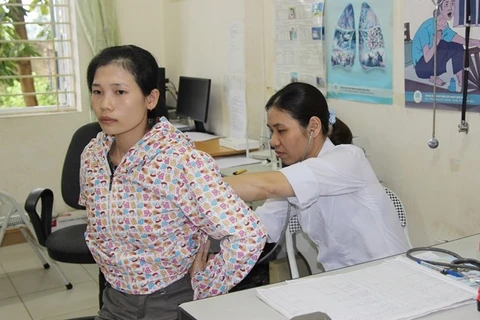
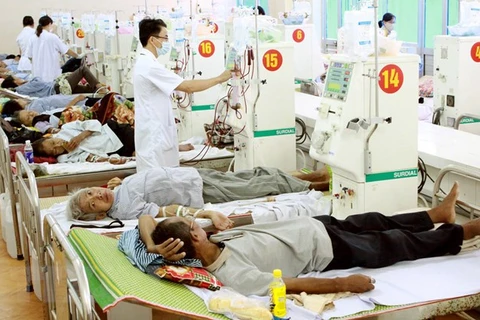
Patients register for health checkup at a hospital in Hanoi (Photo: suckhoedoisong.vn)
 Hanoi (VNS/VNA) - Local-level health care facilities are expected to increase their capacity and provide better services to help reduce pressure at central hospitals by “gaining public trust”, said Nguyen Nam Lien, Director of the Health Ministry's Planning and Finance Department, at a recent press conference in Hanoi.
As Vietnamese in general tend to skip their local health facilities to go straight to central hospitals located in urban centres when they seek treatment, causing persistent overloading at these hospitals, the Government has been trying to find ways to improve the attractiveness of grassroots health care.
Director Lien said that in the coming time, the ministry will continue to invest in grassroots health care, especially at the district and commune level. Grassroots medical health facilities are also ordered to strengthen preventive care, monitoring and management of non-communicable diseases, as well as early diagnosis and effective initial treatment to help curb treatment costs for the people and the health insurance fund.
Medical facilities that saw an increase in hospital visits must arrange for more doctors during peak periods to make sure that each patient is examined sufficiently.
Facilities that frequently face an overflow of patients must report to the provincial People’s Committee to increase beds and staff, or to transfer patients to another facility.
Grassroots level medical facilities are also asked to draw 3-5 percent of their revenues from bed fees, treatment and examination fees to invest in upgrading infrastructure, medical equipment and other utilities.
Lien said the ministry will continue promoting technology transfer, including transfer of medical staff, from central level hospitals to their lower level counterparts.
The Vietnam Social Security (VSS) will regularly hold unannounced inspections to report to the health ministry on medical facilities that have prescribed excessive medical services or unnecessarily long inpatient treatment for patients.
Director Lien also rebutted recent claims that the ministry had hiked hospital fees to as much as 100 times the actual costs with the new circular on adjusting hospital fees (Circular 15/2018/TT-BYT on May 30).
“This is incorrect information. The Vietnam Social Security has reported to the Deputy Prime Minister on this matter,” he said.
To calculate the new pricing scheme, the health ministry has surveyed winning bids results from both central hospitals and grassroots medical facilities, with consideration to each locality’s level of economic development.
“The claim that we base our pricing scheme only on surveys from central hospitals is wrong.”
Surveys have been conducted at 30 hospitals, while reports from four special class hospitals, 56 class 1 hospitals (entities under the management of the health ministry or provincial/municipal people’s committees), 140 class 2 hospitals (under the management of provincial/municipal health departments), and 250 class 3 hospitals (under the management of provincial/municipal health departments, serving residents of a district or a number of districts only) have been compiled, according to Director Lien.
He was referring to the allegation that the ministry developed the new pricing scheme on central level hospitals based in big cities, which are not representative and generally have higher prices.
However, he admitted that there are hundreds of hospitals belonging to each class, while all of them will use the circular on standard pricing, which means there could be small differences between actual costs and the fees charged on patients.
The Circular 15 will provide for a ‘unified’ examination and treatment pricing scheme for health insurance card holders between hospitals of the same class across the country. Eighty-eight medical services will be subject to changes, with 70 to become cheaper.
Especially, examination costs are expected to be brought down by 15-20 percent; 30 imaging and screening tests will receive an average cut of 24 percent.-VNA
VNA