Phu Quoc works to popularise fish sauce making trade

The Ministry of Culture, Sports and Tourism recognised the trade of making fish sauce on Phu Quoc island in the Mekong Delta province of Kien Giang as a national intangible cultural heritage in late May, creating a driving force for local residents to maintain and uphold the essence of the traditional craft.
Phu Quoc works to popularise fish sauce making trade ảnh 1

Photo: Tourists visit a fish sauce making establishment on Phu Quoc island (Photo: VNA)

Hanoi (VNA) - The Ministry of Culture, Sports and Tourism recognised the trade of making fish sauce on Phu Quoc island in the Mekong Delta province of Kien Giang as a national intangible cultural heritage in late May, creating a driving force for local residents to maintain and uphold the essence of the traditional craft.

Covering an area of 589.27 sq.km, Phu Quoc is the largest island in Vietnam with a long coastline. It has long been known as the country's leading fish sauce producer.

Chairwoman of the Phu Quoc Fish Sauce Association Ho Kim Lien said Phu Quoc sea is home to a variety of seaweed and plankton that are major feed sources for anchovy - a key ingredient in its fish sauce.

The craft started in Phu Quoc over 200 years ago and has been developing ever since. Local residents catch anchovy and salt them before fermenting the fish in giant wooden barrels.

Such a way of fermentation is a feature of the traditional craft. The older the barrel is, the more durable it becomes and the better the quality of the fish sauce is.

Barrels have a wide upper end and are made from 55 planks of equal size: 2.2m long, 20cm wide, and 6cm thick. The diameter of the upper ends is about 3.2 metres and that of the bottom, some 2.6 metres. The barrels are also strapped with green rattan.

Lien said the sauce is produced in traditional methods, with the recipe being a ratio of three anchovy and one salt, and the fermentation period of from 10 to 15 months. From the first to final extraction, the fish sauce is divided into different grades based on their protein levels. The product has an amber colour and a slight aroma.

Phu Quoc works to popularise fish sauce making trade ảnh 2

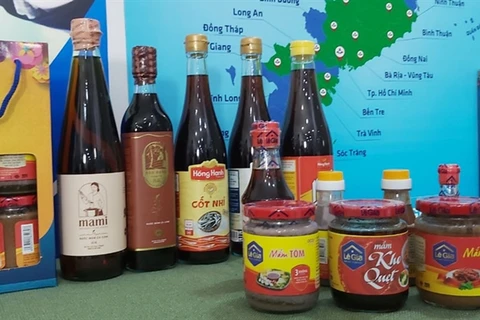
Photo: Phu Quoc traditional fish sauce products (Photo: VNA)

With support from the French Embassy in Hanoi in 1998, the Ministry of Fisheries along with Kien Giang province prepared an application for geographical indication. On June 1, 2001, Phu Quoc fish sauce was the first product in Vietnam to secure such a status.

In July 2013, the EU granted the “Phu Quoc” origin certificate to the Vietnamese fish sauce.

A month later, the Ministry of Industry and Trade handed over the certificate to representatives of the Phu Quoc island district People’s Committee and the Phu Quoc Fish Sauce Association and it has now become an attractive local tourism product.

Phu Quoc city is now home to around 100 fish sauce makers, mostly in Duong Dong and An Thoi wards. Between now and 2025, it will strive to produce 12 million litres of fish sauce each year on average.

According to Lien, a major difficulty for the industry is that some consumers cannot identify genuine Phu Quoc traditional fish sauce, leading to unstable prices. There is currently no planning for a Phu Quoc fish sauce craft village, so it has not yet become a tourist destination.

The Phu Quoc Fish Sauce Association, founded in October 2000 and with 53 members, will pay attention to developing fish sauce quality to continue promoting its trademark, she said.

Efforts are also exerted to seek UNESCO’s recognition for the product as a world intangible cultural heritage, contributing to improving its brand value and promoting the image of Phu Quoc island city.

Fish sauce is used in every kitchen in Vietnam and has been closely tied to the country's culinary and cultural customs for three centuries. It is considered the soul of Vietnam's cuisine, and used for cooking as a key component or a dipping sauce./.
VNA

See more

A performance by the Ruby’s Dance Crew at a celebration of Vietnam's National Day in Hong Kong (Photo: VNA)

Artist helps Vietnamese culture shine in Hong Kong

Teaching traditional dance and songs to children growing up overseas has never been easy. Differences in living environments and ways of thinking, together with pronunciation influenced by the local language, mean that the children need more time to grasp rhythms and pronounce Vietnamese correctly.

A musical performance at the Vietnamese Cultural Festival in Asahikawa, Hokkaido (Photo: VNA)

Vietnamese Cultural Festival brings people together in Japan

Over the two days, the festival featured a range of cultural, artistic and community activities, including a Japanese speech contest for Vietnamese participants, quizzes on Japanese law, culture and history, a Japanese karaoke contest, art performances and Yosakoi exchanges.

Vietnamese Consul General in Perth Pham Hai Anh delivers the opening remarks at the festival. (Photo: VNA)

Vietnamese Lantern Festival connects cultures in Darwin

This year’s festival showcased the waterways, boats and monkey bridges of the Mekong Delta, along with handicrafts made from coconut leaves, bringing the distinctive character of Vietnam’s southern region to life through decorations, interactive activities and artistic performances.

Top 6 contestants of 73rd Miss World pageant (Photo: VNA)

Miss World 2026 promotes Vietnamese culture, tourism

On September 4-5 alone, Khanh Hoa welcomed around 95,000 visitors staying overnight, including approximately 38,000 international visitors, highlighting the event’s considerable appeal and the province’s image as a safe, attractive and welcoming destination.

UNESCO Director-General Khaled El-Enany (Photo published by VNA)

UNESCO, countries welcome Vietnam-led cultural initiative

UNESCO Director-General Khaled El-Enany hailed the UN General Assembly’s proclamation of the International Decade of Culture for Sustainable Development (2027–2036), thanking Vietnam for promoting the initiative, as well as all co-sponsoring countries, members of the core group and the Group of Friends for Culture at the UN for their support.

The Miss World 2026 event in Nha Trang is a showcase of global cultures. (Photo: Miss World 2026 Organising Board)

Miss World 2026 contestants showcase global cultures in Nha Trang

Hosting the final activities and grand final of Miss World 2026 offers Khanh Hoa an opportunity to promote its natural landscapes, cultural heritage and people to international audiences, while attracting visitors to Nha Trang during the National Day holiday.

Border residents and visitors join cultural, sports and tourism activities in Long Sap commune, Son La province. (Photo: QuVNA)

Vietnam-Laos border communities strengthen bonds of friendship

Through the programme, Son La aims to showcase the nature, culture and people of Long Sap, promote traditional cultural values alongside sustainable tourism, boost tourism and trade, and foster stronger cooperation contributing to sustainable socio-economic development in Long Sap and the Moc Chau National Tourism Area.

Young girls at a buckwheat flower valley in Tuyen Quang province. (Photo: VNA)

Culture industries open new growth opportunities for Tuyen Quang

Following its administrative merger, Tuyen Quang is home to 46 ethnic groups, with ethnic minorities accounting for more than 70% of its population. The province has 794 historical and cultural relic sites and 871 intangible cultural heritage items, including 53 recognised as national intangible cultural heritage.

Visitors explore Hà Nội’s master urban plan through a 3D mapping display at the Hà Nội Museum. (Photo: VNA)

Museums enter the digital age

From 3D displays and virtual tours to AI assistants and digital collections, museums across Vietnam are rethinking how heritage is preserved, presented and experienced, with technology opening new ways for the public to connect with the past.