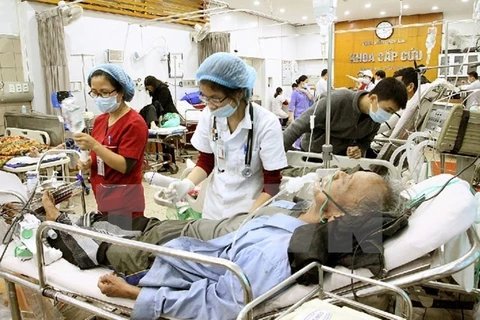
A medical staff member at the Dong Da General Hospital in Hanoi inputs patients’ information on a compute (Photo: VNA)
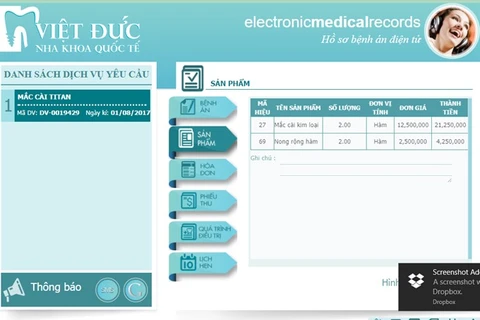
 Hanoi (VNS/VNA) - Keeping medical records in an electronic database brings benefits to citizens and healthcare facilities, experts have concluded thanks to a pilot project launched in June.
The pilot by the Ministry of Health (MoH) introduced software to compile citizens’ medical records in one electronic database in eight cities and provinces in June. Participating localities are Hanoi and HCM City and the provinces of Lao Cai, Yen Bai, Ha Tinh, Khanh Hoa, Lam Dong and Long An.
People who keep their medical records in the database said they were satisfied with the convenience of the system.
Nguyen Van Thanh from Hanoi’s inner district of Ba Dinh said he no longer had to carry all of his child’s written medical records every time he took him to a hospital.
“Now at every hospital we go to, the doctors have already known about his conditions,” he told Hai Quan (Customs) newspaper.
“If the database is used in the whole medical sector nationwide, it will take the burden off our shoulders.”
In addition to keeping patients’ information—including blood type, diseases and allergies—the database also helps synchronise all this information between healthcare facilities at different levels (communal, district, provincial and central), making it easier for citizens to get health checkups everywhere they want.
Dao Ngoc Mai from Hanoi’s outer district of Gia Lam said: “Previously, we farmers only went to hospitals when we got really sick. But the convenience of the database encouraged us to get regular checkups and helped us keep track with our health conditions.”
But some people are worried that health centres in their areas are not equipped with proper facilities to implement the system.
In order to expand the system nationwide in July next year in accordance with the MoH’s plan, Nguyen Khac Hien, Director of the Hanoi Department of Health said more equipment and trained staff would be provided to wards and communes within the city.
“All medical centres will have internet connections and use the same software to access the database,” he said.
“Each citizen will get their own code, and their information will get updated into the system from any healthcare facility they go to,” he added.
“We will also collaborate with schools and State-owned agencies to get medical information of students and civil servants.”
Le Truong Giang, President of the HCM City Public Health Association, said that health centres in the city should increase collaboration and exchange information since most of them are using different software programs to keep citizens’ medical records.
“They should also pay close attention to ensuring information security,” he said.
"Electronic medical records and social security numbers are among the essential tools that will help to simplify medical procedures for citizens," said Nguyen Trong Khoa, Deputy Director of the MoH’s Department of Medical Examination Management.
“With these tools, doctors can easily get hold of their patients’ health conditions and patients will not be required to take unnecessary tests, especially during emergencies,” he said.-VNS/VNA
The pilot by the Ministry of Health (MoH) introduced software to compile citizens’ medical records in one electronic database in eight cities and provinces in June. Participating localities are Hanoi and HCM City and the provinces of Lao Cai, Yen Bai, Ha Tinh, Khanh Hoa, Lam Dong and Long An.
People who keep their medical records in the database said they were satisfied with the convenience of the system.
Nguyen Van Thanh from Hanoi’s inner district of Ba Dinh said he no longer had to carry all of his child’s written medical records every time he took him to a hospital.
“Now at every hospital we go to, the doctors have already known about his conditions,” he told Hai Quan (Customs) newspaper.
“If the database is used in the whole medical sector nationwide, it will take the burden off our shoulders.”
In addition to keeping patients’ information—including blood type, diseases and allergies—the database also helps synchronise all this information between healthcare facilities at different levels (communal, district, provincial and central), making it easier for citizens to get health checkups everywhere they want.
Dao Ngoc Mai from Hanoi’s outer district of Gia Lam said: “Previously, we farmers only went to hospitals when we got really sick. But the convenience of the database encouraged us to get regular checkups and helped us keep track with our health conditions.”
But some people are worried that health centres in their areas are not equipped with proper facilities to implement the system.
In order to expand the system nationwide in July next year in accordance with the MoH’s plan, Nguyen Khac Hien, Director of the Hanoi Department of Health said more equipment and trained staff would be provided to wards and communes within the city.
“All medical centres will have internet connections and use the same software to access the database,” he said.
“Each citizen will get their own code, and their information will get updated into the system from any healthcare facility they go to,” he added.
“We will also collaborate with schools and State-owned agencies to get medical information of students and civil servants.”
Le Truong Giang, President of the HCM City Public Health Association, said that health centres in the city should increase collaboration and exchange information since most of them are using different software programs to keep citizens’ medical records.
“They should also pay close attention to ensuring information security,” he said.
"Electronic medical records and social security numbers are among the essential tools that will help to simplify medical procedures for citizens," said Nguyen Trong Khoa, Deputy Director of the MoH’s Department of Medical Examination Management.
“With these tools, doctors can easily get hold of their patients’ health conditions and patients will not be required to take unnecessary tests, especially during emergencies,” he said.-VNS/VNA
VNA