Minister of Planning and Investment Nguyen Chi Dung (Photo: MPI)
 Hanoi (VNA) – After more than two years of implementing the Planning Law, ministries, sectors and localities have revamped State management and stepped up coordination and information sharing.
Minister of Planning and Investment Nguyen Chi Dung told the press that under the drastic and close instruction of the Government and the Prime Minister, major achievements have been made during the implementation of the Planning Law.
Forming regional, national planning schemes
Competent agencies have issued documents guiding the implementation of the Planning Law, and relevant laws and ordinances, creating a legal corridor to carry out the planning work in the new period.
Ministries, sectors and localities have also drawn up planning schemes in line with the Planning Law. A total of 19 national planning schemes, one regional planning scheme and 26 others at the provincial level are expected to be outlined and submitted to competent agencies for approval this year.
Meanwhile, 19 other national planning schemes, five regional schemes and 37 provincial schemes would be completed and seek approval next year.
Notably, competent agencies have scrapped specific planning schemes on goods, products and services and replaced them with conditions and standards, helping to simplify business conditions and create a fair, open investment climate.
The reform in the planning work at ministries, agencies and localities has dealt with the overlap of documents.
To reap the achievements, attention has been paid to the supervision and implementation of planning schemes.
Limitations still remain
According to the minister, there are still difficulties in the enforcement of the Planning Law, partially due to the slow implementation of documents detailing relevant laws and ordinances.
Many localities have also found it hard to materialise new regulations of the Planning Law, especially those regarding the new planning method under which 50 sectoral planning schemes will be integrated into a provincial one.
In fact, the building of planning schemes for 2021-2030 at ministries, agencies and localities has failed to meet the deadline.
Moreover, limitations in coordination between ministries, agencies and localities have also led to the sluggishness, Dung said.
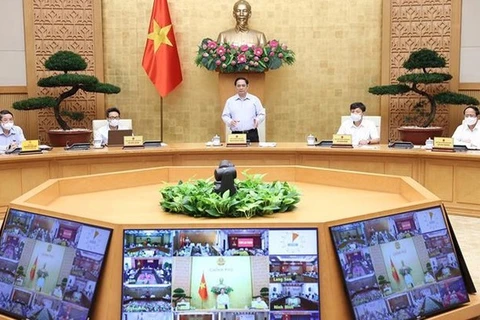
 Illustrative image (Source: VNA)
 He added that complex developments of the COVID-19 pandemic have also greatly affected the study work, data collection and consultancy in planning, making it hard to mobilise experts, especially international consulting firms.
Leaders hold responsibility
To complete the assigned tasks, the MPI has reviewed the implementation of the Planning Law and will report it to the Government and the Prime Minister for consideration.
It has also worked as an advisor for the Government to support the operation of the National Assembly’s supervision team in the enforcement of policies and laws, and the planning work since the Planning Law took effect on January 1, 2019.
At a national conference on the planning work chaired by Prime Minister Pham Minh Chinh on September 19, participants sought ways to create remarkable changes in the implementation of the Planning Law, and accelerate and improve the quality of the work in the time ahead.
Accordingly, leaders of agencies will have to raise their sense of responsibility, Dung said, adding that the conference also considered establishing a national steering committee that will instruct and coordinate with ministries, ministerial-level agencies and localities in the planning work for 2021-2030.
The participants also agreed to propose the Government issue a resolution to monitor the realisation of tasks and solutions, thus removing obstacles regarding mechanisms and policies in this field.
They also suggested amending some decrees guiding technical and specialised planning, making it match regulations of the Planning Law.
The Planning Law and 73 other relevant laws and ordinances (amended and supplemented) sailed through the 14th National Assembly and the NA Standing Committee, and came into force in January 2019.
They have created profound changes in institutions, mindset and methods in planning./.