PM sets major goals for banking sector in digital transformation

Prime Minister Pham Minh Chinh has set three major digital transformation targets for the banking sector, including creating the most favourable conditions for people, businesses and agencies to access banking services.

Prime Minister Pham Minh Chinh addresses the event (Photo: VNA)

Hanoi (VNA) – Prime Minister Pham Minh Chinh has set three major digital transformation targets for the banking sector, including creating the most favourable conditions for people, businesses and agencies to access banking services.

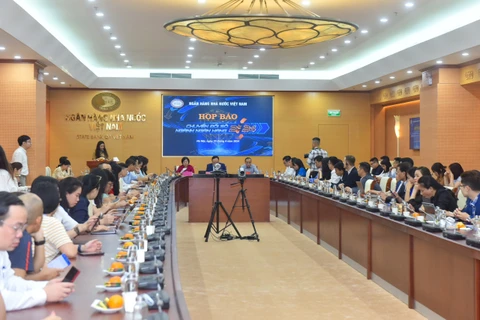
At an event on digital transformation in the banking industry held by the State Bank of Vietnam (SBV) in Hanoi on May 8, the PM said digital transformation should contribute to reducing time and compliance cost for people, businesses and agencies and the banking system itself, while helping control risks and prevent corruption.

The Government leader requested the banking sector to focus on strengthening the perfection of institutions and mechanisms, creating a full legal corridor for the development, expansion and diversification of modern banking services meeting international standards, and promoting the development of the digital banking ecosystem, meeting the growing requirements of the economy.

Alongside, it is necessary to boost electronic payment infrastructure, diversifying banking products and services, creating an important foundation for the development of the digital banking ecosystem and digital economy, while speeding up digital transformation to support banking inspection and supervision, thus enhancing publicity, transparency, and preventing corruption and money laundering.

At the same time, the PM also underlined the need to develop digital human resources in the banking industry, especially high-quality human resources to meet the development needs of the industry and international cooperation activities, along with the enhancement of security and safety in payment, protection of personal data and application of new security standards, ensuring fast, safe, convenient payment at reasonable cost.

PM Chinh emphasised that the banking sector should effectively implement tasks and solutions stated in the national digital transformation strategy, the strategy for banking sector’s development, the digital transformation plan in the banking industry, and Directive 18 on strengthening data connections and sharing serving the development of e-commerce, preventing tax loss and ensuring monetary security.

According to the SBV, after three years of implementing the digital transformation plan for the banking sector until 2025 with a vision to 2030, the sector has reaped fruitful results.

To date, more than 87% of adults have payment accounts at banks and many banks have over 95% of transactions processed on digital channels. The average growth in the number of payment transactions via mobile devices and QR code from 2017 to 2023 reached over 100% per year.

Banking technology infrastructure has been upgraded and developed, ensuring continuous, smooth and safe operations. New digital technologies have also been strongly applied to develop new products and services, meeting the increasing needs of people and businesses. Vietnam has completed cross-border payment connections via QR codes with Thailand, Cambodia, and is connecting with Laos, and expectedly with countries inside and outside the ASEAN region, the SBV said.

The banking sector has closely coordinated with the Ministry of Public Security in crime prevention and control and in using residential data to serve customer information data cleaning, authenticating customers' identification, supporting lending activities.

To date, 58 credit institutions have been implementing applications to authenticate customers with chip-embedded ID cards via devices at the counter, and 14 credit institutions are piloting the use of the identification and authentication app (VNeID) in some of their services.

Positive results have also been seen in cashless payment activities. In the first 4 months of 2024, cashless payment transactions increased 56.57% in number and 31.35% in value, the SBV reported./.

VNA

See more

Vietnam is strengthening its position in the technology value chain, becoming a major manufacturing hub for complete consumer electronics products. (Photo: VNA)

ESG standards offer opportunities to reposition Vietnam’s electronics firms

The 2025-2027 period will be a critical turning point, as exporters to the European market will be required to strictly comply with ESG standards, including net-zero emissions roadmaps, labour standards, corporate governance and transparency requirements. As a key export sector, the electronics industry is being directly and strongly affected by this shift.

A production line for camera modules and electronic components at the factory of MCNEX VINA Co. Ltd, a Republic of Korean-invested company in Phuc Son Industrial Park, Ninh Binh province. (Photo: VNA)

Science, technology, innovation as engines of economic growth

To ensure that science and technology truly act as a powerful growth engine, experts emphasised the need for the Government to put in place supportive mechanisms and policies that encourage enterprises to invest in research and development, while strengthening cooperation among the State, research institutions and the business sector.

The headquarters of the Ministry of Industry and Trade in Hanoi (Photo: VNA)

PM updates lead roles to drive UKVFTA forward

The Ministry of Industry and Trade (MoIT) is named the lead agency, with overall responsibility for the agreement’s general goals and definitions, trade remedies, non-tariff barriers to trade and investment in renewable energy, competition policies, State-owned enterprises, enterprises with special or exclusive rights and those with designated monopolies, as well as institutional, general and final terms.

Vietravel Airlines is taking measures to enhance service quality and optimise operations amid high travel demand during Tet. (Photo: VNA)

Vietravel Airlines to add new route serving Lunar New Year travel peak

During the peak period of the Lunar New Year (Tet) festival in 2026, Vietravel Airlines plans to operate six – eight flights daily on the Ho Chi Minh City – Hanoi route, three flights daily on the Ho Chi Minh City – Da Nang and Ho Chi Minh City – Vinh routes; and two flights daily on the Ho Chi Minh City – Quy Nhon route.

The completion of Can Tho - Ca Mau expressway has helped shorten travel time from Can Tho to Ca Mau to just one hour and a half (Photo: VNA)

Can Tho–Ca Mau expressway fully opens from January 19

The new section, together with the Can Tho–Hau Giang segment that has been operating smoothly since late December last year, has completed the entire 110.85-km route. With total investment exceeding 27.52 trillion VND (1.04 billion USD), the four-lane expressway is built to modern standards and serves as a key transport artery linking major economic and political centres, industrial zones and seaports in the southwestern region.

Vietnam aims to export 7 million tonnes of rice in 2026 (Photo: VNA)

Vietnam to proactively reduce rice exports from 2026

Do Ha Nam, Chairman of the Vietnam Food Association (VFA), said that 2026 presents numerous difficulties and challenges, and the global supply glut significantly impacts all exporters, including Vietnam.

Vietjet to operate nearly 1,800 additional flights for Lunar New Year peak (Photo: Vietjet Air)

Vietjet adds nearly 1,800 flights for peak Lunar New Year travel

Passengers planning to travel during the Tet peak period are advised to book tickets early to secure suitable flight schedules. They are also encouraged to complete online check-in within 24 hours prior to departure via Vietjet’s website at www.vietjetair.com, the Vietjet mobile application or the VNeID platform, in order to save time at airport check-in counters.