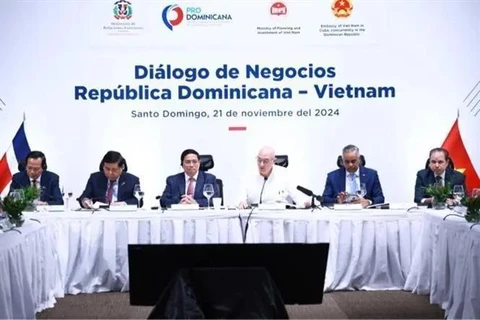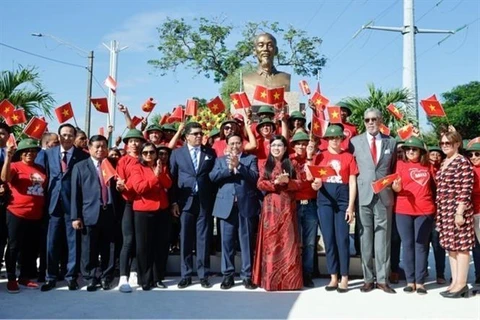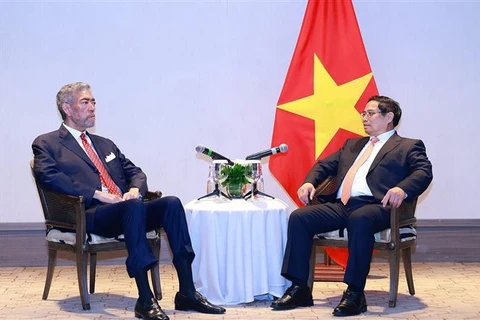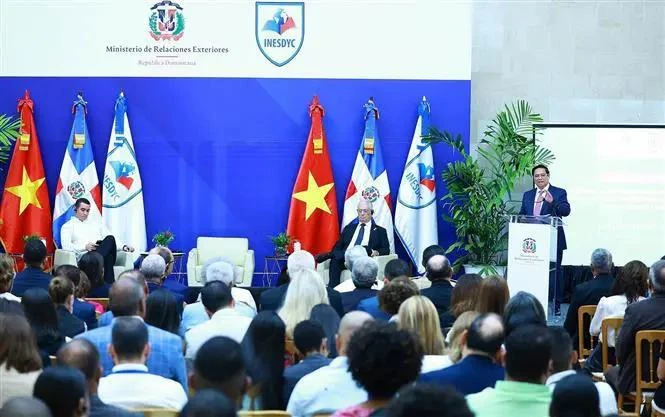
Santo Domingo (VNA) – Prime Minister Pham Minh Chinh highlighted the importance of lifting the Vietnam-Dominican Republic relations to a new height, while delivering a policy speech at the Institute of Higher Education in Diplomatic and Consular Training (INESDYC), as part of his official visit to the Latin American country on November 21 afternoon (local time).
Chinh stressed that although Vietnam and the Dominican Republic are half a world apart, they share a lot of similarities and complement each other. They have strategic positions in each region; economies that complement and promote each other; rich, diverse, and unique cultures; similar ideals, with the highest goal being national independence and the prosperity and happiness of the people; mutual political trust; and aspirations to become richer, stronger, and prosperous. Additionally, both want to contribute to peace, security, and sustainable development of the regions and humanity.
Chinh emphasised that the future of the world is being increasingly shaped by five key trends in today’s new era of connectivity, deep integration, smart technology, and innovation. These key factors include the rapid advancement of science and technology, driven by the Fourth Industrial Revolution, which is already reshaping the global landscape; negative impacts of non-traditional security challenges such as climate change, resource depletion, population aging, natural disasters, food and water security, cyber threats, and transnational crimes; the rise in global fragmentation, division, and polarisation fueled by geo-strategic and geo-economic competitions; the development of the digital, green, circular, knowledge, and sharing economies; and the critical development of high-quality human resources in fields like science and technology, innovation, AI, cloud computing, and the Internet of Things (IoT).
These issues have profound and far-reaching impacts on all countries and people worldwide, Chinh noted, stressing that no nation can tackle them alone, as addressing these challenges requires a new, inclusive, and comprehensive approach on a global-level scope.
The leader further underscored that, more than ever, it is essential for nations to work together to create an international order based on rules, promote multilateralism, and international law. This is not only a responsibility but also a key opportunity for every nation, particularly developing countries like Vietnam and the Dominican Republic.
Chinh told participants that after nearly 40 years of Doi Moi (Renewal), from a country under siege and embargo, Vietnam now has diplomatic relations with 194 countries; is an active member of more than 70 international organisations; and has signed 17 free trade agreements with more than 60 leading economies in the world.
From a poor, backward, and war-torn country, it has become a middle-income developing country, belonging to the group of 34 largest economies in the world and the group of 20 leading economies in terms of trade with import-export turnover expected to reach about 800 billion USD in 2024.
Vietnam is also at the forefront of successfully implementing many Sustainable Development Goals (SDGs), increasingly proactively contributing to common global concerns, including efforts to maintain international peace and security, disaster relief, and humanitarian assistance. The nation is also strongly committed to energy transition, aiming to achieve net zero emissions by 2050.
The PM reiterated Vietnam's strong commitment to deepening its comprehensive cooperation with the Dominican Republic, emphasising the importance of establishing favourable legal frameworks to support bilateral ties. He called for the negotiation and signing of agreements in key areas such as free trade, investment protection, visa exemption, and collaboration in tourism, culture, education, science and technology, energy, oil and gas, telecommunications, agriculture, and climate change response.
Building on this foundation, the leader outlined six priority areas for strengthening bilateral relations, including consolidating and enhancing political trust; making economic, trade, and investment cooperation an important pillar of the bilateral relations; intensifying collaboration in agriculture, science and technology, innovation, digital transformation, and green transition; promoting cooperation in education, training, tourism, and cultural exchange; strengthening multilateral cooperation; and contributing more proactively to addressing global challenges, including climate change, energy security, water security, terrorism, and transnational crimes.
PM Chinh stated that in Vietnam's overall foreign policy, the country places a strong emphasis on developing friendship and cooperation with Latin American and Caribbean countries. Of which, the good relationship between Vietnam and the Dominican Republic serves as an important bridge between the ASEAN region and Latin America and the Caribbean.
The bilateral relationship is opening up significant prospects for cooperation in all fields, especially as the two countries prepare to celebrate the 20th anniversary of their diplomatic relations in 2025, he said.
It could become an exemplary model of South-South cooperation and relations between the Southeast Asian and Latin American regions, he noted.
The PM also held that Vietnam and the Dominican Republic stand before immense opportunities to leverage the existing potential in their bilateral relations, aiming for a higher level of cooperation for the practical benefit of their people and for peace, national independence, democracy, and social progress in both regions and across the globe. He expressed his belief that the Vietnam-Dominican Republic relationship will continue to flourish.
Earlier, during a meeting with Deputy Minister of Foreign Affairs of the Dominican Republic Jose Julio Gomez, and Rector of the INESDYC Jose Rafael Espaillat, PM Chinh introduced key aspects of Vietnam’s foreign policy of independence, self-reliance, and multilateralisation and diversification of relations. He affirmed his support for cooperation between the Diplomatic Academy of Vietnam (DAV) and the INESDYC, particularly in academic fields, policy dialogue, training, and student exchange.
Jose Julio Gomez and Jose Rafael Espaillat congratulated Vietnam on its achievements in foreign affairs in recent years. They assessed that the foreign policies of their two countries share many similarities, with both seeking to maintain a stable and favourable environment for national development.
They also proposed effectively implementing the political consultation mechanism between the two Ministries of Foreign Affairs and the recently signed Memorandum of Understanding between the DAV and the INESDYC, as a foundation for further strengthening cooperation between the two research and training institutions in the field of foreign affairs./.