Poor eyesight affecting gifted, urban Vietnamese students

The number of students suffering from short-sightedness is increasing in Vietnam's big cities, experts said.
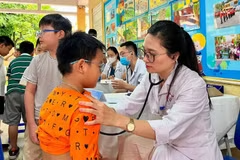
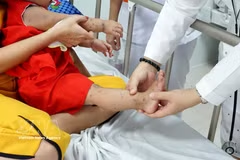
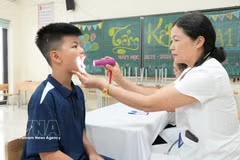
Poor eyesight affecting gifted, urban Vietnamese students ảnh 1Short-sighted children get medical treatment at the Central Eye Hospital in Ha Noi. (Source: VNA)

Hanoi (VNA) – The number of students suffering from short-sightedness is increasing in Vietnam's big cities, experts said.

Vo Thi Chinh Nga, from HCM City Eye Hospital, said during holidays, children from the city and neighbouring provinces flocked to the hospital for examinations and buying glasses.

Through examinations for children in some southern provinces, doctors found that the percentage of children had to wear glasses in suburban and rural areas was lower than those living in urban areas, she said.

For example, only two or three students out of 200 students in rural areas suffered from eye refractive defect while 60 percent of those from classes for gifted students wore glasses, she said.

A study in 2008 showed that schools for gifted students like Le Hong Phong, Tran Dai Nghia had a high rate of short-sighted students, Nga said.

Nga said the main cause was children having little time for outdoor activities.

The problem was that parents put heavy emphasis on education and they didn't encourage children to play, she said.

"Long hours of learning may lead to eye strain which in turn causes an increase in eye-related diseases," Nga said.

A study from the HCM Eye Hospital found that children living in urban areas faced a high risk of eye refractive defect because they spent most of their time indoors, a long educational day with after-school tutoring and an increase in the use of computers, television and smart phones.

Nguyen Thi Thu Hien from Central Eye Hospital shared the same opinion.

There were some factors which led to short-sightedness, she said, among them, genetic factors.

But reading, studying or staring at your phone were also believed to cause the defect.

Hien said exposure to sunlight could be useful for students as sunlight triggers the release of a substance which helped protect their eyes.

The rate of myopia in urban areas had soared in recent year, accounting for a third of visitors to the Central Eye Hospital, she said.

Nguyen Minh Thu, a mother of a seventh-grade student, said her daughter had to wear glasses five years ago.

The level of students affected with myopia increased with the level of study, she said, adding that besides studying at school, her daughter attended four extra lessons a week.

Nguyen Quang Thanh, an owner of a shop on Tran Phu street, said he recognised a growing tendency of young students wearing glasses.

His shop made a record profit by selling glasses for students, he said.

Myopia generally develops during childhood and adolescence, causing blurred vision that has to be corrected by glasses, contact lenses or laser eye surgery, according to ophthalmologists.

If those with eye refractive defects don't discover it in a timely manner, it will affect their eyesight and cause inconvenience for daily life.

Short-sightedness occurs not only in Vietnam but also is prevalent in Asia.

To protect your children's eyesight, Hien said, parents should let children play outdoor activities as much as possible.

She advised children to limit activities like reading, use of computers, tablets and mobile phones and educational practices which are affecting myopia development.

Nga said children's eyesight could be recovered by timely examinations.

"It is necessary that more attention should be paid by schools and parents to reduce the risk of myopia among students," she said.-VNA
VNA

See more

The Son Tra regional medical centre (Photo: benhviensontra.com.vn)

Da Nang: Satellite hospitals prove effective at grassroots level

The model is an important component of the roadmap to turn Da Nang into a specialised medical centre for the central and Central Highlands regions, with a number of key specialties, in line with the spirit of Politburo Resolution No. 72-NQ/TW dated September 9, 2025, on breakthrough solutions to strengthen the protection, care and improvement of people's health.

Illustrative image (Photo: daibieunhandan.vn)

Ho Chi Minh City digitises 99.4% of hospital records

As of July 2026, 163 of the city's 164 hospitals, or 99.4%, adopted electronic medical records, the report said. About 64% of public hospitals and 65% of private hospitals now run the technology across their entire operations

Yersin International Clinic in Ho Chi Minh City. (Photo: VNA)

Ho Chi Minh City eyes more foreign medical tourists

Director of the municipal Department of Health Tang Chi Thuong said a key prerequisite for attracting foreign patients is a strategy to develop centres of medical excellence. He proposed selecting hospitals and specialties with strong expertise for investment towards international standards, particularly in competitive fields such as cardiology, oncology, robotic surgery, assisted reproduction, paediatrics, dentistry, cosmetic medicine, specialised health check-ups, traditional medicine and rehabilitation.

A nurse from Children's Hospital No. 1, Ho Chi Minh City, collects a blood sample for HIV testing from an infant. (Illustrative photo: VNA)

Health cooperation adds fresh momentum to Vietnam-US relations

Through this MOU, the US Department of State, working with Congress, plans to provide 98.75 million USD in life-saving global health assistance over the next five years, including 21.385 million USD in dedicated Global Health Security funding, to support Vietnam’s transition to full country ownership of its HIV/AIDS and tuberculosis programmes while strengthening its capacity to detect and respond to emerging and re-emerging infectious disease threats.

Minister of Health Dao Hong Lan and US Ambassador to Vietnam Jennifer McNamara Wick sign the memorandum of understanding on health cooperation. (Photo: US Embassy in Vietnam)

Vietnam, US launch five-year health cooperation

The cooperation will also support Vietnam in strengthening its healthcare capacity and gradually enhancing self-reliance in HIV/AIDS and tuberculosis prevention and control programmes, as well as in responding to emerging and re-emerging infectious diseases.

Director of the Ho Chi Minh City Department of Health Tang Chi Thuong (third, right) presents flowers to congratulate six young doctors who have volunteered to work at grassroots-level health stations (Photo: VNA)

Ho Chi Minh City strengthens grassroots healthcare workforce

Ho Chi Minh City's Department of Health on September 10 reviewed a pilot programme combining hospital-based practice with work at grassroots health stations and organised the fourth healthcare job fair, attracting nearly 1,000 candidates and 94 recruiters offering 806 positions.

Children undergo health screening. (Photo: Dong Da General Hospital in Hanoi)

Vietnam to screen students nationwide for five health risks from 2028

Vietnam will launch nationwide screening for five groups of school-related diseases and health conditions among students from preschool through high school from 2028, including overweight and obesity, refractive errors, spinal curvature, oral diseases and mental health disorders.

A doctor provides dental checkup for a student. (Photo: VNA)

Free health checkups for children ahead of new school year

According to the Hanoi Department of Health, the city has 4,776 educational institutions with more than 2.2 million preschool and school students. The health campaign will run from August 18 to September 4, targeting 100% coverage before the new school year begins.