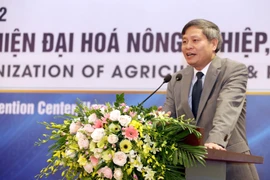
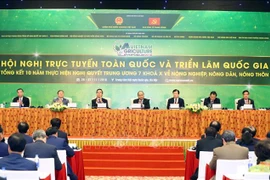
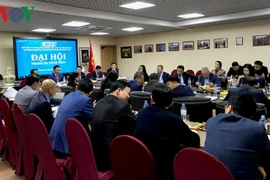
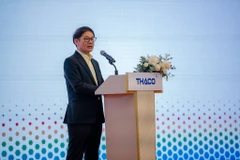
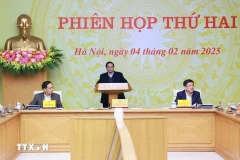
At the event (Photo: VNA)
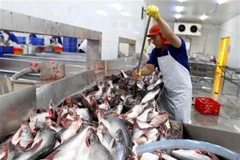
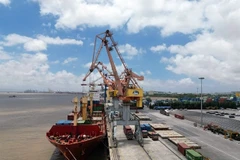
 Hanoi (VNA) – Vietnam holds great advantages to export agriculturalproducts to European Union (EU) countries, whose soil is not suitable for the cultivationof tropical farm produce, experts said.
In particular, when the EU-Vietnam Free Trade Agreement takes effect, Vietnameseproducts will gain a competitive edge in the market as tariff lines will fallto 0-5 percent over the next seven to 10 years.
Atthe Vietnam-EU Trade Forum held by the Ministry of Industry and Trade’s Departmentof European-American Market in Hanoi on December 6, Deputy Minister Cao QuocHung stressed that the EU is a prosperous economic bloc, with a gross domesticproduct (GDP) accounting for 23 percent of the world’s economy, and an incomeper capita mounting to 40,890 USD.
With 28 member states, the EU’s total population reaches some 516 millionpeople with high demand for imports, including farm produce. Meanwhile, morethan 10 key Vietnamese agricultural products have been present in over 160countries and territories worldwide, many of which have gained more than 1billion USD in export revenue like coffee, rice, cashew, vegetables, andfruits, he added.
However, Deputy Head of the Agro Processing Market Development Authority(AgroTrade) Tran Van Cong said that besides robust achievements, shipments offarm produce still face a number of hurdles, like processing ability and undeveloped branding.
Therefore, export turnover is still a far cry from expectation, while earningshave been shared through dozens of intermediary stages.
Trade experts have said that the loose connections between farmers andbusinesses is the first barrier to agricultural exports to the EU. Some 70 percentof agricultural materials have been purchased directly from farmers, who arenot fully provided with appropriate cultivating techniques.
In addition, out-of-date post-harvesting technology is another factor thathinders exports, resulting in a loss of up to 30 percent in farm production.
As the EU sets strict criteria in food safety, antibiotic residues, and productorigin, Alexandre Bouchot, Agricultural Counselor of the French Embassy toVietnam, suggested decentralising management of food policies as well aspromoting investment in the sector.
Research and development activities should be paid due attention and theagricultural sector needs to be reformed to develop in a sustainable manner.
France is willing to share its experience with Vietnam in this field, he added.–VNA
In particular, when the EU-Vietnam Free Trade Agreement takes effect, Vietnameseproducts will gain a competitive edge in the market as tariff lines will fallto 0-5 percent over the next seven to 10 years.
Atthe Vietnam-EU Trade Forum held by the Ministry of Industry and Trade’s Departmentof European-American Market in Hanoi on December 6, Deputy Minister Cao QuocHung stressed that the EU is a prosperous economic bloc, with a gross domesticproduct (GDP) accounting for 23 percent of the world’s economy, and an incomeper capita mounting to 40,890 USD.
With 28 member states, the EU’s total population reaches some 516 millionpeople with high demand for imports, including farm produce. Meanwhile, morethan 10 key Vietnamese agricultural products have been present in over 160countries and territories worldwide, many of which have gained more than 1billion USD in export revenue like coffee, rice, cashew, vegetables, andfruits, he added.
However, Deputy Head of the Agro Processing Market Development Authority(AgroTrade) Tran Van Cong said that besides robust achievements, shipments offarm produce still face a number of hurdles, like processing ability and undeveloped branding.
Therefore, export turnover is still a far cry from expectation, while earningshave been shared through dozens of intermediary stages.
Trade experts have said that the loose connections between farmers andbusinesses is the first barrier to agricultural exports to the EU. Some 70 percentof agricultural materials have been purchased directly from farmers, who arenot fully provided with appropriate cultivating techniques.
In addition, out-of-date post-harvesting technology is another factor thathinders exports, resulting in a loss of up to 30 percent in farm production.
As the EU sets strict criteria in food safety, antibiotic residues, and productorigin, Alexandre Bouchot, Agricultural Counselor of the French Embassy toVietnam, suggested decentralising management of food policies as well aspromoting investment in the sector.
Research and development activities should be paid due attention and theagricultural sector needs to be reformed to develop in a sustainable manner.
France is willing to share its experience with Vietnam in this field, he added.–VNA
VNA