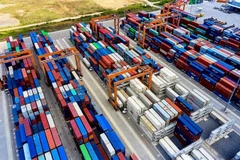
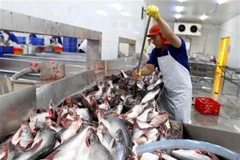
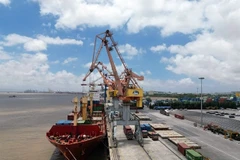
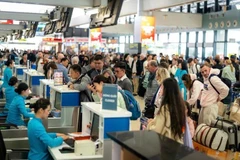
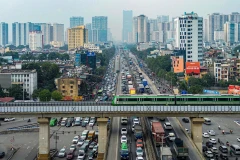
The Vietnamese market is expected to welcome 230,500 more enterprises, both newly established and those resuming operations, in 2024. (Photo: VNA)
 Accordingly, the number of freshly established firms is projected to rise by 2% year-on-year, reaching approximately 162,500. Concurrently, around 68,000 others will be back to operation, marking a 16% increase. The statistical agency’s forecast is based on the registrations of businesses in 2023 and the anticipated global and domestic economic outlook in the coming period.
According to the GSO, the country’s 2024 economic growth continues its positive recovery trend. Supportive policies enacted in 2023 are expected to have a more pronounced impact, with the driving forces of investment, consumption, tourism, and exports envisioned to continue their upward trajectory.
However, challenges persist as major economies and Vietnam’s trade partners and key investors are still experiencing slow and unsustainable recovery, coupled with weak consumer demand, increasing protectionism, and unfavourable global and regional developments. These factors are likely to strongly influence the Southeast Asian economy’s business and industrial activities, export-import operations, and investment attraction.
As a result, the number of businesses exiting the market this year is forecast to be higher than 2023, albeit at a significantly slower pace than during the COVID-19 period. According to the Ministry of Planning and Investment’s Business Registration Management Agency, this figure might reach around 178,000, up 3.5% annually.
To help businesses overcome challenges, GSO General Director Nguyen Thi Huong suggested the government continue to manage monetary and fiscal policies and other policies to ensure macro-economic stability, support economic growth, and stabilise monetary and foreign exchange markets, and the banking system.
Additionally, she urged the Government to vigorously promote growth drivers, improve institutional and legal frameworks, streamline administrative procedures, and facilitate robust digital transformation./.
However, challenges persist as major economies and Vietnam’s trade partners and key investors are still experiencing slow and unsustainable recovery, coupled with weak consumer demand, increasing protectionism, and unfavourable global and regional developments. These factors are likely to strongly influence the Southeast Asian economy’s business and industrial activities, export-import operations, and investment attraction.
As a result, the number of businesses exiting the market this year is forecast to be higher than 2023, albeit at a significantly slower pace than during the COVID-19 period. According to the Ministry of Planning and Investment’s Business Registration Management Agency, this figure might reach around 178,000, up 3.5% annually.
To help businesses overcome challenges, GSO General Director Nguyen Thi Huong suggested the government continue to manage monetary and fiscal policies and other policies to ensure macro-economic stability, support economic growth, and stabilise monetary and foreign exchange markets, and the banking system.
Additionally, she urged the Government to vigorously promote growth drivers, improve institutional and legal frameworks, streamline administrative procedures, and facilitate robust digital transformation./.
VNA