Vietnam’s aquatic exports on track to top 10 billion USD

Vietnam’s aquatic exports are expected to exceed the annual target of 10 billion USD on the back of strong demand from major markets, according to Deputy Minister of Agriculture and Rural Development Phung Duc Tien.

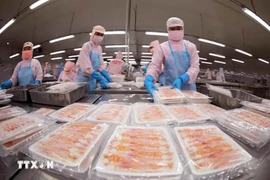
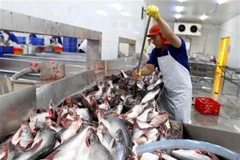
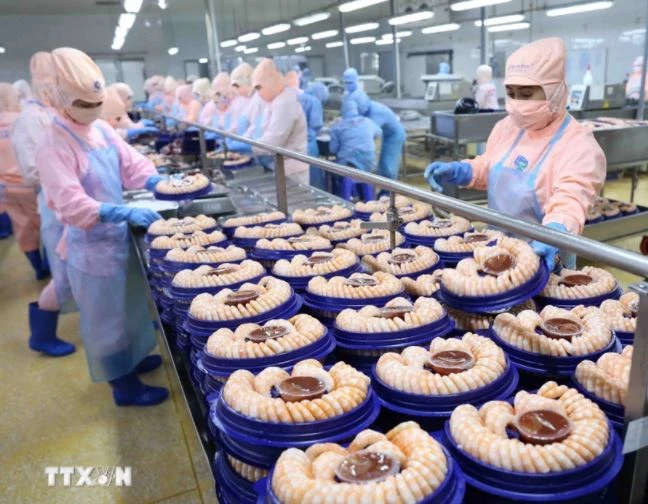
Shrimp will continue to be a key export thanks to growing demand and price recovery in the US, China, Japan, and Australia. (Photo: VNA)

Hanoi (VNA) – Vietnam’s aquatic exports are expected to exceed the annual target of 10 billion USD on the back of strong demand from major markets, according to Deputy Minister of Agriculture and Rural Development Phung Duc Tien.

Statistics from the Ministry of Agriculture and Rural Development showed October exports reached 1.1 billion USD, bringing the total revenue for the first 10 months of 2024 to 8.33 billion USD, a year-on-year increase of 12%.

The US, China, and Japan were the three largest purchasers, accounting for 18.5%, 16.8%, and 15.4% of the market share, respectively. Among the 15 major export markets, Russia had the sharpest growth of 94.8% while Thailand experienced a decline of 10.1%.

In October alone, aquatic shipment to China saw impressive growth of 37%. Meanwhile, robust performance was also recorded in the US (up 31%), Japan (22%), the EU (27%), and the Republic of Korea (13%).

The Vietnam Association of Seafood Exporters and Producers (VASEP) said the US has consistently been Vietnam's largest importer, with annual revenues ranging from 1.5 billion to 2.1 billion USD over the past five years, despite the American market’s anti-dumping and anti-subsidy measures.

A recent preliminary countervailing duty determination by the US Department of Commerce set a rate of 2.84% for Vietnamese shrimp, lower than the 4.26% for India and the 7.55% for Ecuador, giving Vietnamese exporters a competitive advantage.

As of the end of October, Vietnam had shipped 1.5 billion USD worth of aquatic products to the US, rising 15% against the same time last year.

Notably, VASEP predicted that China could surpass the US to become Vietnam’s top aquatic product buyer if its import growth maintains at 20% in the remainder of the year.

In the meantime, the EU market shows promising signs of recovery, with exports to the bloc up 11% by October 2024. Vietnamese products have enjoyed significant advantages under the EU-Vietnam Free Trade Agreement as most raw shrimp products receive immediate duty-free status, while competitors like Thailand and India lack similar trade agreements.

VASEP communications director Le Hang said that shrimp and tra fish will continue to be the key exports thanks to growing demand and price recovery in the US, China, Japan, and Australia. She suggested local firms to take flexible measures to capitalise on market opportunities, given a shortage of domestic raw materials.

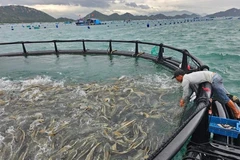
The ministry said total aquatic output neared 7.9 million tonnes in January - October, up 2.5% year-on-year. Aquaculture production exceeded 4.6 million tonnes, increasing by 3.8%, including 1.44 million tonnes of tra fish and over 1.1 million tonnes of shrimp.

Director General of the ministr’s Directorate of Fisheries Tran Dinh Luan said Vietnamese firms should pay due attention to improving product quality and reducing costs so as to gain competitive edge in the international market, elaborating such large export markets as the US, the EU, and Japan have stringent requirements on product quality, origin traceability, and food safety./.

VNA
See more

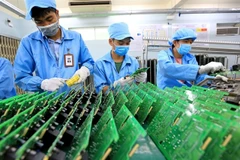
Vietnam is strengthening its position in the technology value chain, becoming a major manufacturing hub for complete consumer electronics products. (Photo: VNA)

ESG standards offer opportunities to reposition Vietnam’s electronics firms

The 2025-2027 period will be a critical turning point, as exporters to the European market will be required to strictly comply with ESG standards, including net-zero emissions roadmaps, labour standards, corporate governance and transparency requirements. As a key export sector, the electronics industry is being directly and strongly affected by this shift.

A production line for camera modules and electronic components at the factory of MCNEX VINA Co. Ltd, a Republic of Korean-invested company in Phuc Son Industrial Park, Ninh Binh province. (Photo: VNA)

Science, technology, innovation as engines of economic growth

To ensure that science and technology truly act as a powerful growth engine, experts emphasised the need for the Government to put in place supportive mechanisms and policies that encourage enterprises to invest in research and development, while strengthening cooperation among the State, research institutions and the business sector.

The headquarters of the Ministry of Industry and Trade in Hanoi (Photo: VNA)

PM updates lead roles to drive UKVFTA forward

The Ministry of Industry and Trade (MoIT) is named the lead agency, with overall responsibility for the agreement’s general goals and definitions, trade remedies, non-tariff barriers to trade and investment in renewable energy, competition policies, State-owned enterprises, enterprises with special or exclusive rights and those with designated monopolies, as well as institutional, general and final terms.

Vietravel Airlines is taking measures to enhance service quality and optimise operations amid high travel demand during Tet. (Photo: VNA)

Vietravel Airlines to add new route serving Lunar New Year travel peak

During the peak period of the Lunar New Year (Tet) festival in 2026, Vietravel Airlines plans to operate six – eight flights daily on the Ho Chi Minh City – Hanoi route, three flights daily on the Ho Chi Minh City – Da Nang and Ho Chi Minh City – Vinh routes; and two flights daily on the Ho Chi Minh City – Quy Nhon route.

The completion of Can Tho - Ca Mau expressway has helped shorten travel time from Can Tho to Ca Mau to just one hour and a half (Photo: VNA)

Can Tho–Ca Mau expressway fully opens from January 19

The new section, together with the Can Tho–Hau Giang segment that has been operating smoothly since late December last year, has completed the entire 110.85-km route. With total investment exceeding 27.52 trillion VND (1.04 billion USD), the four-lane expressway is built to modern standards and serves as a key transport artery linking major economic and political centres, industrial zones and seaports in the southwestern region.

Vietnam aims to export 7 million tonnes of rice in 2026 (Photo: VNA)

Vietnam to proactively reduce rice exports from 2026

Do Ha Nam, Chairman of the Vietnam Food Association (VFA), said that 2026 presents numerous difficulties and challenges, and the global supply glut significantly impacts all exporters, including Vietnam.