Praying for rain – special ritual of Cham ethnic minority

The Cham ethnic minority group has preserved many traditional cultural rituals, one of them being the praying-for-rain festival which prays for favourable weather and bumper crops.
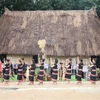
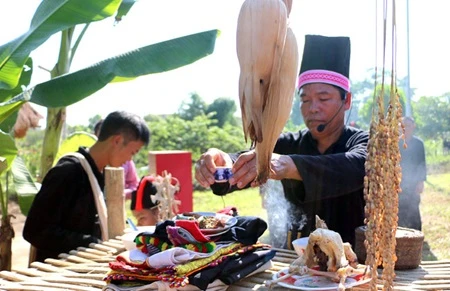
Praying for rain – special ritual of Cham ethnic minority ảnh 1Cham people in Binh Dinh province conduct praying-for-rain rituals (Photo: dangcongsan.vn)

Hanoi (VNA) - The Cham ethnic minority group has preserved many traditional cultural rituals, one of them being the praying-for-rain festival which prays for favourable weather and bumper crops.

The Cham group has a population of about 130,000, who mainly live in the southern central provinces of Ninh Thuan, Binh Thuan, Binh Dinh, Phu Yen, and southern provinces of An Giang, Dong Nai, Tay Ninh and Ho Chi Minh City.

Relying on wet-rice farming, the Cham group conduct the ritual annually in the second lunar month to thank the gods for giving water for cultivation.

Recently, the praying for rain festival has been re-enacted at the Vietnam National Village for Ethnic Culture and Tourism.

Offerings for the ceremony are arranged on a colourful estrade made from four stumps of Bombax ceiba trees.

The offerings include a pig head, two cocks, two wine jars, wax and a cup of rice. The estrade is attached to a Neu pole, which is designed in the form of wings of the Ktang bird – a symbol of peace in Cham people’s beliefs.

The village’s patriarch goes first, followed by two village shamans, called ‘oi quai’ and village’s youths. All of them go around the estrade before the ceremony taking place.

The village’s patriarch represents the villagers to express their wishes to the gods and toss two coins to predict whether the gods accept their request or not. If the two coins fall down with different faces up, it means the gods accept their request.

After that, a shaman throw the rice and alcohol to all the west, north, east and south directions to invite the gods to join the celebration with the villagers.

Local women hold bunches of bamboo strings and stroke them in the air in order to make the sound of wind. Meanwhile, the men beat K’toang drums and gongs to create the sound of thunder.

At the end of the ritual, everyone sips alcohol from a shared cup, celebrating a year of good weather and bumper crops.

The Praying for rain festival is an inseparable part of the Cham people’s daily life. It not only conveys a message for a year of favourable natural conditions and good harvests but through which the community’s unity is vibrantly expressed.-VNA
VNA

See more

Vietnamese traditional martial arts are performed at an event in France. (Photo: VNA)

Traditional martial arts festival to welcome 16 international delegations

The festival will feature a packed programme of cultural and sporting activities, including flower- and incense-offering ceremonies at Kinh Thien Monument and the Quang Trung Museum, large-scale martial arts performances, exchange demonstrations, tours of traditional martial arts schools, and visits to historical, cultural and scenic sites across the central province.

Foreigners taste unique Vietnamese cuisine (PhotoL VNA)

Vietnam looks to turn culinary acclaim into tourism revenue

Vietnam is sitting on a massive culinary heritage with thousands of signature dishes spanning 54 ethnic groups, many of which have earned international acclaim. More and more localities are positioning food not just as a service for tourists, but as a standalone attraction.

The poster of the Vietnam Circus Federation's special performance dedicated to soldiers who devoted and sacrificed their lives in safeguarding the nation's borders. (Photo: Vietnam Circus Federation)

Wide range of artistic programmes to commemorate war invalids and martyrs day

Alongside tribute activities nationwide to mark the 79th anniversary of War Invalids and Martyrs Day (July 27, 1947–2026), arts organisations and local authorities are staging special performances honouring fallen heroes, war invalids, sick veterans and people who rendered meritorious service to the revolution, while promoting the tradition of gratitude, patriotism and national pride.

At the opening of the first-ever Cultures of the World Festival in Hanoi. (Photo: VNA)

Vietnam charts course for regional culture, creativity hub status by 2045

The blueprint seeks to deepen international cultural integration, export Vietnamese values and absorb the essence of world cultures. The end goal is an advanced culture steeped in national identity, deployed as a soft power to fuel rapid, sustainable growth, lift Vietnam’s global standing, and add a distinct thread to the tapestry of human civilisation.

Deputy Minister of Foreign Affairs Ngo Le Van, Chairman of the Vietnam National Commission for UNESCO, speaks at plenary session of the 48th session of the UNESCO World Heritage Committee in Busan on July 20, 2026. (Photo: VNA)

Vietnam proposes priorities to strengthen international cooperation on world heritage conservation

On behalf of Vietnam, the deputy minister proposed three priorities of strengthening international cooperation and capacity-building for member states, particularly developing countries; promoting science-based conservation that strikes a balance between preservation and development while placing local communities at the centre; and enhancing coordination among relevant conventions and programmes, alongside the responsible application of digital technologies and artificial intelligence in heritage conservation.

Claudia Roth, a member of the German Bundestag, visits the Vietnamese booth at the festival. (Photo: VNA)

Vietnam attends multicultural festival in Germany as guest of honour

The Vietnamese booth attracted a large number of visitors with traditional dishes such as "nem cuon" (fresh spring rolls) and "bun cha" (grilled pork with vermicelli), along with displays of ao dai (traditional long dress), conical hats and cultural performances imbued with Vietnamese identity. These activities helped spread Vietnamese culture and foster understanding and closer ties between the Vietnamese community, German residents and international friends.

Representatives of countries and territories participating in the Asian Pencak Silat Championship. Photo: VNA)

10th Asian Pencak Silat Championship opens in Dong Nai

Speaking at the opening ceremony, Director of the municipal Department of Culture, Sports and Tourism Le Thi Ngoc Loan said the championship offers athletes an opportunity to compete in a spirit of fairness and sportsmanship while promoting exchanges, mutual understanding and friendship among participating countries.

A special art performance at the Khanh Hoa Sea Festival 2026 (Photo: VNA)

Khanh Hoa Sea Festival 2026 opens, promoting sustainable marine development

Having been held 10 times, the Khanh Hoa Sea Festival has evolved beyond a local celebration into an event of national significance in culture, economy and external relations. This year's edition continues to honour Vietnam's maritime cultural heritage while promoting tourism, the marine economy and international integration.

The golf course at NovaWorld Phan Thiet will host international tournaments during Sports Festival 2026. (Photo: VNA)

Around 7,000 athletes to compete at Sports Festival 2026

This year's festival will feature 12 sports, introducing several new events such as national youth triathlon and beach tennis championship, while expanding its international scope by bringing together clubs, athletes, and police forces from ASEAN countries for events such as the ASEAN Police Open Golf Tournament 2026.

A performance of Cheo Tau folk singing, a distinctive cultural tradition of O Dien commune in Hanoi. (Photo: VNA)

Beyond preservation: Unlocking the value of Vietnam's heritage

Dr. Nguyen Thu Hanh, Director of the Centre for Research and Development of Vietnam Cultural Industry (SDCI), said Vietnam has traditionally focused on preserving heritage rather than creating new value from it. The key obstacle, she noted, is the weak connection between heritage and science, technology, education, design, communications and the marketplace, limiting its economic, educational and social impact despite the country's abundant cultural resources.