Private sector should be pillar of Vietnam economy: expert

The private sector in Vietnam should receive support to become a pillar of the national economy, said Nguyen Thi Nga, Chairwoman of BRG Group.
Private sector should be pillar of Vietnam economy: expert ảnh 1A worker operates a yarn processing line at Best Pacific Vietnam Co. Ltd at the Vietnam-Singapore Industrial Park (VSIP) in the northern province of Hai Duong. (Source: VNA)

Hanoi (VNA) - Theprivate sector in Vietnam should receive support to become a pillar of thenational economy, said Nguyen Thi Nga, Chairwoman of BRG Group.

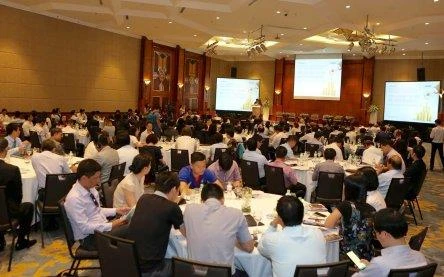
Nga spoke at a forum on how todevelop private enterprises in Vietnam in the capital city of Hanoi on December19. The forum was jointly held by the Party Central Committee’s EconomicCommission and the Vietnam Association of Private Entrepreneurs.

Nga, who is also the standingvice president of the association, said: “Vietnam should be developed as aregional financial and industrial centre. It is time to take advantageof capital flows from China due to trade tensions between the US andChina.”

To do that, Nga said: “TheGovernment should ensure fair competition among economic sectors in Vietnam.” 

Nga asked the Government toincrease protection for private enterprises and allow them to participatein railroads, electricity transmission and aviation infrastructure, whichremain State monopolies.

The BRG chairwoman said:“Private enterprises have enough experience and resources to develop largeprojects, which can help the Government reduce public debt.”

The digital economy was also amajor topic discussed at the forum.

Nguyen Thanh Luu, head ofMarketing Communications at the CMC Group, thought IT was key for Vietnamto develop faster.

As a private firm in thetechnology sector, CMC’s leader proposed that the Government should encourageprivate businesses to develop Vietnam as a digital country and a digital hubfor the region.

Luu said: “The Governmentshould create policies to develop the local IT industry. For example, thereshould be policies to encourage the local use of Vietnamese IT products.”

Luu wanted the Government tohelp the private sector expand into the international market and take partin big projects in Vietnam.

Nguyen Mai, Chairman of theVietnam Association of Foreign Investment Enterprises (VAFIE), said toachieve the goal of becoming a high middle-income country by 2030with a per capita income of 10,000 USD, Vietnam should support the privatesector.

Mai gave the example of brandssuch as Apple, Google, Microsoft and Facebook in the US, as well asSamsung, Hyundai and LG in the Republic of Korea (RoK), saying that the US and theRoK developed into big economies thanks to their supporting policies todevelop private enterprises in IT.

He added that the digitaleconomy was a driving force for development in the US, but only accounts for9.2 percent of the economy in Vietnam.

Mai suggested theGovernment should invest more in IT and human resources for the private sectorso they could do similar things.

So far, the private sector,with more than 700,000 firms, has generated 40 percent of GDPand created 1.2 million jobs. In the first nine months of 2019,the sector’s investment hit 624.6 trillion VND (27.1 billion USD), up16.9 percent on-year, and also the highest investment level compared to theState-owned and the foreign-invested sectors./.
VNA

See more

Tan Mingming, Deputy Director of the Foreign Affairs Office of the Dezhou Municipal People’s Government. (Photo: VNA)

Chinese firms put Vietnam on expansion radar

Tan Mingming, Deputy Director of the Foreign Affairs Office of the Dezhou Municipal People’s Government, told Vietnam News Agency reporters that the city has spent years deliberately tightening its links with the Association of Southeast Asian Nations (ASEAN), with Vietnam seen as a key partner.

A perspective of the Viettel Military Industry and Telecoms Group's high-tech semiconductor chip manufacturing plant at Hoa Lac Hi-Tech Park. (Photo: Viettel)

Hanoi builds momentum as Vietnam's semiconductor hub

As Hanoi continues to strengthen its semiconductor ecosystem, the city is creating a new growth driver for both the capital and the country, enhancing Vietnam's technological capabilities and paving the way for deeper integration into the global semiconductor value chain.

Clams are processed for export at the factory of Thanh Hoa Seafood Import-Export JSC in Thanh Hoa province. (Photo: VNA)

Vietnam steps up export to achieve 550-billion-USD target

Against a backdrop of persistent uncertainty in global commerce, the Government is implementing a broad range of measures to strengthen export growth during the remainder of the year. These include expanding overseas markets through economic diplomacy, maximising the benefits of free trade agreements (FTAs), streamlining administrative procedures, reducing logistics costs, improving access to credit and helping businesses overcome trade barriers. Authorities are also encouraging deeper processing, official cross-border exports and greater market diversification to improve the competitiveness of Vietnamese products.

A hydroponic vegetable garden in Nguyet Hoa ward operated by Green Farm Co., Ltd. (Photo: VNA)

Incentive policies for high-tech agricultural zones

Under Decree No. 263/2026/ND-CP, qualified projects are given priority to participate in State support programmes as well as funds and policies on research and development, technological innovation, technology transfer, human resource training, investment promotion and trade promotion.

Wind turbines stand fully installed at a wind power project in Gia Lai province. (Photo: VNA)

Gia Lai approves 56-million-USD wind power project

The 42MW wind farm is expected to generate about 123,780.8 MWh of electricity each year. Power generated will be transmitted to the national grid via the 220kV Pleiku 2–Krong Buk transmission line.

Garments for export to the Japanese market are produced at Hung Viet Garment Company in Hung Yen province. (Photo: VNA)

Vietnam’s garment sector pivots towards value-added growth

Future growth can no longer rely on expanding production capacity alone. Meeting this year's 48 billion USD export target will require greater productivity, higher value addition, stronger domestic sourcing, broader market diversification, and faster digital and green transformation.

Trucks carrying goods wait for customs clearance at the Thanh Thuy International Border Gate in Tuyen Quang province. (Photo: VNA)

Border economy strengthens Tuyen Quang’s growth momentum

While the stronger performance provides momentum for the province's 2026 growth target of 10.17%, officials say the focus must now shift from increasing cargo volumes to expanding services, reducing costs and retaining more value locally.

Construction of several key components of Long Thanh International Airport is entering its final stages. (Photo: VNA)

Major works at Long Thanh International Airport gather pace towards completion

The ACV said on July 20 that contractors are deploying additional workers and equipment to speed up construction under Component Project 3, which covers the airport's essential aviation infrastructure. Major facilities, including the first and second runways, taxiways, aircraft aprons, the passenger terminal apron and the aircraft fuel supply system, are approaching completion.

The VinFast Evo electric motorcycle on display at the event. (Photo courtesy of VinFast)

VinFast marks new step in expansion strategy in Southeast Asia

The Evo is priced at 17.5 million IDR (about 973.90 USD) in Jakarta and is available in four colour options: black, red, white and olive green. The Feliz II is sold for 18.5 million IDR, while the Viper is priced at 22 million IDR. All prices include a battery subscription package.

Passengers check in at Hanoi's Noi Bai International Airport. (Photo: VNA)

Vietnam records 15.4% growth in international air passengers

CAAV statistics show that international passenger throughput reached 26.2 million as of June 15, 2026. Of the total, Vietnamese airlines transported 9.6 million international passengers, a slight increase of 0.2% year-on-year, accounting for 36.6% of the total international passenger market.