Project promotes sustainable aquaculture in Mekong Delta region

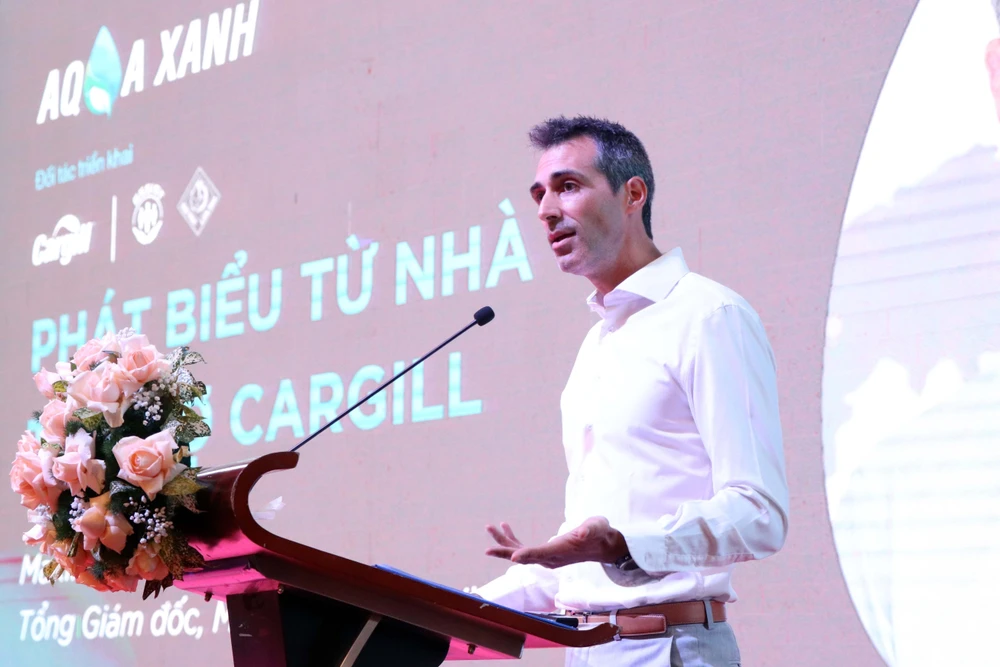
Cargill Inn and Asia Society for Social Improvement and Sustainable Transformation (ASSIST), a foreign non-governmental organisation, on May 8 announced their partnership and the launch of Green Aqua project which aims to reduce water pollution through promoting the application of sustainable aquaculture practices in the Mekong Delta region.

A representative from Cargill speaks at the event. (Photo: VNA)

Ca Mau (VNA) – Cargill Inn and Asia Society for Social Improvement and Sustainable Transformation (ASSIST), a foreign non-governmental organisation, on May 8 announced their partnership and the launch of Green Aqua project which aims to reduce water pollution through promoting the application of sustainable aquaculture practices in the Mekong Delta region.

The project will be implemented until July 2026, initially in Ca Mau province. It aims to provide training for more than 300 shrimp farmers on farming practices towards the Aquaculture Stewardship Council (ASC) standards on responsible aquaculture, as well as animal feed, waste management, and biodiversity preservation.

Ten outstanding trainees will have a chance to attend intensive training, enabling them to transfer farming techniques to their fellows in the following periods.

At the same time, a shrimp farming cooperative will have the opportunity to receive an ASC certificate, while three pilot farms will strive to reduce wastewater by 30% and cut nitrogen and phosphorus emissions by 20% by 2025.

The southernmost province of Ca Mau is the largest shrimp production hub in the country with a total farming area of 280,000 hectares.

During the two years of pilot implementation, the project will focus on supporting shrimp farms and creating a positive impact on the shrimp farming area across the province, while building local farmers’ capacity to adapt to climate change.

The project is expected to contribute to coping with climate change challenges, improving the environment quality through promoting and strengthening processes to sustainably use water resources and treating waste in the aquaculture sector of Ca Mau in particular and the Mekong Delta region in general./.

VNA

See more

Toy production at a Hong Kong-invested factory (Photo: VNA)

Vietnam targets deeper market penetration in Hong Kong in 2026

Vietnam-Hong Kong trade hit 62.3 billion USD in the first 11 months of 2025, soaring 73.1% annually. Vietnamese exports to Hong Kong amounted to 36.8 billion USD, a 90.6% hike, ranking fourth among Hong Kong’s import sources, while imports from Hong Kong stood at 25.5 billion USD, up 52.9% and ranking third.

Vietnam’s start-up market enters restructuring phase

Vietnam’s start-up market enters restructuring phase

In 2026, venture capital inflows into Vietnam’s start-up ecosystem are expected to recover gradually, though in a more selective manner. VinVentures forecasts that capital will focus on start-ups that have survived the rigorous screening of 2024–2025, possess clear business models, strong commercialisation capacity, and the ability to generate real cash flows.

Workers process tra (pangasius) for export (Photo: VNA)

Vietnam–Singapore trade continues to thrive

For the year as a whole, Vietnam retained its position as Singapore’s 10th largest trading partner. Bilateral trade reached a record high of nearly 40 billion SGD, up 26.2% from the previous peak of 31.67 billion SGD recorded in 2024.

Eric Van Vaerenbergh, an energy expert and lecturer at the Brussels Engineering School (ECAM) (Photo: VNA)

Belgian expert optimistic about Vietnam’s economic outlook

Vietnam should move from a growth model based mainly on expanding capital and labour to one driven by productivity improvements. He said that this requires enhancing the quality of the workforce, particularly engineers, technicians, and managers in industrial sectors.

Workers at the VSIP Hai Phong industrial and urban complex, which specialises in producing electronic components for office equipment. (Photo: VNA)

Roadmap aims to improve business climate and boost competitiveness

By the end of 2026, Vietnam aims to rank among the world’s top 50 performers in the United Nations Sustainable Development Goals, advance at least three places in the International Property Rights Index, and climb at least one position in the Global Innovation Index.

Vietnam is strengthening its position in the technology value chain, becoming a major manufacturing hub for complete consumer electronics products. (Photo: VNA)

ESG standards offer opportunities to reposition Vietnam’s electronics firms

The 2025-2027 period will be a critical turning point, as exporters to the European market will be required to strictly comply with ESG standards, including net-zero emissions roadmaps, labour standards, corporate governance and transparency requirements. As a key export sector, the electronics industry is being directly and strongly affected by this shift.