Pu Luong – a paradise amidst jungle for travellers on budget

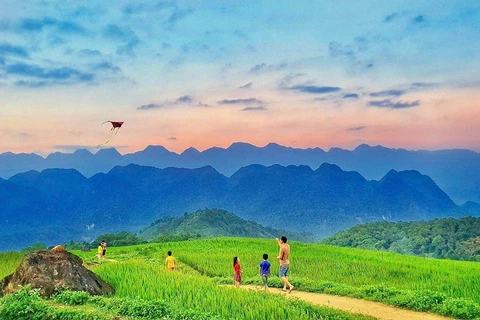
Located in the north central province of Thanh Hoa, Pu Luong is renowned as an ideal destination for trekkers and budget travellers because of its seclusion and fantastic scenery of terraced rice fields and primary forests.
Pu Luong – a paradise amidst jungle for travellers on budget ảnh 1A terraced rice field in Pu Luong, Thanh Hoa. (Photo: VNA)

Hanoi (VNA) – Located in the north central province of Thanh Hoa, Pu Luong is renowned as an ideal destination for trekkers and budget travellers because of its seclusion and fantastic scenery of terraced rice fields and primary forests.


About 130km northwest of the provincial capital city of Thanh Hoa and 190km south of Hanoi, Pu Luong is close to several favoured tourist attractions in Hoa Binh province’s Mai Chau, Tan Lac and Lac Son districts, providing explorers with a full circle of exciting adventure.

It is the best to travel to Pu Luong at the end of May and early June since it is the occasion to start a new rice crop when terraced fields here wear a layer of green, looking all fresh and peaceful.

Mid-summer is also a good time to go to Pu Luong as it is situated in a low land limestone area, with many tropical forests and few inhabitants, making its climate quite pleasant even during hot days.

Visitors can also travel to Pu Luong between September and October when it enters harvest season, with multi-layer terraced fields on the hillsides turning yellowish, making it even more spectacular. During this time, Pu Luong is dubbed as “a paradise amidst the jungle,” attracting a lot of tourists to enjoy the scenery of ripening rice fields.

Residents in the hamlets surrounding Pu Luong, such as Son, Ba and Muoi in Lung Cao commune; Kho Muong in Thanh Son; Don in Thanh Lam; and Hieu in Co Lung, are Thai and Muong ethnic minority people who lead lives steeped in tradition and customs. They remain largely uninfluenced by modern means.

Discovering the local cuisine and culture is a highlight of any trip to Pu Luong. There is nothing more delightful than dishes made from ingredients grown right in the area. Pu Luong is home to an array of vegetables, such as baby pumpkin leaf, green beans and bamboo shoots. For a real Pu Luong lunch or dinner, visitors should try the locally raised pork and grilled mountain snails dipped in fish sauce.

In Lunar February, local people flock to the top of Pu Luong to harvest wild bitter-tasting bamboo shoots which are served in various local unique dishes, from simple to difficult. The simplest one, boiled bamboo shoots served with chili fish sauce, is also the most popular the locals use as a treat to welcome their guests.

Far different from the hustle and bustle of city life, a day in Pu Luong starts with the sound of singing birds and babbling brooks meandering down through low hills, and the picturesque view of mountains blanketed in a fluffy layer of fog. It truly provides a great getaway for those who want to have some quality time without distractions of modern life.

There are many stilt houses in the villages where visitors can explore daily life of the locals and spend the night. They can also stay in a wide range of hotels and resorts inside Pu Luong Nature Reserve, for example, Puluong Natura Bangalow, Puluong Retreat, Puluong Eco-Garden, and Puluong OhayO, which offer a combination of local architecture and modern elements.

Pu Luong is a nature reserve established in 1999 with its area covering Ba Thuoc and Quan Hoa districts. It is considered as a valuable natural reserve for scientific research, socio-economic and ecotourism development./.
VNA

See more

Visitors explore and experience the cultural space of Lo Lo Chai village in Lung Cu commune, Tuyen Quang province. (Photo: qdnd.vn)

Administrative expansion unlocks new momentum for tourism development

Nguyen Thi Hoai, Deputy Director of the Department of Culture, Sports and Tourism of Tuyen Quang, said the expansion of administrative boundaries has opened up new development space for the province, with key tourism products including cultural-historical tourism, ethnic cultural experiences, community-based tourism linked to scenic sites, spiritual tourism, and other distinctive experiential offerings.

At Thung Nham ecological tourism site in Ninh Binh province. (Photo: VNA)

Vietnam’s tourism defies fuel price shock with record Q1 “hat-trick”

According to data released by the National Statistics Office, foreign arrivals in March reached nearly 2.1 million, up 1.3% year-on-year. In total, Vietnam welcomed an estimated 6.76 million foreign tourists in the first quarter, a more than 12% jump from the same period in 2025 and the highest Q1 figure ever recorded.

Visitors scan QR codes at Km0 Ha Giang to access tourism information. (Photo: VNA)

Technology powers tourism growth in mountainous province

Last year, Tuyen Quang welcomed over 3.9 million visitors, and is aiming to attract around 4.1 million arrivals, including around 600,000 foreigners, this year. Tourism continues to be identified as a key economic sector, with development oriented toward sustainability, green growth, and enhanced competitiveness through digitalisation.

Tourists enjoy a rickshaw tour of Hoi An Ancient Town, Da Nang city. (Photo: VNA)

ITE HCMC 2026 to promote Vietnam’s tourism on global map

With its large scale, the ITE HCMC 2026 aims to promote tourism cooperation between Vietnam and priority markets such as Northeast Asia, Western Europe, North America, Southeast Asia, and Oceania while also boosting visitor arrivals from the Indian market

The organisers of VITM 2026 honour sponsors. ( Photo: VNA)

VITM 2026 boosts tourism demand ahead of peak season

According to the organisers, around 4,500 representatives from Vietnamese and international tourism enterprises attended the event, generating more than 25,000 business meetings and partnership exchanges. Approximately 15,000 discounted tours and travel products were offered to visitors.

Traditional dragon procession held on the river in Ninh Binh. (Photo: VNA)

Cultural heritage drives sustainable tourism growth in Ninh Binh

In the first two months of 2026, Ninh Binh welcomed over 5.4 million visitors, up 9.9% year-on-year, generating nearly 5.84 trillion VND (221 million USD) in tourism revenue, up 15.9%. During the 2026 Lunar New Year holiday alone, the province received 2.38 million visitors, an 81.4% increase from the previous year, ranking second nationwide.

Outstanding individuals and firms honoured at VITM 2026 (Photo: VNA)

Outstanding individuals, firms honoured at Vietnam International Travel Mart 2026

In 2025, Vietnam’s tourism sector recorded its highest-ever number of visitors, welcoming more than 21.5 million international arrivals, up more than 20% from 2024, and serving over 135.5 million domestic travellers. Tourism revenue also surpassed 1 quadrillion VND (nearly 38 billion USD). The sector has become a bright spot of the economy, with Vietnam ranking among the world’s fastest-growing tourism destinations.

The Ba Trieu Temple in Thanh Hoa province (Photo: VNA)

Thanh Hoa taps digital transformation to boost heritage tourism

With 28 nationally-recognised intangible cultural heritage elements, Thanh Hoa province has prioritised integrating conservation with tourism development. Digital transformation, in particular, is seen as a crucial bridge connecting tradition with innovation, helping heritage sites become more accessible and engaging.

Pristine white-sand beach on Cu Lao Cham Island, Da Nang city, is a magnet for visitors. (Photo: VNA)

Vietnam – a safe destination amid global uncertainties

Despite global tourism headwinds linked to geopolitical conflicts, transport disruptions and surging travel expenses, Vietnam’s tourism sector has sustained strong growth, underscoring the destination’s resilience and rising international profile.

A border guard at the Mong Cai International Border Gate processes exit procedures for passengers at the Bac Luan 1 border gate in Quang Ninh province. (Photo: VNA)

Vietnam, China promote AI application in cross-border tourism cooperation

During the programme, participants will attend intensive courses delivered by AI technology experts, China–ASEAN policy researchers, and tourism specialists. The curriculum focuses on the application of big data in tourism policy planning, the development of cross-border tourism products, and the building of joint tourism brands.