Public healthcare goes long way after “Doi Moi”

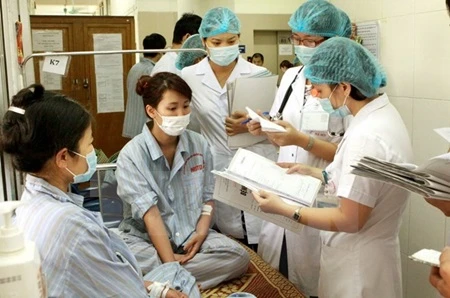
Vietnam’s healthcare has gone a long way since the “Doi Moi” (Renewal) Process 30 years ago with improved service quality and equality.
Public healthcare goes long way after “Doi Moi” ảnh 1A doctor provides check-up for a patient at Nam Nhoong commune's medical station in Que Phong district, central Nghe An province. (Photo: VNA)

Hanoi (VNA) – Vietnam’s healthcare has gone a long way since the “Doi Moi” (Renewal) Process 30 years ago with improved service quality and equality.

The mortality rate of children aged under one fell from 44.4 per 1,000 in 1990 to 15.2 per 1,000 in 2014, while the under-five mortality rate dropped more than half over the past two decades, from 58 per 1,000 in 1990 to 22.9 per 1,000 in 2014.

The maternal death rate fell two-thirds from 233 per 100,000 live births in 1990 to 60 per 100,000 births in 2014.

The country’s HIV infection rate has been reduced to below 0.3 percent as targeted by the National Target Programme on HIV/AIDS Prevention and Control from 2004 – 2010, while outbreaks of SARS, A/H5N1 and dengue fever have been contained.

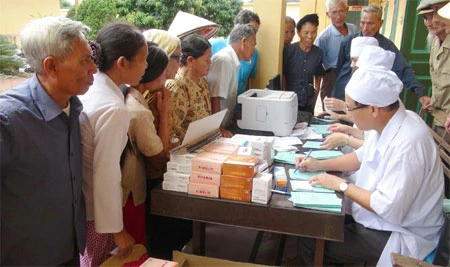
The network of communal healthcare units has been expanded with over 11,500 commune-based medical stations spreading from deltas to border and far-flung areas throughout the nation. The network has been recognised as a successful example for other countries to follow.

Vietnam is now home to approximately 13,440 public healthcare establishments, 75 sanatoriums and more than 1,000 general and antenatal clinics.

Hospitals have continued to apply information technology in management while advanced medical techniques, such as organ transplants, endoscopy, IVF, heart surgery and surgery to separate conjoined twins have also become more common.

Vietnam, one of the few vaccine producers in the world, has been certified by the World Health Organisation (WHO) as a country with a fully-equipped national regulatory authority (NRA) that ensures the safety and efficacy of vaccines produced and used.

The country made remarkable progress in 2015, particularly in efforts to curb overcrowding at major hospitals, Health Minister Nguyen Thi Kim Tien said.

Tien took K Hospital, National Endocrinology Hospital and Cho Ray Hospital as examples, saying that patients no longer have to share beds.

Some hospitals even have hotel-standard accommodation facilities, she added.

The Ministry of Health has worked hard to accelerate administrative reforms and develop satellite hospitals to provide quality treatment for more people.

The initial satellite hospital project has brought good results, alleviating the overload at major hospitals. At present, there are 46 satellite hospitals throughout Vietnam linked to city hospitals where satellite staff are trained and given technical updates.

However, existing problems still challenge the sector, notably health access disparities between rural and urban areas, the aging population, deadly epidemics and climate change-related diseases, along with a lack of medical facilities and personnel at local levels.

The ministry plans to further reduce treatment times and improve health workers’ attitudes towards patients to increase patient satisfaction in 2016, while home visits by family doctors, a new service in Vietnam, will be expanded across the nation.

International cooperation will also be intensified for the increased use of advanced medical technologies in hospitals.-VNA

VNA

See more

Medical staff at Cho Ray Hospital in Ho Chi Minh City cares for and treat the victim. (Photo published by VNA)

Last survivor of Phu Quoc boat capsize shows signs of recovery

The health condition of the last patient receiving treatment following the deadly boat capsize off the Phu Quoc special one in An Giang province has shown positive signs of improvement after three more days of intensive care, Cho Ray Hospital in Ho Chi Minh City said on July 16.

The number of foreign tourists coming to Ho Chi Minh City for travel combined with medical check-ups is increasing. (Photo: VNA)

Vietnam looks to unlock medical tourism potential with national strategy

The draft strategy aims to position Vietnam as a trusted healthcare destination in Southeast Asia by 2030 and eventually among Asia's leading medical tourism hubs. The plan marks a shift from viewing medical tourism as an untapped opportunity to making it a national development priority.

Delegates at the conference. (Photo: VNA)

Vietnam to produce first homegrown next-generation vaccines from 2028

Under the agreement, Sanofi will transfer technology to VNVC to manufacture selected high-demand vaccines for children and adults at VNVC Vaccine and Bioproduct Plant. The first next-generation vaccines produced in Vietnam are expected to roll off production lines in 2028.

Eric and Alysha joyfully welcome their baby through Mini IVF after more than 10 years of waiting. (Photo: Hong Ngoc Phuc Truong Minh General Hospital)

Vietnam - a destination for journeys to parenthood

An increasing number of international families are choosing Vietnam for infertility treatment, embarking on journeys to parenthood that transcend geographical distance and differences in nationality.

Prime Minister Le Minh Hung delivers remarks at the inauguration ceremony for Viet Duc University Hospital's second campus in Ninh Binh province. (Photo: VNA)

PM urges modern restructuring of healthcare network

The PM stressed that throughout the country’s development process, people have consistently been regarded as the centre, the driving force, the objective and the most important resource for national development. Sustainable and rapid development requires not only a healthy, knowledgeable and skilled population but also a modern, equitable, efficient, sustainable and accessible healthcare system.

Thu Duc General Hospital, with a capacity of 1,000 beds, was inaugurated and put into operation in April 2025 (Photo: VNA)

Ho Chi Minh City moves to expand robotic surgery to gateway hospitals

According to the municipal Department of Health, developing gateway hospitals is a key pillar of the city's strategy to establish a regional specialised healthcare system. The network is designed to permanently relieve overcrowding at major downtown hospitals while strengthening strong inter-regional emergency care and treatment network.

Doctors conduct health screenings for children in Tru Van Tho commune, Ho Chi Minh City. (Photo :VNA)

Ho Chi Minh City moves closer to universal health check-ups

Achieving universal health check-ups in 2026 will lay the foundation for a new healthcare model in which every resident has an electronic health record, receives regular screenings, benefits from lifelong health management and gains access to early intervention through primary healthcare services.