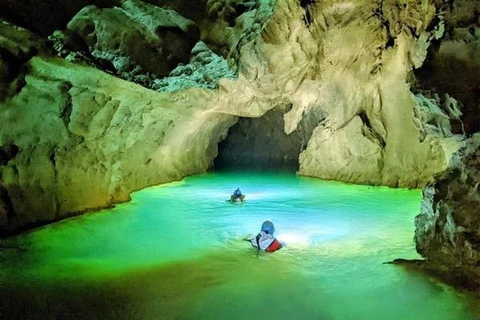
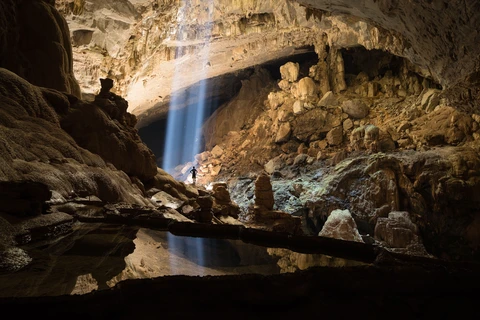
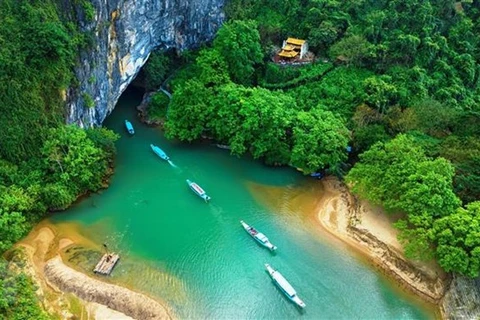
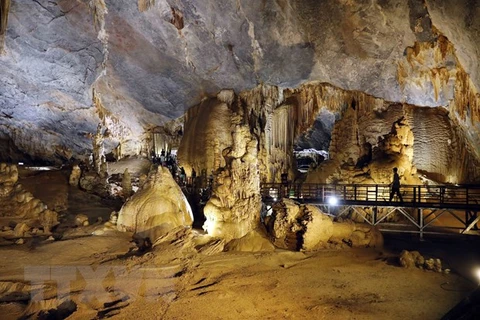
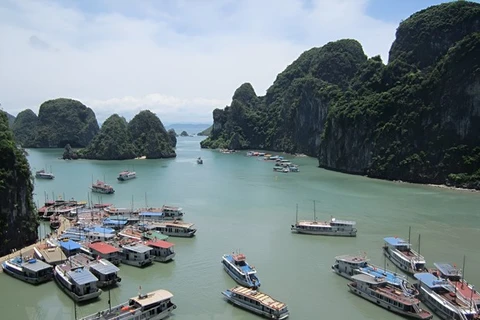
Visitors experiencing many games at tourist attractions in Phong Nha-Ke Bang. (Photo: VNA)
 Hanoi (VNA) – The Management Board of Phong Nha-Ke Bang National Park regards forest management and protection as a top priority task. This is an ongoing venture since the park was recognised by UNESCO as a World Heritage Site some 20 years ago.
The agency sees conservation and management as the foundation, scientific research as the core, and heritage value promotion as the motivation.
Various applications such as SMART, GIS and Drones have been employed in forest protection patrols, monitoring biodiversity, tracking land changes, as well as observing the impacts of natural phenomena and human activities.
As a result, the resource management has recorded good efficiency. The number and frequency of visits by wild animal species, particularly primate species, have been increasing.
Sustainable heritage preservation
On July 3, 2003, the World Heritage Committee under the United Nations Educational Scientific and Cultural Organisation (UNESCO) approved Vietnam's submission to recognise the Phong Nha-Ke Bang National Park in the central province of Quang Binh as a World Natural Heritage Site, with criteria of exceptional global value in terms of geology and geomorphology.
The recognition has become a significant milestone that not only acknowledges the global value of the site but also efforts in preserving and promoting the heritage resource values.
The Government of Vietnam, with the support of international organisations, saw the park expand to more than 123,000 hectares to preserve the largest ancient limestone region in Southeast Asia.
On July 3, 2015, at the 39th meeting in Bonn, Germany, the UNESCO’s World Heritage Committee agreed to add the criterion of outstanding value representing the evolutionary and development processes of terrestrial ecosystems, possessing meaningful natural habitats for biodiversity conservation.
More than 2,000 people from international conservation communities have so far visited Phong Nha – Ke Bang National Park for research purposes. All of them have unanimously affirmed that this is an exceptionally rare natural heritage site on a global scale.
Research is the cornerstone in preserving the value of natural resources. Over the past 20 years, the management board has proactively collaborated with both domestic and international organisations to implement scientific projects and tasks in various fields, including the environment, geology-geomorphology, ecology, biodiversity, and culture - history.
Phong Nha-Ke Bang National Park, inscribed on the World Heritage List in 2003, covers 85,754 hectares. It is located in the middle of the Annamite Mountain Range in Quang Binh province, and shares its boundary with the Hin Namno Nature Reserve in Laos to the west. The property comprises an area of 123,326 ha and contains terrestrial and aquatic habitats, primary and secondary forest, sites of natural regeneration, tropical dense forests and savanna and is rich in large, often spectacular, and scientifically significant caves.
The park’s landscape is formed by limestone plateaus and tropical forests. It features great geological diversity and offers spectacular phenomena, including a large number of caves and underground rivers. The site harbours a high level of biodiversity and many endemic species. The extension ensures a more coherent ecosystem while providing additional protection to the catchment areas that are of vital importance for the integrity of limestone landscapes.
The national park is a model of "Ecosystem and Biodiversity" with a unique population not found anywhere else on Earth, an evergreen tropical forest with a 500-year-old cypress species.
The environmental protection and disaster response efforts have been also implemented promptly and accurately, contributing to mitigating impacts on the heritage resources.
Thanks to tireless efforts, residents living in the buffer zone covering 10 communes have all undergone a shift in their awareness to actively contribute to preserving the heritage site.
According to Pham Hong Thai, Director of the Phong Nha – Ke Bang National Park Management Board, more than 99% of the local population have ceased their negative impact on the heritage forest.
Sustainable tourism development
Apart from managing and preserving the heritage, the management board has also paid special attention to promoting its values through tourism and service activities.
 Tourists explore the ecosystem of Phong Nha-Ke Bang National Park. (Photo: VietnamPlus)
Phong Nha-Ke Bang National Park has three forms of tourism, including self-exploration, joint venture businesses, and leasing of forest environment services.
Currently, the World Natural Heritage site has 15 different routes and tours that include various combinations of nature exploration, caves, camping, trekking, and zip line activities.
Notably, the tour to explore Son Doong cave is regarded as one of the international-level tourism tours.
Over the last 20 years, over 9.5 million holidaymakers visited Phong Nha – Ke Bang National Park, including over 1.1 million foreigners. The revenue from fees and charges reached over 1.74 trillion VND (over 73.2 million USD).
The development of tourism services has attracted an increasing number of visitors to the site. In order to ensure both tourism development and sustainable heritage conservation, the park management board is monitoring and assessing the impact of tourism activities on the caves to mitigate negative impacts on the heritage.
In this way, tourism not only contributes to economic development in the locality, but also serves as an effective solution for preserving the heritage. It reduces pressure on natural resources by creating job opportunities for local residents and shifting the labour force from natural resource exploitation to tourism and services development./.