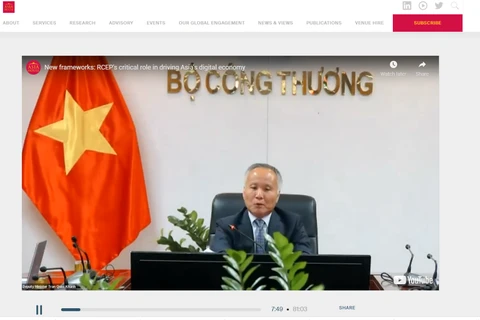
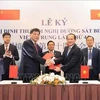
At the workshop on the implementation of the RCEP agreement hosted by the Ministry of Industry and Trade on July 13. (Photo: VietnamPlus)
 Hanoi (VNA) - Although the Regional Cooperation Economic Partnership (RCEP) agreement boasts no breakthrough in import tariff reduction, less stringent requirements on origin tracing will help businesses optimise incentives from signatories.
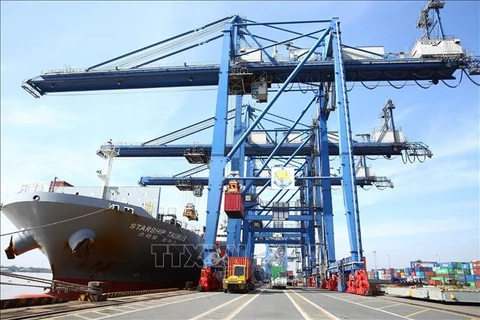
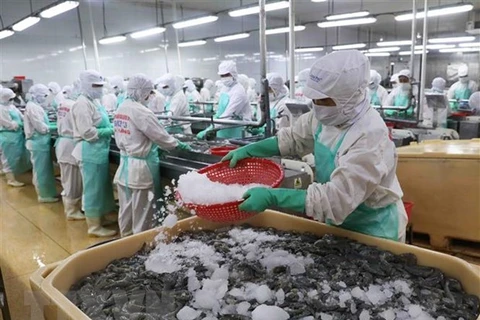
As signatories of the trade pact account for about 30 percent of the global gross domestic product (GDP) and 40 percent of the total agro-forestry-fishery export turnover of Vietnam, agricultural enterprises are forecast to have more opportunities to expand markets and increase exports, heard a workshop, jointly held by the Ministry of Industry and Trade and the Ministry of Agriculture and Rural Development.
Chance to bolster exports
Speaking at the event, Deputy Minister of Agriculture and Rural Development Phung Duc Tien said agriculture over the years has emerged as a dynamic economic sector and engaged in international integration, turning Vietnam into among 15 leading farm produce exporters of the world.
Farm produce turnover enjoyed a remarkable surge of 62.3 percent in the past six years, to 48.6 billion USD last year from just 30 billion USD in 2015.
Vietnam’s agro-forestry-fishery products have hit the shelves of 196 countries and territories across the globe. Of them, there are various items whose export value exceeds 1 billion USD. Farm produce exports fetched 27.88 billion USD in the first half of this year, posting a trade surplus of 5.75 billion USD.
The achievement was attributed to the fruit of international integration efforts, especially the effective optimising of free trade agreements (FTAs) that Vietnam has signed, including the RCEP pact, Tien underlined.
The official added that Vietnam is a signatory of an array of new generation FTAs that open up major opportunities for trade and investment in agriculture.
In particular, the RCEP agreement is hoped to offer manufacturers the chance to import more diverse and less expensive materials with high quality.
More importantly, Vietnamese firms can seize chances to further take part in the regional and global supply chain, with stronger commitments on investment and services. The RCEP agreement is also believed to increase foreign direct investment influx into Vietnam, including in the agricultural sector.
The agreement is expected to generate mid- and long-term opportunity, create favourable conditions for the development of new supply chains in the region, and set up a stable export market for Vietnam.
Tariffs will be removed for some commodities that Vietnam boasts strength in after the agreement took effect in the start of 2022, namely aquatic products, meat, vegetables, farm produce, machines, electronic devices and components.
 Delegates at the event (Photo: VietnamPlus)
 Sharpening competitive edge
Data from the General Statistics Office showed that Vietnam earned 70.45 billion USD from exports to RCEP countries in the first half of this year, seeing a year-on-year expansion of 15.03 percent.
Three largest markets of Vietnam in the period were China (26.1 billion USD), the Republic of Korea (12.1 billion USD) and Japan (11.3 billion USD).
General Secretary of the Vietnam Chamber of Commerce and Industry (VCCI) Tran Thi Lan Anh said the RCEP agreement is hoped to open up export opportunities for more companies, particularly small- and medium-sized enterprises (SMEs). This differentiates the trade pact with other new generation FTAs that have huge potential but are difficult for small scale firms to capitalise on. These include the Comprehensive and Progressive Agreement Trans-Pacific Partnership (CPTPP) and EU-Vietnam Free Trade Agreement (EVFTA).
At the same time, participation in the agreement entails plenty of challenges to Vietnamese businesses, amid a commitment to opening doors to products from other signatories. As a result, a fiercer battle is coming for Vietnamese products right on their home soil.
Furthermore, phytosanitary and food safety as well as origin tracing regulations and technical barriers will be more stringent, prompting ‘easy-going’ markets to become more demanding. Therefore, manufacturers must quickly raise their productivity and quality of products in order to maintain their place in such a competitive climate.
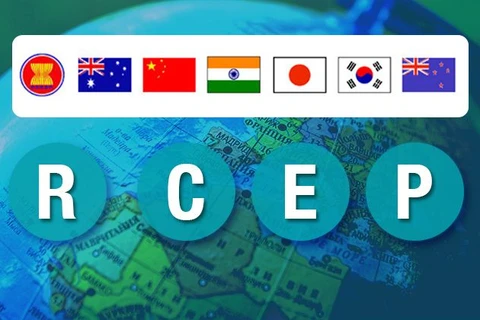
The RCEP Agreement officially took effect on January 1, 2022. The trade pact was signed by 10 ASEAN members and their five partner countries in November 2020 on the sidelines of the 37th ASEAN Summit chaired by Vietnam.
The agreement, gathering the 10 ASEAN member nations and Australia, China, Japan, New Zealand and the Republic of Korea, will cover a market of 2.2 billion people, accounting for about 30 percent of the world’s population, and a total GDP of 26.2 trillion USD./.