Rubber latex processing plant inaugurated in Son La

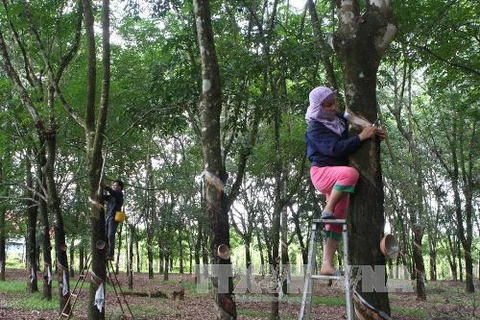
The Vietnam Rubber Group (VRG) held a ceremony to inaugurate its rubber latex processing plant in Thuan Chau district in the northern mountainous province of Son La on December 26.
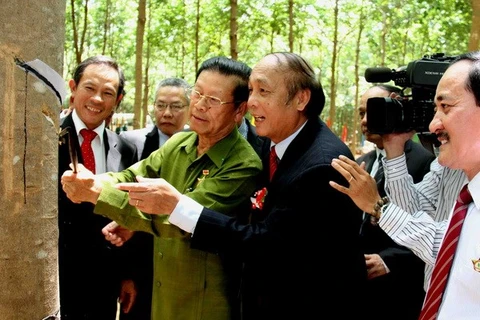
Rubber latex processing plant inaugurated in Son La ảnh 1At the inaugural ceremony (Photo VNA)

Son La (VNA) –
The Vietnam RubberGroup (VRG) held a ceremony to inaugurate its rubber latex processing plant inThuan Chau district in the northern mountainous province of Son La on December26.

The construction of the plant started in early2018 with total investment of nearly 110 billion VND (4.7 million USD).

Covering nearly 16 hectares in Thuan Chau’s TongLenh commune, the plant is designed to have a processing capacity of 9,000tonnes of rubber latex per year.

The project was divided into two phases with thefirst one with annual capacity of 6,000 tonnes. The second phase isscheduled to be inaugurated in 2020 with capacity of 3,000 tonnes per annum.

According to Director of the Son La Rubber JointStock Company Ho Anh Duc, when the factory is put into operation, it willincrease the value of rubber latex four times from about 10 million VND (429USD) per tonne to 40 million VND (1,717 USD) per tonne.

It also helps generate jobs for over 200workers, he added.

At present, Son La has over 6,000 hectares ofrubber, including over 2,300 hectares for harvesting. In 2018, theprovince’s rubber latex output was estimated at over 5,000 tonnes. 

Chairman of the provincial People’s CommitteeCam Ngoc Minh said the development of rubber trees will help increase the forestcoverage, minimise flash floods, and reduce poverty.

He asked the Son La Rubber Joint Stock Companyto quickly complete the waste treatment project and closely work with localauthorities and farmers to ensure effective business and environmentalprotection.

The plant will be operated 10 months in a year.This is the first latex processing plant in the northwestern region after morethan 10 years of developing rubber trees.-VNA

VNA
See more

Saigon Marina IFC, an emerging landmark, reflects Ho Chi Minh City’s pioneering spirit.

Saigon Marina IFC – The light of Ho Chi Minh City’s new icon

Saigon Marina IFC, an emerging landmark, reflects Ho Chi Minh City’s pioneering spirit. Designed to become an International Financial Centre, this new architectural icon along the Saigon River is envisioned not only as a premium commercial complex, but as a central platform supporting financial institutions, international investors and cross-border capital flows in the years ahead.

Shoppers at a supermarket in Hung Yen (Photo: VNA)

Retailers see tax compliance, AI as key to survival in 2026 survey

The annual survey, conducted at the end of 2025 among retail and food and beverage (F&B) sellers nationwide, found that businesses are shifting their focus from rapid growth to operational efficiency, cost control and legal compliance amid increasingly stringent regulatory standards.

Visitors shop at Glorious Spring Fair 2026 (Photo: VNA)

Spring Fair 2026 opens broader prospects for Vietnam–UAE trade cooperation

For Vietnam, the UAE serves not only as a consumer market but also as a gateway to the Middle East and North Africa. Vietnamese agricultural products such as cashew nuts, pepper, cinnamon and rice have steadily gained market share, while aquatic products, including tra fish and tuna, are increasingly present in the UAE’s hospitality sector.

Bao Viet Bank's employee counts Vietnamese banknotes at a transaction counter in Hanoi. (Photo: VNA)

Credit quota reform, tighter capital rules may widen gap among banks

Yuanta Vietnam Securities estimates that to achieve GDP growth above 10%, credit growth would need to exceed 16%. This suggests bank credit is no longer expected to be the main growth driver, with greater reliance on fiscal policy, public investment and capital markets.

Commercial Counsellor Do Viet Phuong, Head of the Vietnam Trade Office in Cambodia. (Photo: VNA)

Spring Fair 2026 offers ample room to deepen Vietnam–Cambodia trade ties

Cambodia holds substantial potential for cooperation in agro-processing and exports, especially in key products such as rice, cashew nuts and rubber. In recent years, the country’s cultivation area and agricultural output have grown steadily, providing a stable raw material base for processing industries.

Vietnam is projected to have approximately 2.4 million SMEs, accounting for over 98% of the country’s total enterprises. (Photo: cafef.vn)

Banks offer diverse solutions to support SMEs

With an increasingly significant role in the economy, the small and medium-sized enterprise (SME) sector is becoming a key segment in the credit growth strategies of many banks and the banks have been taking diverse solutions to support the enterprises.

Workers process coconuts for export at Vina T&T Group. (Photo: nhandan.vn)

Agricultural exports reliant on securing raw material supply

According to Secretary General of the Vietnam Pepper and Spice Association Le Viet Anh, pepper remained Vietnam’s leading spice export in 2025, with shipments exceeding 247,000 tonnes, accounting for 59.3% of total spice export volume. Export revenue reached 1.66 billion USD, out of total spice exports of 2.1 billion USD.